Knowledge Discovery Efficiency (KEDE) and Ashby's Law of Requisite Variety




Abstract
Ashby's Law of Requisite Variety is rarely applied quantitatively, because a regulator's internal variety and knowledge cannot be observed directly. We adopt Ashby's black-box stance and ask what a system's external record reveals about the knowledge it lacked: the responses it commits, which of them survive evaluation against its goal, and the capacity spent producing them. Building on the information-theoretic form of the law, we define Knowledge To Be Discovered (KTD) as the conditional entropy H(X|Y) of the response class that successful regulation requires, given the disturbance information available to the regulator. This is the term of the law that measures not how many responses a regulator has, but how well it can select among them. We model the staged selection that reduces KTD as a Knowledge Discovery Process, distinguish within-episode discovery from learning retained across episodes, and account for both in operational and knowledge ledgers. We then show that KTD, though latent, can be estimated from closure counts alone. For certainty-terminated binary protocols, the ratio of counted capacity to surviving closures gives, with high probability, an upper bound on average KTD; under bounded search it gives a two-sided bracket, and in an ideal regime it converges to KTD. Its bounded transform, Knowledge-Discovery Efficiency (KEDE), takes values in (0, 1] and makes requisite knowledge observable. We illustrate KEDE on typing, software development, intelligence testing, basketball, and assembly line processes.
Introduction
The Law of Requisite Variety, formulated by W. Ross Ashby, states that for a system to effectively regulate its environment, it must have at least as much variety/complexity as its environment[1]. This principle is foundational in disciplines such as cybernetics, control theory, and machine learning.
The concept of requisite variety has since been applied across diverse domains, including organizational theory, ecology, and information systems. It underscores the necessity for systems to adapt to environmental complexity in order to maintain stability and achieve intended outcomes.
Real-world attempts to apply Ashby's Law of Requisite Variety face three persistent obstacles. (i) Combinatorial explosion: enumerating all relevant states of a system and its environment quickly becomes intractable, especially when hidden or unmeasured variables are present. (ii) Dual control dilemma: a regulator must simultaneously amplify its own control variety and attenuate external variety—an optimization that is delicate in multiscale, hierarchical, and time-varying settings such as digital ecosystems or military command structures. (iii) Resource constraints: limited data, computational power, and organisational capacity often preclude sophisticated control architectures. Existing remedies—markup-language state catalogues, iterative multidimensional sampling, and distributed self-organising controllers—mitigate but do not eliminate these limitations.
In section 2, we conduct a literature review of the primary challenges in applying Ashby's Law to real-world systems. We propose a black-box measurement approach that uses externally recorded closure and invalidation histories, together with a declared action-unit capacity convention, to quantify operational discovery load and, under explicit bridging assumptions, bound the remaining uncertainty about required regulatory responses. In section 3, we present the Law of Requisite Variety in both its set-based formulation—covering the Table of Outcomes, requisite variety, goal revision, and behavioral rework—and its information-theoretic formulation, covering entropy, probabilistic success, residual variety bounds, response-equivalence, and the regulator's learned law of action. We conclude section 3 by introducing Knowledge To Be Discovered as the conditional entropy H(X|Y) that remains after available disturbance information is known. In section 4, we establish the Knowledge Discovery Process as the staged reduction of Knowledge To Be Discovered. We develop this in three layers: a set-based formulation of staged selection covering episodes, closures, and rule regulation; an information-theoretic formulation introducing the expected staged reduction of H(X|Y), action units, and response-class commitment; and learning across episodes, including comparable episodes, the learning axiom, and the posterior-becomes-prior rule. We also develop the operational ledger and the knowledge ledger, together with their window-level accounting measures and a three-loop feedback reading of all revisions. In section 5, we show how to quantify Knowledge To Be Discovered from observable outcomes alone, deriving the operational one-bit effective-depth estimator. and its relationship to the latent entropy. In section 6, we generalize the Knowledge-Discovery Efficiency (KEDE)—a scalar metric in [0,1] that quantifies how efficiently a system closes the gap between the variety demanded by its environment and the variety embodied in its prior knowledge. Finally, in section 7, we explore applications of KEDE across diverse domains including manual assembly, typing, software development, intelligence testing, sports performance, and industrial assembly lines, demonstrating its utility as a unified diagnostic tool for evaluating system performance and adaptability.
Core challenges in applying Ashby's Law to real systems
We conducted a literature review aimed at identifying the primary challenges and limitations associated with applying Ashby's Law in real-world systems.
A central challenge that emerges is the measurement of variety. In most of the reviewed literature, the concept of variety is either poorly defined or not explicitly measured, resulting in ambiguity and potential misinterpretation of the law's implications. Key obstacles to effective measurement include:
- The direct measurement of variety is fundamentally incomputable for all but the simplest systems [14].
- Hidden variables introduce uncertainty and complicate measurement efforts [15].
- Trade-offs often arise between variety at different scales [16].
- A combinatorial explosion occurs when attempting to enumerate all possible system states [15,16].
- Resource limitations constrain the feasibility of comprehensive measurement [20].
- Environmental complexity is frequently “unknowable,” preventing complete assessment [25].
- Most studies lack explicit or standardized methods for quantifying variety [14,17'-20,25,27].
- Existing approaches often lack rigorous quantitative validation [17].
Several measurement methods have been proposed, including:
- Markup language-based variety estimation [18],
- Iterative sampling techniques [21],
- Entropy and determinism metrics to evaluate communication complexity, where greater variety was correlated with improved effectiveness [22],
- Social network and cluster analysis to assess resilience [23], and
- Multiple Correspondence Analysis (MCA) for capturing organizational complexity [24].
In addition, a subset of studies estimate variety through observed performance rather than structural attributes. Notable examples include:
- Communication-based performance measures, employing determinism metrics to evaluate repeatable patterns in team behavior [22];
- Team performance assessments, using task-based surveys to evaluate an organization's risk-handling capabilities [23];
- Leadership behavior analysis, based on actual behavioral responses to simulated scenarios [26]; and
- Relative performance comparisons, assessing organizational effectiveness across contexts using perception-based rather than absolute metrics [14].
While these performance-based approaches provide practical insights, they often rely on subjective or indirect indicators of variety, which may introduce biases and limit their generalizability. For example, performance outcomes may fail to account for hidden variables or the underlying complexity of the system [15]. Moreover, these approaches remain underrepresented in the literature, where structural and theoretical analyses still dominate.
In summary, although numerous methods for measuring variety have been proposed, no single comprehensive or universally accepted solution has emerged. Quantification remains a persistent challenge in the application of Ashby's Law to complex real-world systems.
Solution
These challenges significantly hinder the practical application of Ashby's Law. Whether considering a human, an AI model, or an organization, we are typically limited to observing external behavior rather than internal mechanisms—unless we are able to "open the box."
Ashby himself emphasized that all real systems can be considered black boxes. He argued that while black boxes mimic the behavior of real objects, in practice, real objects are black boxes: we have always interacted with systems whose internal workings are, to some extent, unknown.
This leads to what Ashby termed the black box identification approach [2], which involves:
- Perturbing the system by applying external disturbances,
- Measuring the system's responses to these perturbations, and
- Inferring the internal variety or capacity from the observed input-outcome relationships.
In most practical scenarios, we are only able to observe the outcomes of a system. These observable outcomes can be used to infer bounds on the system's internal variety—specifically, the extent of variety it must possess or lack in order to exhibit the observed behavior.
We propose treating the system as a black box, recording which committed responses produce outcomes that remain acceptable and how much counted capacity was spent producing them, and from that record bounding the knowledge the regulator lacked when it began each episode.
The Law of Requisite Variety
For a system to effectively regulate its environment, it must have at least as much variety as its environment.
Set-based formulation
Regulation achieves a goal by selecting responses against disturbances.
is the essential-variable vector. The essential variables are the goal-relevant state components. is the value set of . The essential variables define the dimensions; their value sets define the coordinate domains of the essential-variable space , which is the set of all possible combinations of their values[29].
An essential state is one particular point in the essential-variable space, i.e. a tuple of values of these dimensions, e.g. .
It is assumed that the goal has already been determined: the acceptable essential states are given by an acceptable region in the essential-variable space. Thus, the goal is a region in a multidimensional essential-variable space .
Let D, R, and Z denote, respectively, the disturbance variable, regulatory-response variable, and outcome variable. Let their corresponding sets of possible values be , , and . Thus , , and are particular values.
In the general case, the outcome-value space may itself be multidimensional. Let be the outcome-variable vector. The outcome variables are the components used to describe the concrete or functional result produced by a disturbance-response pair. is the value set of . Thus the outcome-value space is .
An outcome-value is one particular point in the outcome-value space. In the multidimensional case, it has the form . In the Appendix we have an example of a typing task, where an outcome-value may record both the intended target position and the typed symbol: .
The number of outcome dimensions m need not equal the number of essential-variable dimensions n. The outcome-value space describes the result produced by the system, while the essential-variable space describes the goal-relevant state used to judge that result. The mapping from outcomes to essential-variable values will be introduced below.
The scalar outcome-value case is recovered when . In that special case, each outcome-value may be treated as an unstructured value. More generally, each table cell still contains one outcome-value, but that outcome-value may itself be internally structured as a tuple.
We use roman for the essential-variable vector and script for its value space. Likewise, we use roman for the outcome-variable vector and script for its value space.
The Table of Outcomes is the map
so that for each disturbance-value and response-value , the value is the outcome-value .
Thus the table T is two-dimensional in its indexing by disturbance-response pairs (d,r), while each cell-entry may be a scalar outcome-value or a structured outcome-vector. The scalar-outcome case is recovered when .
| T | R | ||||
|---|---|---|---|---|---|
| r₁ | r₂ | r₃ | ... | ||
| D | d₁ | z₁₁ | z₁₂ | z₁₃ | ... |
| d₂ | z₂₁ | z₂₂ | z₂₃ | ... | |
| d₃ | z₃₁ | z₃₂ | z₃₃ | ... | |
| d₄ | z₄₁ | z₄₂ | z₄₃ | ... | |
| ... | ... | ... | ... | ... | |
Two distinct disturbance-response pairs may yield the same outcome-value:
This means that repetition belongs to the mapping T, not to the set . A set contains each of its elements only once. So one should not say that contains repeated values. What repeats is the same outcome-value appearing as the image of multiple table-cells.
Correspondence between outcome-values and essential-variable values. The “outcomes” in the Table of Outcomes are simple outcome-values, without any implication of desirability. An outcome-value is a concrete or functional result of a disturbance-response pair. An essential-variable value is the goal-relevant state description used to judge whether the result falls inside or outside the acceptable region.
The correspondence between outcome-values and essential-variable values is therefore not automatic. It is part of the modeling frame of the regulatory problem. To use a function from outcomes to essential-variable values, the outcome-description must be specified at a level of detail sufficient to determine the relevant essential-variable value. In this article we assume that this has been done. Thus each outcome-value under the adopted description has a determinate associated essential-variable value.
so that . This means that the function is a modeling map from the outcome-description used in the table to the essential-variable description used for regulation. It should not be read as saying that every possible description of an outcome would automatically determine an essential-variable value. If the outcome-description were too coarse to determine the relevant essential-variable value, then would have to be replaced by a relation, a refinement of , or a probabilistic mapping.
The reduced, bijective, and many-to-one cases discussed below are therefore not alternatives to this modeling assumption. They are different ways in which the adopted outcome-description may correspond to the essential-variable description. In the reduced case, outcome-values already are essential-variable values. In the bijective case, outcome-values and essential-variable values are distinct descriptions but correspond one-for-one. In the many-to-one case, several finer-grained outcome-values correspond to the same essential-variable value.
Reduced correspondence. The special case is the reduced representation in which the table T directly contains values of the essential variables, i.e.
Bijective correspondence between outcome-values and essential-variable values. This is the case in which each relevant outcome-value maps to a unique essential-variable value, and each relevant essential-variable value is represented by exactly one outcome-value. In the bijective case, is one-to-one and onto between the relevant outcome-values and the relevant essential-variable values represented in the regulatory model, not bijective over the entire possible outcome and essential-variable spaces. Then and are conceptually distinct but informationally equivalent: with and every essential-variable value relevant to the regulatory model has exactly one corresponding . On this reading, may still be understood as the outcome-value space and as the essential-variable space, but every relevant distinction in outcomes is mirrored one-for-one at the level of the essential variables. This is the form used in later reformulations such as with an explicit bijection between the outcome-value variable and the essential variable E. In that literature Y corresponds to our outcome variable Z, or to the induced outcome variable generated through T. Aulin-Ahmavaara's formulation uses a one-to-one mapping between outcome Y and essential variable E, so our is a generalization of that case[31]. See the illustrative example in the Appendix.
Many-to-one correspondence between outcome-values and essential-variable values. This is the case in which multiple distinct outcome-values map to the same essential-variable value. Ashby says that a particular outcome can be treated “as unit with unit,” but “in another context, [it] may be analysed more finely.[1]” That means an outcome can be used as a single table-entry in the regulatory schema, even though in a more detailed analysis it may unfold into a whole trajectory, microstate, or process.[1] Then different outcome-values can collapse to the same essential-variable value: .
On this reading, contains finer-grained outcomes, while contains the coarser essential-variable values that matter for survival or goal-attainment. The many-to-one relation therefore expresses that several distinct outcome-states may be equivalent from the standpoint of regulation. Successful regulation is still judged at the level of the essential variables: distinct trajectory histories may all count as equally successful if they yield the same relevant value of and hence fall within the acceptable region . This is a refinement of Ashby's basic regulatory schema, but it is an added modeling layer[1]. See the illustrative example in the Appendix.
In this article formulas below are written in the general form. Most later calculations use the general -form; where individual outcome deletion/addition is interpreted literally, the reduced or bijective case is assumed unless stated otherwise.
Requisite variety
The regulator does not choose outcome-values directly. It selects a response-value in the presence of a disturbance-value, and thereby determines an outcome-value.
Strictly speaking, there may be many disturbance-values that are conceivable in the world but not part of the regulatory problem currently being modeled. Let denote the larger set of all conceivable disturbance-values. In the present formulation, however, we restrict attention to the disturbance-values under consideration in the regulatory problem. For notational economy, we write this context-restricted disturbance set simply as , where .
This restriction is part of the modeling frame, not an effect of regulation. It does not mean that the regulator has already reduced the disturbance variety. It means only that success is being evaluated over the disturbance-values included in the present regulatory problem. Thus, from this point onward, means the disturbance set under consideration.
In Ashby's table formulation, the “actual outcomes” is the rule-induced actual outcome-set selected from the possible outcome table by the regulator's response choices. They are actual in contrast to the full set of possible outcomes , not necessarily actual in the narrower historical sense of having occurred in a single observed run[1][8].
Let the regulator use a response rule
This induces the actual outcome map
and its image:
The image is the rule-induced actual outcome-set under the response rule . It contains the outcome-values selected from the possible outcome table when each disturbance-value under consideration is paired with the response chosen for it by the rule . In this Ashby-style sense, these are the rule-induced actual outcomes: actual relative to the regulator's response rule, as distinct from the full space of possible outcomes .
This should be distinguished from the historically realized outcome-set in one particular run. If only some disturbance-values actually occur, let be the historically realized disturbance subset. Then the historically realized outcome-set is
Thus is the possible outcome-value space; is the actual outcome-set over the modeled disturbance domain; and is the historically realized outcome-set in the actual case.
Successful regulation requires that the essential-variable values corresponding to all rule-induced actual outcomes lie in the acceptable region: for any
This is a universal rule-level success condition over the disturbance set under consideration. At a particular moment only one disturbance may occur, but the response rule is judged by what it would produce for every disturbance in the modeled set.
This set-based representation tracks which outcome-values can occur under the policy, but it does not track multiplicity, frequency, or probability. Its role here is to support a universal success condition over the disturbance set.
Equivalently, successful regulation requires that every disturbance-value under consideration be mapped, through the selected response rule, into an acceptable outcome-value:
Here, the acceptable outcome-set denotes the preimage of the set , not a two-sided inverse function. Also is a subset of , so it is at the outcome-value level.
This subset relation is the primary success condition. It says that every actual outcome produced under the response rule must lie in the acceptable outcome-set. Any variety inequality derived from it is only a necessary numerical consequence, not the defining criterion of success. In Ashby-style terms, regulation succeeds when the rule-induced actual outcomes remain within the goal subset[1].
In this subsection, V denotes count-variety: for any finite set , we define , the number of distinguishable values/states in under the adopted classification. The following count-variety statements assume that the relevant spaces have been discretized into distinguishable classes under the adopted modeling resolution. If is an interval in a continuous space, plain cardinality becomes unhelpful because many regions may have the same infinite cardinality. For continuous spaces, the same role would have to be played by a measure, entropy, or another explicitly chosen variety measure. In the information-theoretic formulation this role is played by entropy over the regulatory partition. Thus all formulas written with are cardinality statements. Therefore, at the level of variety, success implies the following necessary numerical bound:
Similarly, from we obtain the necessary bound
These variety inequalities are consequences of the subset condition. They are not, by themselves, equivalent to it: an actual outcome-set may have variety no greater than that of an acceptable set and still fail to be a subset of that set. So success is fundamentally a matter of set inclusion, while the variety inequalities are derived necessary conditions. They are not, by themselves, equivalent to it.
Under the reduced representation in which and , the outcome-values are already values of the essential variables, so the success condition reduces to
and therefore implies the numerical bound
This numerical compatibility condition is still only necessary, not sufficient. The decisive success criterion remains: .
Thus, in this set-based formulation, regulatory success is stated at the level of the rule-induced actual outcome-set , not at the level of a single actual outcome which is used to state success at a particular time.
A special finite-table lower-bound result. Under Ashby's finite table T idealization, a special count-variety consequence of the law of requisite variety can be stated precisely[1][8]. Suppose the table T has finitely many disturbance-values and response-values, and suppose that no response-column contains a repeated outcome-value. Equivalently, for every fixed response-value , the map is injective. Thus a single unchanged response-value cannot by itself collapse different disturbance-values into the same outcome-value.
Let the regulator select one response-value for each disturbance-value by a response rule . This selects one cell from each disturbance-row of the table and induces the actual outcome-set
The response rule may use only a subset of the available response repertoire. Define the used response-set as
Because no response-column contains a repeated outcome-value, any one outcome-value can appear among the selected cells at most once per used response-column. Since the rule uses response-columns, any one outcome-value can cover at most selected disturbance-rows. But the response rule selects one cell from each of the disturbance-rows. Assume is non-empty, so that is also finite and non-empty. Therefore the selected cells cannot collapse into fewer than the ceiling of disturbance-rows divided by used response-columns:
Since , we also have . Therefore the weaker repertoire-level lower bound is:
This is a finite-table, count-variety quotient analogue of the Ashby-style requisite-variety bound. It is not Ashby's general entropy formulation. It is not derived from the goal-subset condition alone. It follows from the additional table assumption that no response-column already contains repeated outcome-values. If the table itself contains such repetitions, then some disturbance variety has already been collapsed by the table structure before the regulator's response rule is considered. In that case this quotient lower bound need not hold at the outcome-value level.
This is an outcome-value-level bound before applying . In the many-to-one case, may collapse several distinct outcome-values into one essential-variable value, so the same lower bound need not hold for unless is injective on the selected outcome-values.
The quotient bound is a lower bound on the variety of the actual outcome-set selected by the response rule. Successful regulation, however, is still defined by set inclusion, not by the quotient alone. The success condition remains:
Therefore a necessary outcome-level numerical compatibility condition for success is:
This condition is necessary, not sufficient. It says only that the acceptable outcome-set is numerically large enough to contain the unavoidable residual outcome variety. It does not guarantee that the table entries are arranged so that some response rule actually maps every disturbance-value into the acceptable outcome-set. Success remains a matter of the subset relation itself.
If one wants the numerical condition to count only outcome-values that are actually attainable from the table, define the table-image as
Then the attainable acceptable outcome-set is
Using this stricter attainable set gives the sharper necessary condition:
In the reduced representation, where and , the acceptable outcome-set is just the acceptable essential-variable region:
Therefore the necessary numerical condition becomes:
The same reduction holds in the bijective case, provided preserves cardinality on the relevant acceptable sets. In the many-to-one case, however, may be much larger than . Thus the outcome-level compatibility condition and the essential-variable-level compatibility condition coincide in the reduced or bijective case, but can diverge in the many-to-one case.
Outcome map induced by a response rule at time t
At time , let the regulator use the response rule
The induced actual outcome map is
where := for notational economy.
The acceptable outcome-set at time t is not chosen directly in ; it is induced by pulling back the acceptable essential-variable region along the outcome-to-essential-variable map .
Thus the acceptable outcome-set is the pullback, or preimage, of the acceptable essential-variable region. An outcome-value is acceptable at time t exactly when its associated essential-variable value lies in .
Successful regulation under the criterion prevailing at time means that the response rule maps every disturbance under consideration into the acceptable outcome-set for that time:
Equivalently,
Goal revision with fixed table and time-indexed acceptable outcomes
We consider a regulator acting against disturbances within a fixed system structure. The aim is to model the case in which the structure of the system does not change from time t1 to time t2, but the criterion of success does.
In this subsection, goal revision means a change in the acceptable region within a fixed modeling frame. The disturbance space , the response space , the possible outcome space , the essential-variable space , the table , and the outcome-to-essential-variable map remain fixed. Thus the same outcome-value keeps the same essential-variable interpretation. What changes is the acceptable region and therefore the acceptable outcome-set changes from to inside the same essential-variable space , not the meaning or dimensionality of the essential variables themselves.
If the goal revision changes which variables count as essential, or changes the level at which outcomes are mapped to essential-variable values, then or must also be revised; that would be a different modeling case.
This is goal revision within a fixed repertoire, not structural adaptation. That distinction is important because stronger Ashby-style adaptation involves change in the system's structure, organization, or available repertoire, not merely a different rule selected from the same fixed table[1].
In a higher-order system, revising the acceptable set may itself be part of a meta-regulatory process[57]. Here, goal revision is treated as an external change in the criterion of success, not as regulation by the fixed first-order regulator. It could be modeled as higher-order regulation in a larger adaptive system, but that is outside the fixed-table case considered here.
A change in the acceptable set is not yet a change in actual behavior. It is a change in the criterion by which behavior is judged. A behavioral change occurs only if the regulator changes its response rule from to . Such a change is required only when the old rule no longer maps the disturbances under consideration into the revised acceptable outcome-set.
Thus the transition from to first changes the criterion of success. This induces a change from to . The old response rule must then be tested against the revised acceptable outcome-set. If , then the old behavior remains successful under the new criterion. If not, regulation requires selecting a revised response rule such that . Goal revision is not itself regulation. Continued regulation after goal revision requires that some response rule — possibly the old one, possibly a revised one — maps the disturbances under consideration into the revised acceptable outcome-set.
We are therefore tracking acceptability at the level of outcome-values in , via the pullback along φ. Acceptability-status is time-indexed, while outcome-identity in is not. So the change is not that outcome-values disappear from the table. The change is that some fixed outcome-values in may cease to be acceptable, while others may become acceptable. That is why it is correct to time-index Oacc,t.
Before defining deletion and addition at the level of outcome-values, one qualification is needed. If acceptability is defined by pulling back the acceptable essential-variable region along φ, then acceptability is constant on the fibers of φ.
The set is the fiber of outcome-values that all correspond to the same essential-variable value . If , then all members of the same fiber have the same acceptability-status at time t.
When acceptability is defined by pullback from , acceptability cannot vary inside a fiber of φ. If two distinct outcome-values map to the same essential-variable value, they share the same acceptability-status at time t. Therefore, if the modeler wants two outcome-values in the same fiber to have different acceptability-statuses, then the map has collapsed a distinction that is relevant for regulation.
This is not a limitation of the set-theoretic construction; it is a consequence of the chosen level of description. If two outcome-values must be judged differently for purposes of regulation, then they cannot be treated as equivalent under the outcome-to-essential-variable map. In that case, is too coarse for the regulatory problem being modeled. The outcome-description must be refined, or the mapping must be replaced by a relation, a more detailed essential-variable space, or a probabilistic mapping.
Therefore, in the many-to-one case, deletion and addition of acceptable outcome-values is not truly individual. It happens fiber-wise. Because acceptability is defined by pulling back the acceptable essential-variable region along , one cannot remove one member of a fiber from the acceptable set while leaving another member of the same fiber acceptable.
Revision of acceptability: deletion, addition, and substitution within the acceptable outcome-set
With this interpretation, the notions of deletion, addition, and substitution are legitimate, provided they are understood as operations on the acceptable subset Oacc,t, not on the table T itself. So no outcome-value is deleted from the table T. Rather, some fixed outcome-values may lose or gain acceptability.
An outcome-value z is deleted from the acceptable set between t1 and t2 iff
This does not mean that z disappears from the table T. It means only that z, though still a possible outcome-value in T, is no longer acceptable under the revised goal.
These definitions concern changes in acceptability-status only. They do not imply that the regulator actually produces, stops producing, or replaces those outcome-values. Behavioral change is tracked separately by comparing and .
An outcome-value z is added to the acceptable set between t1 and t2 iff
In the minimal set-theoretic sense, a weak substitution occurs when one acceptable outcome loses acceptability and another gains acceptability between t1 and t2. That is, there exist b, c ∈ such that
Then one may say that b is removed from the acceptable set and c is admitted into it. This expresses substitution as coexistence of loss and gain; a stronger one-for-one replacement notion would require an additional correspondence between lost and gained elements.
It is useful to decompose the transition from t1 to t2 into three parts.
The persistently acceptable outcomes are
Equivalently, changes in acceptable outcome-values are the pullbacks of changes in acceptable essential-variable values. If , then the outcome-values that lose acceptability between t1 and t2 are:
The outcome-values that gain acceptability between t1 and t2 are:
This makes the fiber-wise character explicit. If several distinct outcome-values map to the same essential-variable value , then they enter or leave the acceptable outcome-set together. The reason is that acceptability is assigned first to essential-variable values and only then transferred back to outcome-values through .
Thus, in the reduced or bijective case, each relevant fiber contains exactly one outcome-value, so deletion and addition can be read directly at the level of individual outcome-values. In the many-to-one case, however, deletion and addition should be read as operations on whole fibers of .
Then
and the disjoint unions of the persistently acceptable outcomes and the outcomes that lose and gain acceptability are given by:
Thus deletion, addition, and substitution are operations on acceptability-status within the fixed outcome-space , not on the existence of values in T itself.
This models the attempt to maintain regulation under an externally revised criterion of success within a fixed repertoire. It is not structural adaptation in the stronger sense, because the regulator does not alter its own structure or acquire a new repertoire. Stronger adaptation enters only when the fixed repertoire is no longer sufficient and the system must reorganize itself.
Strict substitution
A strict substitution is stronger than the mere coexistence of loss and gain. Weak substitution says only that some outcome-values lose acceptability and some other outcome-values gain acceptability. Strict substitution says, in addition, that the model supplies a specified replacement correspondence between the lost and gained outcome-values.
Using the earlier definitions:
A strict substitution structure from t1 to t2 is an ordered triple
such that:
and the model supplies a specified bijection
where λ12 is not merely a bijection whose existence follows from equal cardinalities. It is part of the model. It specifies which lost acceptable outcome-value is treated as replaced by which newly acceptable outcome-value.
Thus,
means that the previously acceptable outcome-value b is replaced, under the revised criterion of success, by the newly acceptable outcome-value c.
Strict substitution is still a relation between acceptability-statuses. It says that the revised criterion treats newly acceptable outcome-value c as the specified replacement for previously acceptable outcome-value b. It does not, by itself, imply that the regulator has actually produced c as a behavioral replacement for b. That would require an additional closure event or a change in the response rule.
The existence of a bijection requires
but this equality is only a necessary cardinality condition. It does not determine which lost outcome-value corresponds to which gained outcome-value. The transition of acceptable sets determines only the lost set and the gained set. It does not, by itself, determine the replacement pairing.
Therefore, replacement is not objectively present in the set transition alone. Weak substitution is present in the set transition whenever loss and gain coexist. Strict substitution requires additional correspondence structure.
In the special one-for-one case, where exactly one outcome-value loses acceptability and exactly one outcome-value gains acceptability, strict substitution reduces to:
In that case there is only one possible bijection, so one may say that b is strictly substituted by c.
This defines strict substitution at the outcome-value level. In the many-to-one case, one may instead define strict substitution at the essential-variable level by pairing lost and gained elements of and . The outcome-level and essential-variable-level notions coincide in the reduced or bijective case. Strict substitution at the outcome-value level may fail in the many-to-one case even when strict substitution exists at the essential-variable level, because fibers may have unequal cardinalities.
Behavioral rework
The preceding definitions describe revision of acceptability-status. They do not yet describe behavioral rework. Behavioral rework concerns a change in the outcome-values actually selected by the regulator's response rule. Thus, an outcome-value is behaviorally removed between t1 and t2 iff:
It is behaviorally added iff:
Therefore, goal revision changes the criterion of success; behavioral rework changes the regulator's selected outcomes. The two are related but not identical. A goal revision may require no behavioral rework if the old response rule remains successful under the revised acceptable outcome-set.
Information-Theoretic Formulation
The set-based formulation specifies the regulatory problem in terms of value spaces, the Table of Outcomes, the outcome-to-essential-variable map, and the acceptable region. The information-theoretic formulation keeps that same structure and adds probability distributions over it. It does not introduce a different regulatory model; it measures uncertainty, variety, buffering, and knowledge over the same disturbance-values, response-values, outcome-values, and essential-variable values.
Random variables over the set-based regulatory geometry
At time t, let , , , and denote, respectively, the disturbance random variable, regulatory-response random variable, outcome-value random variable, and essential-state random variable. These random variables are functions into the value spaces introduced above:
Thus their realized values satisfy , , , and .
The disturbance distribution Pt(Dt) describes how probability mass is distributed over the disturbance-values under consideration. The regulator's response policy is represented by Pt(Rt | Dt). In the deterministic case, this policy reduces to a response rule:
meaning that Pt(Rt = r | Dt = d) = 1 exactly when r = ρt(d).
Given the Table of Outcomes T : 𝒟 × 𝓡 → 𝒵, the disturbance and response variables induce the outcome-value variable:
The corresponding essential-state variable is obtained by applying the outcome-to-essential-variable map:
Under the fixed-table assumption used here, the system transition is deterministic: once d and r are fixed, z = T(d,r) and e = φ(z) are fixed. A stochastic plant would require replacing the indicator terms below with conditional probability kernels.
Equivalently, the joint distribution is concentrated on tuples satisfying the structural constraints imposed by T and φ:
Thus the information-theoretic formulation measures uncertainty over the same regulatory geometry already defined in the set-based formulation. The Table of Outcomes determines which outcome-value is produced by a disturbance-response pair, and φ determines which essential-variable value is associated with that outcome-value.
Entropy, variety, and the outcome-to-essential-variable map
Shannon entropy, denoted by H, measures uncertainty over distinguishable values of a random variable. For a finite random variable X with distribution P(X), entropy is:
When all values in the finite support of X are equiprobable, entropy reduces to the logarithm of count-variety:
More generally, entropy is the probabilistic analogue of variety. It measures how much uncertainty remains about which distinguishable value of a variable will be realized.
Because Et = φ(Zt), the essential-state variable is a function of the outcome-value variable. Therefore:
More precisely:
In the reduced or bijective case, H(Zt|Et) = 0, so the outcome-value variable and the essential-state variable are informationally equivalent on the relevant support:
In the many-to-one case, φ collapses several distinct outcome-values into the same essential-variable value. Then outcome-level uncertainty may be greater than essential-variable uncertainty. Equality holds only when φ is one-to-one on the relevant outcome-values. This distinction matters because regulation is judged at the level of the essential variables, even though the Table of Outcomes produces outcome-values.
Probabilistic success and support-level success
The acceptable region at time t is the set:
The corresponding acceptable outcome-set is the pullback of that acceptable essential-variable region along φ:
Strict probabilistic success at time t means that the essential-state variable lies inside the acceptable region with probability one:
Equivalently, at the outcome-value level:
In discrete support notation, this is:
or equivalently:
This is the distribution-level probabilistic version of the set-based success condition. It checks the disturbance-values that have positive probability under the current disturbance distribution. If supp(Dt) = 𝒟, then in the deterministic rule-level case it reduces to the universal set-based condition that the rule-induced actual outcome-set lies inside the acceptable outcome-set. If supp(Dt) ⊂ 𝒟, then the probability-one condition is weaker: it guarantees success only over disturbance-values that have positive probability at time t.
For universal rule-level success over the whole modeled disturbance set, the policy must be successful for every disturbance-value under consideration. Here Pt(Rt|Dt=d) is treated as the regulator's policy kernel, defined for every modeled disturbance-value d ∈ 𝒟, not merely for disturbance-values with positive probability under the current disturbance distribution.
Define the acceptable concrete response-set for disturbance d as:
Then universal rule-level success requires:
In the deterministic case, this condition reduces to:
This distinction matters because probability-one success is a statement about the support of the current distribution, while universal set-based success is a statement about every disturbance-value included in the modeled regulatory problem.
Allowed residual variety
If the acceptable essential-variable region is finite, its maximum allowed essential-variable entropy is:
Strict probabilistic success implies the necessary entropy condition:
This entropy condition is necessary, not sufficient. A distribution can have low entropy while still placing probability mass outside the acceptable region. Successful regulation requires confinement within ηt, not merely low entropy.
Similarly, if the acceptable outcome-set is finite, its maximum allowed outcome-level entropy is:
Strict probabilistic success at the outcome-value level implies:
In the reduced representation, where 𝒵 = 𝓔 and φ = id𝓔, the acceptable outcome-set is just the acceptable essential-variable region, so hO,t = hη,t. In the many-to-one case, however, the outcome-level entropy allowance hO,t may be larger than the essential-variable entropy allowance hη,t, because the pullback may include whole fibers of φ back into acceptability.
Response-equivalence and regulatory ignorance
Aulin-Ahmavaara and Heylighen characterize the ignorance term H(R|D) at the level of disturbance, regulator action, and quality of regulation. They describe it as uncertainty about how to react correctly to a disturbance and how to use the available regulatory acts optimally — using "correctly" and "optimally" loosely as near-synonyms rather than as a deliberate two-level distinction. However, their prose does not fully fix the granularity of the response variable R. It leaves open whether the response denotes: (i) an equivalence class of concrete responses that achieve the same acceptable outcome, (ii) the exact concrete response emitted by the regulator, or (iii) the optimal response among several acceptable responses[29][31].
The term H(Rt|Dt) measures uncertainty over which concrete response-value the regulator will use after the disturbance is known. That is useful, but it can overcount ignorance if several concrete responses are equivalent for the adopted success criterion. Entropy only measures uncertainty over the variable supplied to it; it does not know which distinctions matter for regulation.
To avoid counting irrelevant implementation variation as ignorance, we introduce response-equivalence classes. “Response-equivalence” means that two concrete responses belong to the same response class if the model treats them as interchangeable for the regulatory purpose being analyzed. At the coarsest success-preserving granularity, two concrete responses are placed in different classes only if choosing between them can matter to whether the resulting outcome is acceptable under the adopted success criterion.
For a fixed time t, let gt : 𝓡 → 𝓧t map each concrete response-value to a response-equivalence class. Each element of 𝓧t is therefore a subset of 𝓡. The partition 𝓧t should be chosen at the coarsest granularity that still preserves distinctions relevant to the adopted valuation and success criterion. Note that this choice is what fixes the finite resolution at which KTD is measured. The response-class random variable is:
One natural acceptability-based response-equivalence requirement is:
That is, two concrete responses may be placed in the same class only if replacing one with the other never changes success or failure under the adopted regulatory criterion. This weaker version is enough when regulation only asks: Did the outcome fall inside the acceptable region?
If the model needs to preserve exact essential-variable values rather than merely acceptability-status, a stronger valuation-based response-equivalence requirement may be used:
The weaker success-equivalence relation is appropriate when only membership in the acceptable region matters. The stronger valuation-equivalence relation is appropriate when different acceptable essential-variable values must still be distinguished. If the modeler wants the coarsest possible partition, the corresponding implication can be strengthened to a biconditional. “Response-equivalence” is important because it determines what uncertainty counts as regulatory ignorance.
Using the acceptable concrete response-set 𝒜t(d) defined above, the corresponding acceptable response-class set is:
In words, a response-class is acceptable for disturbance d when every concrete response in that class is acceptable for d. If a proposed class contains both acceptable and unacceptable concrete responses, then the class is too coarse for the adopted success criterion and must be refined.
The basins of the cycle branches are Cantor-like [66] (Fig. 6). Any finite bin near a basin boundary contains inputs leading to different branches. The refinement therefore may never finish, and a coarsest success-preserving partition may not exist at finite resolution. [66] Fig. 8 shows the number of certainly-reachable outcomes growing with r. Therefor g_t presupposes non-fractal acceptability boundaries.
Regulator's learned law of action
The regulator's accumulated structure Mt is its learned law of action: its prior knowledge about disturbances, available responses, outcome consequences, and success-relevant distinctions. In the deterministic case, this learned structure may be represented as a response rule:
In the general case of learning and uncertainty, Mt induces a response policy:
This policy describes how probability mass is allocated across possible response-values or response-classes for each disturbance-value, given the regulator's current knowledge state. If the Table of Outcomes T is the fixed space of possibilities, then Mt is the learned structure that induces a probability distribution over possible paths through that table.
Across time, Mt need not remain fixed. Changes in Mt alter which disturbance-response pairs become more or less probable, and therefore how the system's realized trajectories are distributed over the Table of Outcomes. Successful learning shifts probability mass away from ineffective responses and toward responses that better compensate the same disturbances.
All probabilities, entropies, and mutual informations used to describe the regulator's knowledge state can therefore be read epistemically, relative to Mt. When that dependence matters, we write PMt and HMt. When it is clear from context, the subscript is suppressed.
When the regulator's response variation is both disturbance-specific and correct for the Table of Outcomes, Mt reduces residual outcome or essential-variable variety. However, correctness is still judged by the set-based success condition:
or, equivalently:
Knowledge To Be Discovered
Let Yt denote the disturbance information available to the regulator. In the simplest fully observed case, Yt = Dt. In a partially observed case, Yt may be only a signal, observation, or classification of the disturbance.
For a particular observation-value y, define the disturbance-values still possible under that observation as:
Then the acceptable response-class set under observation y is:
Thus, under partial observation, a response-class is safely acceptable only if it works for every disturbance-value still possible under the regulator's observation. If this intersection is empty, then no response-class is guaranteed to succeed under that observation without additional information, additional buffering, or a richer response repertoire.
If the regulatory problem is modeled as requiring a unique valuation-based response-equivalence class for each disturbance-value, let qt : 𝒟 → 𝓧t denote the target-class map. The required response-class random variable is then:
Under this unique-target assumption, the regulator's remaining epistemic ignorance after the available disturbance information is known is:
When the dependence on Mt is clear from context, this may be written more simply as H(X|Y).
In this article, H(X|Y) is called Knowledge To Be Discovered: the remaining uncertainty, after the available disturbance information is known, about which required target response-equivalence class must be fixed for successful regulation.
Knowledge To Be Discovered is defined by the conditional entropy of the required target class: H(Xt*|Yt). It is not generally defined by H(Xt|Yt), because Xt may describe the regulator's actual policy variation rather than the response-class that success requires, unless we explicitly assume:
That assumption is strong. It means the regulator's actual response-class variable is already aligned with the required target-class variable. Without that alignment, H(Xt|Yt) can measure randomness, indecision, exploration, implementation variation, or even consistently wrong behavior — not necessarily knowledge still to be discovered. However, correctness is a separate matter. A regulator may be perfectly selective and still wrong. Therefore, Knowledge To Be Discovered must be paired with a success/misalignment condition if the model is to distinguish uncertain regulation from confidently wrong regulation.
In the more general set-valued case, where several response-classes are acceptable for the same disturbance or observation, Knowledge To Be Discovered is not a single conditional entropy unless the model adds a selection criterion that turns the acceptable set into a target-class variable.
The H(X|Y) should be used as Knowledge To Be Discovered only after the model specifies a selection criterion that makes one class the target. Otherwise, uncertainty among several equally acceptable response-classes is not necessarily regulatory ignorance. Successful regulation requires only that the class eventually fixed by the regulator lie inside the acceptable response-class set, not identification of one uniquely correct class:
This is the key distinction: uncertainty over concrete responses is not automatically ignorance. It becomes regulatory ignorance only when the unresolved distinction matters for achieving an acceptable outcome under the adopted success criterion.
If Xt is a quotient of the concrete response variable Rt, then Xt is determined by Rt. Therefore:
More explicitly, since Xt = gt(Rt):
The second term, , is residual uncertainty over which concrete response inside the already-fixed response-equivalence class will be emitted. That residual uncertainty is not necessarily regulatory ignorance. It may simply be implementation variation.
For example, suppose the disturbance is “pay $10,” and both “use one $10 bill” and “use ten $1 bills” are equally acceptable from the valuation layer's point of view. These are different concrete response-values, but they belong to the same response-equivalence class if the adopted success criterion cares only that $10 is paid. In that model, uncertainty between those concrete responses should not increase Knowledge To Be Discovered.
If the environment later cares about speed, accounting policy, fraud risk, or change preservation, then “one $10 bill” and “ten $1 bills” may no longer be equivalent. They should then be separated into different response-equivalence classes. In that revised model, uncertainty over which bill combination to use is genuine lack of requisite knowledge.
Thus, Xt must be defined at the right granularity. If Xt is too fine, the model counts irrelevant implementation variation as ignorance. If Xt is too coarse, the model hides distinctions that matter for success. Knowledge To Be Discovered is meaningful only when the response-equivalence classes preserve exactly the distinctions required by the adopted regulatory criterion.
Therefore, response-equivalence is the bridge between the entropy formula and Ashby's regulatory success condition. Without it, H(X|Y) is merely uncertainty over a chosen response variable. With it, H(X|Y) is uncertainty over the response variable at the regulatory granularity being analyzed: the uncertainty that must still be resolved for successful regulation.
Resolution-relativity of Knowledge To Be Discovered
Knowledge To Be Discovered is not an absolute property of the underlying state space. It is a conditional entropy defined over the response-equivalence classes that the regulatory problem requires to be distinguished, conditioned on the disturbance distinctions available to the regulator. Regulatory granularity is set by the goal, not by the observer's measurement precision. It is how coarse the classes can be without mixing acceptable and unacceptable responses. Thus, the granularity of X is fixed by success-relevance i.e. the coarsest partition preserving acceptability (or valuation) under , φ and T .
Physical resolution is how finely the regulator can discriminate disturbances and actuate responses. It determines whether that regulatory partition can actually be realized by the regulator's discrimination and actuation. Physical observations have finite precision. Continuous states are therefore represented by distinguishable bins, and Shannon information applies to those resulting symbols. More importantly, the amount of observable information depends explicitly on resolution[66].
KTD is relative to both the distinctions that matter for success, and to physical resolution, which constrains which of those distinctions the regulator can make. H(X | Y) depends on the resolution of both variables, in opposite directions. Refining X by splitting each class into at most k subclasses can raise H(X | Y) by at most [66]. That is our "implementation variation counted as ignorance" problem. Refining Y can never raise H(X | Y), because conditioning on a finer partition does not increase entropy.
This answers the question of why KTD is finite when the underlying variables are continuous? Differential entropy can be negative and changes under reparametrization of the response space by the expected log-Jacobian. Entropy over a fixed partition is invariant to any relabelling or change of units, so KTD does not depend on how the response parameter is coordinatized. The condition is that the success-preserving partition must be finite, or at least have finite entropy[66]. Metzler's fractal basins show this can fail. When the acceptability boundary is fractal, every finite cell near it is mixed, so the coarsest success-preserving partition does not exist at finite resolution. At the regulator's physical resolution some classes then straddle the boundary, and certainty-guaranteed success is unattainable. Thus, KTD is finite whenever the regulatory problem admits a finite success-preserving partition at the regulator's physical resolution.
Where the acceptability boundary is too fine for any such partition — as with the fractal basins of the logistic map (Metzler, Bar-Yam & Kardar 2004) — some classes are necessarily mixed and certainty-guaranteed success is unavailable. The observer-relativity of variety was noted and deliberately set aside by Ashby [2], Bateson and Heylighen [29] said which distinctions should count, and Metzler et al.[66] show quantitatively how the numbers move with resolution: . Response-equivalence is this article's way of taking up the complication Ashby deferred.
Knowledge To Be Discovered and effective regulatory knowledge
The preceding definition of Knowledge To Be Discovered is not separate from the mutual-information terms used in the Ashby-style formulation below. It is the complementary uncertainty term in the same entropy decomposition.
Under the unique-target assumption, Xt* is the response-equivalence class that must be fixed for successful regulation. The total uncertainty over required response-classes is:
The mutual-information term I(Xt*;Yt) measures how much the available observation reduces uncertainty about the required response-class. The conditional-entropy term H(Xt*|Yt) is Knowledge To Be Discovered: the remaining uncertainty about which response-class must be fixed.
Thus Knowledge To Be Discovered and effective regulatory knowledge are two sides of the same decomposition:
In the fully observed case, where Yt = Dt, this becomes:
This is the response-class version of Aulin-Ahmavaara's ignorance term. At the correct regulatory granularity, the effective knowledge available to the regulator is the part of required response-class variety already determined by the disturbance information. The Knowledge To Be Discovered is the part not yet determined.
Therefore, the later mutual-information term I(St;Dt) should be read as an effective regulatory-knowledge term only when St is defined at the same success-relevant granularity as the required response-class variable. In the unique-target case, this means setting St = Xt*. If St denotes concrete responses or some other granularity, the mutual-information term measures disturbance-response coupling, but not necessarily Knowledge To Be Discovered.
Ashby-style residual-variety bounds
The preceding success conditions are exact confinement conditions. A variety inequality is not the definition of success; it is a necessary numerical consequence under additional assumptions.
In the idealized finite-table case, where disturbances and responses are treated as distinguishable possibilities, the Ashby-style count-variety lower bound can be written as:
In logarithmic form, and ignoring the ceiling for the idealized entropy analogue, this becomes:
This expression should be read as an idealized lower-bound form, not as a general theorem about every possible Table of Outcomes. It assumes that disturbance variety is not already collapsed by the table structure except for any explicitly modeled buffering or passive absorption. If the table itself collapses several disturbance-values into the same outcome-value, then the lower bound must be modified to reflect that additional collapse.
The preceding subsection defined Knowledge To Be Discovered at the level of the required response-equivalence class. The Ashby-style residual-variety bound can now be written using a general response variable St, where St is the response variable at the regulatory granularity being analyzed. If concrete response-values are relevant, then St = Rt. If response-equivalence classes are the relevant units, two cases must be distinguished. If St denotes the actual response-class emitted by the regulator, then St = Xt. If St denotes the required target response-class, then St = Xt*. Thus St is not a new kind of response; it is a placeholder for the response-level at which regulatory knowledge and residual variety are being measured.
Under the same idealizing assumptions as the finite-table quotient argument — no unmodeled table collapse except buffering K, a response variable St defined at the same regulatory granularity as the outcome variable being bounded, and correct disturbance-specific compensation — the following Shannon-style residual-variety analogue may be written:
Here [a]+ := max(a,0), since residual entropy cannot be negative. The term K denotes buffering capacity: disturbance variety absorbed passively before active regulation is required. This equation should be read as an information-theoretic analogue of Ashby's finite-table lower-bound argument under the stated idealizing assumptions.
Since:
the same bound can be written compactly as:
The mutual information I(St;Dt) measures how much the regulator's response variable, at the chosen regulatory granularity, is coupled to disturbance variation.
This is a measure of disturbance-specific response selection at the regulatory granularity being analyzed. By itself, however, it is not a guarantee of correctness. A response can be strongly coupled to a disturbance and still be the wrong response for the Table of Outcomes. Under the additional assumption that the coupling maps disturbances to appropriate compensating responses, it can be interpreted as requisite regulatory knowledge.
The outcome-level residual-variety bound can therefore be written as:
Combining this lower bound with the allowed outcome-level residual variety gives the following necessary feasibility condition for strict success:
In the reduced or bijective case, where the acceptable outcome-set and the acceptable essential-variable region have the same relevant variety, this becomes:
Expanded, this is:
If this necessary condition fails under the stated assumptions, strict success is impossible. If it holds, success is still not guaranteed; the response mapping must still be appropriate for the actual Table of Outcomes. The decisive success condition remains the confinement condition:
In the many-to-one case, the outcome-level and essential-variable-level statements must be kept distinct. A lower bound on H(Zt) does not automatically imply the same lower bound on H(Et), because φ may collapse outcome distinctions that are irrelevant at the essential-variable level. The safer formulation is therefore to write the bound first for Zt and then relate Zt to Et through Et = φ(Zt).
Point regulation
In the special case of point regulation, the acceptable region contains only one essential-variable state:
Under the reduced or bijective representation, the necessary feasibility condition becomes:
Equivalently:
In the ideal best-opportunity case, where buffering is ignored, the response policy is deterministic at the relevant regulatory granularity, and the response mapping is correct, this reduces to:
This should be read as an optimal-control limit, not as a blanket claim that every control problem is solved whenever response entropy is at least as large as disturbance entropy. The response mapping must also select the right response-values or response-classes for the actual Table of Outcomes, so that the induced outcome-values fall inside the acceptable outcome-set.
The deterministic-policy assumption means that the regulator's response variable at the chosen regulatory granularity is fully determined by the disturbance: H(St|Dt) = 0. This represents complete requisite knowledge only under the additional assumption that the learned response mapping sends each disturbance to an appropriate regulatory act. A regulator can deterministically choose the wrong response; therefore, zero conditional entropy alone does not prove correct regulation.
Successful essential-variable outcomes do not depend solely on the amount of response variety available to a regulator. The system must also be able to select the appropriate response for the given disturbance. Effective compensation of disturbances requires that the system possess a mapping from disturbances to appropriate responses within its repertoire. The absence or incompleteness of such knowledge can be represented by the conditional entropy H(St|Dt) only when St denotes the required response-class variable, or when the actual response variable is assumed to be aligned with the correct target mapping. Otherwise, zero conditional entropy means only that the response is determined by the disturbance; it does not by itself mean that the selected response is correct.
In other words, H(St | Dt) measures how much uncertainty remains about the regulator's response at the chosen regulatory granularity after the disturbance is known. Under the regulatory correctness assumption, this uncertainty corresponds to lack of requisite knowledge. Merely increasing response variety is therefore not sufficient. It must be complemented by a corresponding increase in selectivity: a reduction in H(St | Dt), i.e. an increase in knowledge. This requirement may be called the law of requisite knowledge[29].
The larger H(St | Dt) is, the less selectively the regulator's actions are determined by the disturbance. Under the assumption that each disturbance requires a limited set of appropriate responses at the chosen regulatory granularity, this increases the risk of selecting an ineffective response. Therefore, the term H(St | Dt) has a plus sign in the inequality: more uncertainty about how to respond increases the lower bound on residual outcome or essential-variable variety[54].
The information-theoretic formulation therefore does not replace the set-based success condition. It measures the uncertainty, variety, buffering, and knowledge involved in satisfying that condition. The set-based section gives the geometry of the regulatory problem; the information-theoretic section puts probability mass over that same geometry and measures the remaining uncertainty in bits.
Knowledge Discovery Process
The process of selection may be either more or less spread out in time. In particular, it may take place in discrete stages. What is fundamental quantitatively is that the overall selection achieved cannot be more than the sum (if measured logarithmically) of the separate selections. (Selection is measured by the fall in variety.) 13/17[2]
Ashby's selection in design and regulation share the same abstract selection schema: both reduce a space of possible alternatives by applying constraints, tests, rules, observations, or feedback. In regulation, however, the regulator does not select an outcome-value directly. It selects a response-value in the presence of a disturbance-value; the Table of Outcomes then determines the resulting outcome-value, and the outcome-to-essential-variable map determines whether that outcome is acceptable.
Importantly, so far we assumed that the regulator selects a response-value to a given disturbance-value in a single step. However, in many real-world regulatory problems, the regulator does not select a response-value in a single step. Instead, the regulator may select a response-value in stages, where each stage of selection may depend on the disturbance-value and on the response-values selected in previous stages. For example, a regulator may first select a coarse response-value, and then refine that coarse response-value in subsequent stages of selection. To capture this staged selection we now add time to the notation to indicate that the candidate response-sets are generated by a process of selection that unfolds over time.
Throughout this subsection, the index denotes the staged selection trace index at which the disturbance, knowledge state, acceptable region, and committed response are evaluated. It does not index the internal stages of the staged selection trace. The internal stages of a staged selection trace are indexed by . Thus a staged selection trace at time may contain several internal selection stages, but those stages are represented by the stage index , not by changing the external selection trace time index.
Unless explicitly stated otherwise, the acceptable region and the knowledge state are treated as the regulatory frame for the selection trace indexed by .
Set-based Formulation of Staged Selection
Using the set-based formulation above, for a disturbance-value and a response-value , the outcome-value is . The corresponding essential-variable value is . At time , this response is successful exactly when that essential-variable value lies in the acceptable region .
Equivalently, the acceptable outcome-set at time is the pullback of the acceptable essential-variable region:
For a given disturbance-value , define the acceptable response-set at time as:
This is just the pullback of the acceptable outcome-set through the row of the table T corresponding to disturbance d.
Equivalently:
The set contains exactly those response-values that would produce an acceptable outcome-value for the disturbance-value under the criterion of success prevailing at time .
We can now define the set-based staged selection trace as the nested reduction of candidate response-values for a realized disturbance-value. For a particular disturbance-value , let
be a nested sequence of candidate response-sets. Here, is the initial set of response-values available or considered for disturbance . Each stage applies a constraint, observation, test, rule, model, or feedback signal that removes response-values no longer admissible under the current regulatory problem.
The set-based trace is strongly successful when the remaining candidate response-values are all acceptable:
In the limiting case, the process fixes a single acceptable response-value:
Thus, the set-based staged selection trace is the staged reduction of candidate responses until the regulator can commit a response-value that maps the present disturbance into the acceptable outcome-set. The candidate response-set represents the remaining support of response-values still admissible after stage for the realized disturbance-value . This is a support-level description. It records which response-values remain possible.
Rule regulation
The rule-level version is obtained by applying the same idea to response rules rather than individual responses. Let be the set of possible response rules .
For a rule , define its induced outcome map by and its image over the modeled disturbance set by
At a particular moment, the regulator may face one realized disturbance-value. But a response rule is judged by what it would produce for every disturbance-value in the modeled disturbance set .
Define the successful rule-set at time as:
The rule-level condition is a universal guarantee over the modeled disturbance set. The episode-level condition is a pointwise condition for one realized disturbance
Equivalently:
This means a rule succeeds only if it produces acceptable outcomes for every modeled disturbance.
A rule-level staged selection trace is then a nested sequence of candidate rule-sets:
The process succeeds at the rule level when the remaining candidate rules are successful:
In the limiting case, the process fixes a single successful response rule:
This rule-level formulation is the universal version of the pointwise acceptable-response condition. Equivalently, a rule is successful when, for every modeled disturbance-value , it selects a response-value in .
Therefore, staged response selection is not a process outside regulation. At the set level, it is the nested narrowing of candidate responses or candidate response rules over the disturbance-values under consideration
Episodes and Closures
The set-based staged selection trace, an episode, and a closure describe three different aspects of the same regulatory event. The set-based staged selection trace is the nested reduction of candidate response-values for a realized disturbance-value. An episode is one realized run of that trace. A closure is the realized outcome-value produced when the episode terminates in a committed response-value.
For a selection trace at time , suppose the realized disturbance-value is . An episode at time is the realized set-based staged selection trace initiated for that disturbance-value. The staged candidate trace begins with an initial candidate response-set and proceeds through a sequence of internal staged reductions:
Since t is fixed, we suppress the time index and write instead of for readability.
The selection process terminates when the regulator commits a response-value . This commitment terminates the realized staged selection trace for that episode. The committed response-value then produces the realized outcome-value:
Thus, a closed episode can be represented by the formal tuple:
The closure is what closes the episode : the punctual act, committed at time , at which the regulator fixes the response and ends the episode's staged selection. It is the closure act, not its outcome-value, that individuates one counted closure unit.
The closure act produces a realized outcome-value through the Table of Outcomes, realized at time :
The commitment and the outcome need not coincide in time. The half-open interval between them,
carries no response-relevant discrimination and no further commitment; it is booked as feedback. The closure unit is anchored and charged at , while the closure event is recorded at , when is realized.
An acceptable closure is a closure whose realized outcome-value belongs to the acceptable outcome-set prevailing at the outcome time :
Therefore, there are two different success conditions that should not be confused. A strongly successful staged selection trace terminates with a remaining candidate response-set containing only acceptable responses:
In that case, any response-value selected from the final candidate set will produce an acceptable closure.
The two conditions are equivalent, since ; the right-hand form is the one used by the survival and invalidation accounting below. Because acceptability is a property of the outcome-value while counting is a property of the act, two distinct closure acts that produce the same outcome-value remain two counted closures.
A realized successful episode requires only that the response-value actually committed by the regulator be acceptable:
Equivalently:
Equivalently, the episode has an acceptable closure exactly when the essential-variable value induced by the realized outcome lies inside the acceptable region:
The strong condition guarantees successful closure before final commitment. The realized condition judges the episode after the committed response has produced its outcome. Therefore, episode closure is defined at the outcome layer. It records that the regulator has committed a response-value and that this commitment has produced a realized outcome-value. Acceptable closure adds the further condition that the realized outcome-value is acceptable under the goal criterion prevailing at time .
This distinction matters because response commitment and acceptable closure are not identical. A regulator may commit a response-value and still fail to produce an acceptable outcome-value. Conversely, an acceptable closure does not require that only one acceptable response-value was possible. Multiple distinct response-values may map the same disturbance-value into the acceptable outcome-set.
At the set level, staged selection is the process by which a regulator narrows candidate response-values until it can commit a response. An episode is one realized run of that staged selection trace. The episode closes when that committed response, together with the disturbance-value, produces a realized outcome-value. The closure is acceptable when that outcome lies in the acceptable outcome-set . For an acceptable closure:
The set-based staged selection trace does not by itself produce an outcome-value. It narrows the candidate response-set until the regulator can commit a response-value. The Table of Outcomes then maps that committed response-value, together with the disturbance-value, into a realized outcome-value. The episode has an acceptable closure exactly when that realized outcome-value belongs to the acceptable outcome-set prevailing at the time of closure.
Action-unit protocols
The staged candidate trace can be generated by an ordered action-unit protocol. For the episode indexed by , let
denote the realized physical action-unit protocol inside that episode. Each is the concrete action-unit token that occurs at internal stage : a test, observation, constraint application, sensor reading, feedback step, model application, partial execution, or other discriminating operation performed at internal stage . The action unit may be externally visible or hidden from the observer, but it is treated as part of the realized physical process.
The protocol is defined extensionally as the physical trace that occurs in the episode. This definition does not specify how the regulator chooses the action units, nor does it require the observer to identify the regulator's internal rule for selecting them. It only records that the episode contains an ordered sequence of physical action units. The formalism does not require a model of how the regulator selected that action unit. The action unit may have been fixed in advance, selected adaptively, or generated by an unobserved mechanism. Once it occurs in the realized trace, it is treated as the action unit for that stage.
At the set level, each physical action unit induces an update on the live candidate response-set. Let
be the set-update operator induced by the physical action unit . The update is eliminative or non-expansive:
Thus an action unit may remove candidate response-values, or it may leave the candidate set unchanged. The latter case represents a physical action unit that occurs but produces no set-level narrowing.
For a realized disturbance-value , define the candidate response-set after stage by:
and, for ,
The resulting set-based staged selection trace is therefore:
The trace is strongly successful when the final candidate response-set is non-empty and every remaining candidate response-value is acceptable for the realized disturbance-value:
The protocol contains only the internal physical action units of staged selection. The terminal commitment or emission of a response-value is a separate closure event, denoted:
When the regulator closes the episode, it commits a response-value from the final live candidate set:
In the limiting case, the staged selection trace fixes a single response-value:
This is a purely set-based and physical description. It records the realized action-unit protocol and the corresponding reduction of candidate response-values. It does not yet introduce informational variables associated with the action units. Those informational variables are introduced only in the information-theoretic formulation, where the physical action-unit trace is interpreted as inducing epistemic distinctions under the knowledge state .
Count-Variety Selection
The set-based formulation above defines the episode, the staged selection trace, and the closure. It records which candidate response-values or response rules remain possible after each stage. This is a support-level account. It can be given a logarithmic count-variety interpretation in the finite equiprobable case, but it does not yet define Knowledge To Be Discovered. Knowledge To Be Discovered requires a probability distribution over the required response-equivalence class and is therefore introduced in the information-theoretic formulation.
For finite equiprobable sets, Ashby[13/15 [2]] measures the amount of selection in bits as:
In the present formulation, the “before” and “after” varieties are the cardinalities of explicitly defined candidate sets. For finite candidate response-sets, the count-variety selection achieved at stage is:
This expression assumes that the remaining alternatives are being counted as distinguishable candidate response-values under the adopted modeling resolution i.e. is a concrete-level quantity rather than an class-level quantity. It measures support reduction, not probability-weighted uncertainty reduction. For the present set-based formulation, no probability distribution over is required.
The total count-variety selection achieved over a nested staged process is therefore:
This additive form is valid when the stages are nested refinements of the candidate set. Each stage must reduce the currently remaining alternatives, not independently recount the original space. If two stages constrain the same distinction in overlapping ways, the second stage's contribution must be counted relative to the alternatives that survived the first stage.
For finite equiprobable rule-sets, the corresponding rule-level count-variety selection at stage is:
And the total rule-level count-variety selection is:
This bridge establishes the count-variety special case. In the finite equiprobable case, and when selection operates purely by eliminating alternatives, logarithmic cardinality reduction coincides with entropy reduction. The information-theoretic formulation generalizes beyond that case by allowing non-uniform probabilities and probability redistribution among surviving candidates. In that formulation, the object being reduced is not merely the candidate set, but the regulator's Knowledge To Be Discovered: the conditional entropy of the required response-equivalence class.
Information-Theoretic Formulation of Staged Selection
What the Information-Theoretic Model Adds
The information-theoretic formulation does not redefine an episode. An episode remains the realized set-based regulatory event defined above. What this subsection adds is a probability model over that episode.
The set-based formulation records the realized regulatory trace: a disturbance occurs, the regulator narrows candidate responses, fixes a response class, emits a concrete response, and produces a closure through the Table of Outcomes. The information-theoretic formulation adds an epistemic description of that trace: it represents uncertainty over the required response-equivalence class and how that uncertainty changes as information-bearing selection signals are obtained.
A realized episode has an associated conditioning path: The uncertainty remaining about the required response-equivalence class is its conditional entropy under the regulator's knowledge state . This conditional entropy is the Knowledge To Be Discovered, measured in bits.
The information-theoretic description has two related but distinct levels. Before the signal-values are known, conditional entropy gives an expected KTD trace. Because conditioning reduces entropy on average, expected residual KTD is non-increasing as additional information-bearing signals are introduced. After particular signal-values have been observed, the episode has a realized posterior trace. A particular observation need not reduce entropy: it may concentrate the posterior, leave its entropy unchanged, or make the posterior more diffuse.
This distinction follows the specific-information analysis of DeWeese and Meister [61]. For a particular observation, they identify information gained with the change in entropy between the distribution before and after that observation. They show that this definition has the required additive property across successive observations and that, when averaged over possible observations, it recovers mutual information. Consequently, realized information gained at one stage may be positive, zero, or negative, even though its expectation is non-negative.
The organizing distinction is therefore: the episode is the realized set-based regulatory event; the conditioning path is the information-theoretic path through that episode; expected KTD describes uncertainty before future signal-values are known; realized specific information describes the signed change in uncertainty caused by each actually observed signal-value; and the closure is the outcome-value produced after final response commitment.
Notation and Modeling Assumptions
In this subsection, D denotes the actual disturbance-value that enters the Table of Outcomes, while Y denotes the disturbance information available to the regulator. In the fully observed case, Y = D. In the partially observed case, Y may be a signal, observation, classification, or task condition that leaves several actual disturbance-values possible.
Unless otherwise stated, X denotes the required response-equivalence class at the regulatory granularity being analyzed. In the unique-target case, this is the variable previously denoted Xt*. Thus X is not merely the regulator's actual response-class variation; it is the target response-class variable whose value must be fixed for successful regulation.
If several response-classes are equally acceptable, then uncertainty among those equally acceptable classes is not automatically Knowledge To Be Discovered. In that case, H(X|Y) should be interpreted as Knowledge To Be Discovered only if the model supplies a further selection criterion that turns the acceptable set into a target-class variable. Otherwise, residual uncertainty among equally acceptable response-classes is not regulatory ignorance at the granularity being analyzed.
The regulator's knowledge state is denoted by Mt. All probabilities, entropies, and mutual informations in this subsection are evaluated relative to the epistemic distribution induced by Mt. When that dependence matters, it is written explicitly as PMt, HMt, and IMt.
As in the set-based episode definition, the episode index t is fixed in this subsection. The response-equivalence map gt : 𝓡 → 𝓧t, the acceptable region ηt, and the knowledge state Mt are evaluated at the same episode index.
| Role | Symbol | Meaning in this subsection |
|---|---|---|
| Actual disturbance | D | The disturbance-value that combines with the final concrete response in the Table of Outcomes. |
| Available disturbance information | Y | The observation, signal, classification, or task condition available to the regulator. |
| Required response-equivalence class | X | The response class still unresolved for the regulator after observing Y. |
| Knowledge state | Mt | The epistemic state relative to which probabilities, entropies, and mutual informations are evaluated. |
| Action unit | qi | The operation performed at stage i. |
| Selection signal | Ui | The information-bearing result of action unit qi. |
| Actually fixed response class | X̂k | The response class selected by the regulator after k stages. |
| Concrete final response | Rfinal | A concrete response emitted from the fixed response class. |
| Outcome | Z = T(D,Rfinal) | The outcome produced after final response commitment. |
Staged Action Units and Realized Signals
Within an episode indexed by , the external regulatory frame is fixed: the knowledge state is , the acceptable region is , and the realized disturbance-value is . The internal stages of the episode are indexed by .
The episode-level action-unit protocol is denoted by . Its individual action units are denoted by . Let the action-unit prefix through stage be:
The observable result produced by action unit is denoted by , representing the epistemic signal made available by that unit under knowledge state . Let the corresponding realized signal prefix be:
The result , not the mere occurrence of the action unit, is the information-bearing signal associated with the physical action unit . On a realized episode path, and . Thus the action unit specifies the discriminating operation, while the realized signal selects which candidate responses remain compatible with the realized episode path.
This ensures a conceptual separation between the action unit and the realized signal. The protocol structures the episode. The action unit specifies a discriminating operation. The signal is the realized information-bearing result. The candidate-set update is the support-level consequence. Entropy reduction is the information-theoretic measure of how much uncertainty about the required response-equivalence class has been removed.
The action-unit protocol is treated as the realized physical enactment of the regulator's learned law of action under the knowledge state . The protocol may be fixed, dynamic, or adaptive. However, its adaptivity is governed by the law of action already contained in and by the episode history already represented in and the prior realized signals . Therefore, is not treated as an additional information-bearing signal about . It is the physical action-unit token that determines which signal map is applied at stage . The informational update is carried by the realized signal , not by conditioning on the action-unit token itself.
We assume the selected action protocol is fixed in advance or is a deterministic function of information already contained in Y under the frame Mt, That means: knowing the physical protocol tells us nothing about X beyond what Y=y already tells us, thus conditioning on adds no further information about X.
Therefore, after conditioning on the initial observation and realized signals, the protocol path adds no further information about the required response-equivalence class:
Equivalently:
Expected Staged Reduction of Knowledge To Be Discovered
The initial Knowledge To Be Discovered is the regulator's remaining epistemic uncertainty, under , about which required response-equivalence class must be fixed after the available disturbance information is known:
Each information-bearing signal Ui conditions that uncertainty further. After stages, the expected residual Knowledge To Be Discovered under the selected action-unit protocol is:
Equivalently, the residual Knowledge To Be Discovered after i stages is the initial Knowledge To Be Discovered minus the information gained from the first i selection signals:
A Knowledge Discovery Process is the sequence:
The expected reduction achieved by stage i is the difference between the residual Knowledge To Be Discovered before and after that stage:
The total expected selection achieved over all k stages is:
Shannon's chain rule for mutual information gives the operational decomposition of that total reduction:
The chain-rule identity holds regardless of dependence among the signals U1, ..., Uk. It does not require the stage signals to be independent or conditionally independent. Dependence among stages is handled by conditioning each stage-wise term on the earlier signal-values.
Therefore the per-stage contributions must be conditional and incremental. If stages share information or impose overlapping constraints, summing their marginal reductions I(X;Ui|Y) can overcount. The chain-rule decomposition avoids that overcounting by crediting each stage only for the reduction of residual uncertainty left by previous stages.
Realized Conditioning Path Inside One Episode
The quantities KTDi defined above are expected conditional entropies under Mt. A realized episode, however, follows one concrete conditioning path: , explicitly layered on top of the physical protocol . After the signal-values are observed, the regulator's uncertainty is represented by conditioning on those realized values.
For the fixed episode , let the regulator's posterior distribution over required response-equivalence classes immediately before stage be:
In particular, at the conditioning prefix is empty, so the entry state of the realized path is the posterior induced by the initial disturbance information alone:
After observing the realized stage signal , the posterior becomes:
The question is now what scalar quantity should be assigned to the change . Shannon mutual information determines the information gained on average over possible observations, but by itself does not uniquely determine the information carried by one particular observed signal-value. DeWeese and Meister show that infinitely many functionals of the prior and posterior can have the correct mutual-information average, so additional requirements are needed to identify the event-specific information measure [61].
Form of the realized stage-information functional
Let denote the information gained in a stage that changes the regulator's belief over from a distribution to a distribution . The realized staged Knowledge Discovery Process requires four properties.
D1 — Belief-pair sufficiency. The information gained in a stage depends only on the belief state immediately before and immediately after that stage:
The prior and posterior jointly represent what the observation did to the regulator's uncertainty about the required response-equivalence class. No additional feature of the physical execution trace or elapsed time enters the event-specific information functional. is defined on every ordered pair of distributions over the response-equivalence classes, not only on pairs that happen to be realized in a given episode.
D2 — Stage additivity. If two successive observations move the regulator through belief states , then the information gained across the two stages together must equal the sum of the information gained at each stage:
Thus the information attributed to successive stages must sum to the information attributed to the corresponding combined observation. The requirement is imposed for every ordered triple of belief states, not only for triples arising along one particular conditioning path.
D3 — Averaging consistency. For the episode prefix , let the posterior that would result from a possible next signal-value be:
The realized posterior is therefore . Averaging the event-specific information over the possible next signal-values must recover the corresponding conditional mutual information:
This is required to hold at every stage, for every realized prefix, and for every candidate signal variable the regulator could observe at that stage under — not only for the signal actually realized. Averaging consistency is a condition on the measure, not a property of one episode, so it must constrain the counterfactual stages the regulator could have run as well as the stage it did run.
D4 — Resolution normalization. When a stage identifies the required response-equivalence class exactly, the resulting belief state is scored identically whichever class it turned out to be. Writing for the point mass on class , the requirement is that
Once the required class has been pinned down, nothing remains to be discovered, and it should not matter which class it was. D4 is what distinguishes a measure of removed ignorance from a measure that also scores the identity of the answer.
These four requirements are precisely the properties needed for a realized staged information quantity: it must be determined by the before-and-after beliefs, it must compose across stages, its average must agree with Shannon mutual information, and it must not attach residual value to the identity of a fully determined class.
Lemma 0 — Uniqueness of the entropy-difference form. Under D1–D4, the event-specific stage functional is forced:
where is the Shannon entropy functional.
Proof. Step 1: separation. By D1, every transition between two belief states is scored by the same functional. Applying D2 with gives , hence . Applying D2 to the chain for an arbitrary fixed reference distribution gives:
Setting , the functional separates into the difference of a single state functional:
The choice of shifts by a constant and leaves every difference unchanged.
Step 2: identification. By the quantifier attached to D3, the requirement applies in particular to a candidate stage whose observation determines exactly. Every resulting posterior is then a point mass , and by D4 takes one and the same value for every class . The right-hand side of D3 is the mutual information of a fully resolving observation, so it collapses to the prior entropy:
The left-hand side of D3 is , so D3 reduces to:
which gives:
This holds for every belief state , because a fully resolving candidate observation exists at every belief state. The additive constant cancels in every difference, leaving:
This is the DeWeese–Meister result for their additive event-specific information [61]. □
Remark — D4 is not decorative. Belief-pair sufficiency, stage additivity, and averaging consistency do not by themselves force the entropy difference. For any fixed function on the response-equivalence classes, the functional
satisfies D1 by inspection and D2 because the added term telescopes. It also satisfies D3, because posteriors average back to the prior,
so the added term has zero average at every stage. Yet differs from the entropy difference whenever is non-constant, and it assigns to a fully resolved belief state, so that identifying one class would be scored differently from identifying another. D4 excludes exactly this family and nothing else that matters here.
Realized stage information
Lemma 0 fixes the realized entropy-based selection measure. For the actual transition , define:
Equivalently, is the DeWeese–Meister event-specific information carried by the realized signal given the already realized episode prefix:
This quantity tracks the probability-weighted change in uncertainty, including changes caused only by redistribution of probability mass when the support itself does not change. Its entropy-difference form is therefore not a modelling convenience: under D1–D4, no alternative event-specific functional is available.
In a realized episode, σient may be positive, zero, or negative. It is positive when the observed signal reduces posterior entropy, negative when the observed signal makes the posterior more diffuse, and zero when entropy is unchanged. Non-negativity holds only after averaging over the possible observations.
For the fixed realized prefix , D3 evaluated at the entropy-difference form gives:
Fully averaging over the initial disturbance information and all earlier signal-values gives:
Where the number of stages is itself path-dependent, this outer expectation is taken over the realizations in which stage occurs. The per-prefix identity above is unaffected, since it conditions on a prefix that has already reached stage .
Why specific surprise is not the stage-flow measure
DeWeese and Meister contrast the additive event-specific information above with the non-negative Kullback–Leibler divergence from the prior to the posterior, which they call specific surprise [61]. For the realized stage, this statistic is:
The superscript distinguishes it from the additive stage measure; the symbol is reserved throughout for closure counts.
This statistic is always non-negative, and its average over possible signal-values also recovers the corresponding mutual information. It therefore satisfies belief-pair sufficiency and averaging consistency. It does not, however, satisfy stage additivity. It measures how strongly the realized observation displaced the regulator's belief, not the signed amount by which the observation reduced uncertainty. Under the requirements stated by DeWeese and Meister, the entropy-difference form is the unique additive event-specific information measure, while the Kullback–Leibler form is the corresponding non-negative one; the two properties cannot be had together [61].
Corollary 0 — Negative realized stage information is unavoidable. Suppose two successive observations return the regulator to the belief state from which they started, which ordinary conditioning within permits. D2 then requires their contributions to sum to zero, so the two contributions are equal and opposite. If either is nonzero, the other is negative. No additive event-specific measure can therefore be non-negative, and the sign behaviour of σient is a consequence of stage accounting rather than a defect of the definition [61].
Proposition 0 — Unit information capacity. Fix the episode , the prefix , and let the stage- signal take values in a finite alphabet . Then
In particular a binary unit conveys at most one bit in expectation over its possible signal-values. No such bound holds for the realized flow : e.g. with uniform on eight classes and the binary signal "is it class 1", the realized answer yes carries three bits, and Corollary 0 shows the realized flow may also be negative.
Proof. The equality is D3 evaluated at the entropy-difference form (Lemma 0); the first inequality is ; the second is the uniform bound on the entropy of a finite alphabet. □
Standing conditions on the protocol:
- (P1) Each stage signal takes values in an alphabet of at most values; the default is ;
- (P2) The choice of the next stage is a fixed function of the information already conditioned on, so adds nothing about X beyond .
- (P3) The number of units in an episode is a stopping time of the signal sequence.
Corollary 0' — Path capacity. Let the number of stages be a stopping time of the signal sequence (the regulator decides to close on the basis of what it has observed) and let every stage alphabet have at most values. Then
Proof. Because is a stopping time, no realized signal string is a proper prefix of another, so the strings satisfy the -ary Kraft inequality and the entropy of a prefix-free set of variable-length strings is at most its expected length times [Cover & Thomas, Thm 5.3.1; McMillan]. □
Terminal realized Knowledge To Be Discovered
At the terminal point of the realized conditioning path, the Knowledge To Be Discovered remaining in episode is the posterior entropy left after the actual signal-values have been observed:
The realized reduction in Knowledge To Be Discovered along the complete path is:
Because every realized stage contribution is the difference of the same entropy functional, the stage contributions telescope:
Thus the realized net information gained over an episode depends only on the initial and terminal posterior entropies. The conditioning path may contain many stages, and individual stages may contribute positive or negative amounts, but their sum is exactly the net reduction in the realized Knowledge To Be Discovered. Segmenting one informational update into finer stages cannot change that total.
In this sense, the realized starting Knowledge To Be Discovered is the uncertainty stock present at the beginning of the realized discovery path. Each observed selection signal contributes a signed event-specific information flow, and the sum of those flows equals the reduction of that stock between the beginning and end of the episode. This is the realized counterpart of the expected episode-start quantity , which averages it over the disturbance law; the qualifier realized is retained throughout to keep the two apart.
In the unique-target case, if the realized conditioning path makes the required response-equivalence class posteriorly certain, then:
In that special case, the realized conditioning path has removed all of the Knowledge To Be Discovered present after the initial disturbance information was observed:
Combining the telescoped identity with Corollary 0': when the path terminates at certainty, the realized reduction equals on every path, so its expectation over paths is , and therefore
The realized count on one path is not bounded below by ; a lucky early termination can resolve three bits of starting uncertainty with one binary stage. What the starting uncertainty bounds is the expected length of the path.
This terminal quantity is still a posterior uncertainty measure, not by itself a success condition. Zero terminal realized Knowledge To Be Discovered means that the required response-equivalence class has become identifiable under the model. Successful regulation additionally requires that the class actually fixed by the regulator be the required class.
Fixed-model scope of the specific-information result
The DeWeese–Meister result is applied here only within one fixed epistemic model. Throughout this section the episode index is fixed, so every posterior is obtained by conditioning the same knowledge state . In particular:
so the chaining condition required for stage additivity holds by construction. No stationarity assumption is required, and the stage signals need not be independent. They may be statistically dependent in arbitrary ways, provided that the successive posteriors remain conditionals of the same .
The result does not apply across a change of epistemic model such as:
Such a transition replaces or revises the model under which the entropy is evaluated and therefore is not, in general, an ordinary conditioning step inside the original . The additive specific-information identities established here apply only to fixed-model conditioning segments.
Lemma 0 therefore fixes the informational functional used by the realized Knowledge Discovery Process. It does not yet make that latent entropy reduction observable or countable: connecting the bit-valued epistemic quantity to operational execution units is a separate measurement problem.
Bridge to the Set-Based Candidate Trace
The set-based staged selection trace introduced above is naturally indexed by the realized disturbance-value. That trace is an ex post description of what happened in the episode. For a realized disturbance-value , write the actual response-candidate trace as:
This actual trace is disturbance-indexed. It records the nested response-values that remain compatible with the realized disturbance and the realized physical action-unit path. However, in a partially observed regulatory episode, the regulator does not generally condition on the realized disturbance-value itself. It conditions on the observation available at the start of the episode and on the realized action-unit and signal history. Therefore, the information-theoretic bridge must use an epistemic candidate trace.
The regulator's information state after stage is . The realized action-unit path is protocol context: it identifies which discriminating operations were applied. It is not, under the default protocol assumption, an additional information-bearing signal about .
For an information state , write the epistemic response-candidate set as:
This set contains the response-values still live from the regulator's point of view after the observed information path. The actual trace answers the ex post question, “Which responses remained compatible with the realized disturbance?” The epistemic trace answers the regulatory question, “Which responses remain possible under the information currently available to the regulator?” The two traces coincide only in the fully observed case, where the initial observation fixes the disturbance-value.
Bridge Lemma: epistemic support and terminal real KTD
Let be the knowledge state governing the episode. Let denote the required response-equivalence class. Let map each response-value to its response-equivalence class under the regulatory frame at time . The epistemic class-candidate set induced by the response-candidate set is:
The bridge condition is that this induced class-candidate set equals the probabilistic support of the required response-equivalence class under the same information state:
Define the terminal real Knowledge To Be Discovered after the realized protocol and signal history as:
Under the bridge condition, terminal real KTD is zero exactly when the terminal epistemic trace leaves only one required response-equivalence class possible:
Equivalently, if the terminal epistemic response-candidate set may still contain several response-values, terminal real KTD is nevertheless zero whenever all those response-values belong to the same required response-equivalence class:
Proof sketch. By the bridge condition, the class-candidate set induced by the epistemic response trace is exactly the conditional support of under the realized information state. For a finite random variable with positive probabilities on its support, conditional entropy is zero exactly when the conditional support is a singleton. Therefore, terminal real KTD is zero exactly when the terminal epistemic trace has reduced the possible required response-equivalence classes to one. This does not require the regulator to have fixed a unique response-value. It requires only that all remaining response-values be equivalent for the regulatory problem.
If the selected action-unit sequence carries information about beyond the realized signals, then it must remain inside the conditioning set as shown above. If the protocol is fixed in advance, or is conditionally determined by information already contained in and , then the simpler expression omitting is equivalent.
Action Units, Signals, and Response-Class Commitment
An action unit is an operational intervention performed during an episode. The intervention may produce or expose a signal , whose realized value updates the set or probability distribution of responses still considered possible. The action unit and the signal should therefore be kept conceptually distinct: the action unit is what the regulator does, whereas the signal is the evidence made available by that action.
The first implication is operational rather than deterministic: an action unit specifies how evidence is sought, but the resulting signal-value may depend on the disturbance, the system, and the current knowledge state. The second implication represents the epistemic effect of the realized evidence on the live candidate-response set.
Let denote the live concrete candidate-response set after the -th action unit in the realized set-based trace. Let be the count measure, or another admissible size measure, on candidate-response sets. Provided both sets have positive measure, define the concrete-response amount of selection contributed at stage as:
In the finite case with the count measure, this becomes:
This measure records the logarithmic reduction in the variety of live concrete responses. Within an ordinary fixed-knowledge-state episode:
- when no concrete candidate response is eliminated;
- when the update eliminates some candidates but leaves more than half of the previous measure;
- when the update halves the measure of the live candidate set; and
- when the update leaves less than half of the previous measure.
The concrete-response measure does not yet establish how much uncertainty about the required response-equivalence class has been removed. Several concrete responses may belong to the same response-equivalence class and may therefore be interchangeable for the regulatory problem. Let map concrete responses to their response-equivalence classes. Using the response-candidate trace defined above, the corresponding class-projected candidate set is:
For finite class-candidate sets, define the class-level set-based amount of selection as:
The concrete-response and class-level amounts of selection need not coincide:
For example, an action unit may eliminate several concrete responses while leaving every previously possible response class represented. In that case, concrete-response variety has been reduced but no required response-equivalence class has yet been ruled out. Conversely, a small concrete-set reduction may eliminate an entire response class and therefore produce a larger proportional reduction at the class level. The two measures coincide only under additional structural conditions on the projection , such as when it is injective on the relevant live candidate responses.
Set reduction must also be distinguished from probability redistribution. Let denote the posterior probability distribution over the required response-equivalence classes after observing the information available through stage . An action unit may affect the episode in four distinct ways:
| Case | Support effect | Probability effect | Interpretation |
|---|---|---|---|
| Pure support reduction | Relative probability ratios among the surviving classes are unchanged. | The signal rules out one or more candidate response classes. | |
| Probability redistribution only | The same classes remain possible, but their relative plausibilities change. | ||
| Mixed update | on the surviving support. | The signal both eliminates classes and redistributes probability mass among the survivors. | |
| Epistemically null update | The signal contributes no information about the required response class. |
Here the realized entropy-based selection measure is the entropy-based analogue of , and measures realized event-specific information, including redistribution of probability mass even when support does not change.
In a probability-redistribution-only update, no response class has been ruled out, and therefore: . The realized entropy-based selection may nevertheless be positive, zero, or negative because the posterior distribution over the surviving classes has changed.
In a mixed update, because the class support has shrunk. The realized entropy-based selection may still be positive, zero, or negative, depending on how probability mass is redistributed among the surviving classes. Non-negativity applies to the expected information gain, not necessarily to every realized entropy change.
In an epistemically null update, both the posterior support and the posterior distribution remain unchanged:
Thus, an action unit may narrow an episode by eliminating concrete responses, by eliminating response-equivalence classes, by concentrating probability mass among classes that remain possible, by combining these effects, or by contributing no information about the required response class. The concrete set-based measure observes reduction in response variety. The class-level set-based measure observes elimination of response-equivalence classes. The entropy-based measure additionally observes probability redistribution. These three effects are related, but they are not identical.
Under a fixed knowledge state , ordinary conditioning on a signal-value that had positive probability cannot broaden the support of possible response classes:
If an action unit reveals that a response class previously assigned zero support must be reconsidered, the event is not ordinary staged conditioning under the unchanged knowledge state . It is a model-revision, reopening, or rework event and should be represented by an updated knowledge state or by the start of a new episode.
At some stage, the regulator commits to a response-equivalence class. Let be the set of response-equivalence classes over which ranges. Let denote the response class actually fixed by the regulator after stages of selection. This commitment may be represented by a decision rule:
Response-class commitment is an act of the regulator and does not, by itself, prove that all uncertainty has been removed. A regulator may commit while several response classes remain possible. The special case of uniquely determined commitment occurs when the terminal class-candidate set is a singleton:
The actually fixed class is distinct from , which denotes the required response-class uncertainty being reduced by the staged-selection process. In a well-aligned successful case, the regulator fixes the class required by the regulatory problem. The notation keeps the required class and the actually fixed class separate because a regulator may become confident, commit, and still select the wrong class.
A realized set-based episode may therefore be represented as:
This display describes the realized set-based episode. The corresponding information-theoretic conditioning path is:
If the sequence of action units is fixed in advance, or is generated by a policy already included in the regulator's prior structure , the signal sequence is sufficient to represent the staged conditioning path. If the choice of the next action unit is itself adaptive and may convey information about , the selected action unit must also be included in the information sequence. The stage-level information contribution is then represented by:
Success, Closure, and Policy-Level Success
At the response-class level, success requires that the actually fixed class lie inside the acceptable response-class set for the available disturbance information:
In the partially observed case, a response class is acceptable under Y = y only if every concrete response in that class is acceptable for every actual disturbance-value still possible under Y = y:
This is a robust class-level acceptability condition. It is stronger than realized closure success, because it requires success for every disturbance still possible under the observation, not merely for the actual disturbance that occurs.
Once the response class is fixed, a concrete response is emitted from that class:
The Table of Outcomes then produces the closure:
Closure does not, by itself, imply that the terminal realized Knowledge To Be Discovered is zero. Closure means that the regulator has committed a final response and that the Table of Outcomes has produced an outcome-value. It does not necessarily mean that the realized conditioning path has eliminated all posterior uncertainty about the required response-equivalence class.
A closed episode may therefore still end with positive terminal realized Knowledge To Be Discovered:
This is not a contradiction. It means only that the episode has produced a closure while the model still represents residual uncertainty over the required response-equivalence class. Whether that residual uncertainty counts as remaining Knowledge To Be Discovered depends on the response-class granularity and on whether the model requires one specific target class to be fixed.
At the level of a realized episode, success is judged by the actual closure:
The closure is acceptable exactly when its induced essential-variable value lies in the acceptable region:
At the probabilistic policy level, a stronger almost-sure success condition is:
These are different levels of evaluation. The first judges one realized episode. The second judges the regulator's policy across the modeled distribution of episodes.
In the unique-target case, successful selection requires that the residual uncertainty about the required response-equivalence class approach zero: HMt(X | Y, U1, ..., Uk) → 0. However, zero residual entropy means only that the regulator has enough information to identify the required class. It does not by itself mean the regulator actually selects it. Successful selection additionally requires that the class actually fixed by the regulator equals the required class: X̂k = X.
More generally, regulation does not require that only one concrete response remain possible. It requires that the concrete response finally emitted by the regulator belong to a response class that induces an outcome inside the acceptable region.
In the fully observed special case, where Y = D, the closure may also be written as Z = T(Y,Rfinal). In the general partially observed case, however, Y is only the regulator's observation or signal, while D is the actual disturbance-value that enters the Table of Outcomes.
Summary
The information-theoretic staged-selection formulation does not replace the Table of Outcomes, the outcome-to-essential-variable map, the acceptable region, the set-based episode, or the closure. It places a probability model over the staged regulatory event and defines Knowledge To Be Discovered as the conditional entropy of the required response-equivalence class relative to the regulator's knowledge state .
The set-based episode is the realized regulatory event. The conditioning path is the information-theoretic path through that episode. The expected KTD trace describes the expected reduction of residual uncertainty before future signal-values are known. The realized posterior trace records the uncertainty after the actual signal-values are observed. The information contributed by one realized selection signal is defined as the signed reduction in posterior entropy produced by that observation[61]. A realized signal may therefore contribute positive, zero, or negative specific information.
Within a fixed knowledge state , these realized stage-wise contributions are additive: their sum equals the initial realized KTD minus the terminal realized KTD. Their expectation gives the corresponding conditional mutual information.
The bridge condition links concrete candidate narrowing to response-class posterior support. Success is judged after final response commitment, when the emitted concrete response produces an acceptable closure. Thus KTD is an entropy stock, realized specific information is the signed stage-wise change in that stock, and the set-based action-unit trace is the physical selection process through which those epistemic changes are induced.
In this limited formal sense, the Knowledge Discovery Process gives an “it from bit” reading of regulation: the realized response or response rule is the result of information-bearing selection from a larger space of possibilities[6].
Learning (across episodes in a window)
The preceding sections described how a single episode discovers enough information to commit a response and produce a closure. The present section asks a different question: whether the discoveries made inside one episode are retained as stored regulatory structure for later comparable episodes.
Comparable episodes
A comparable task class defines the reference frame for comparison. A comparable episode is a realized closed episode whose Knowledge To Be Discovered can be evaluated inside that reference frame. Comparability is therefore not an intrinsic property of an episode alone. It is a relation between an episode and a declared task class.
Let denote a comparable task class. A comparable task class is not merely a collection of tasks that appear similar in ordinary language. It is a formal comparability frame for a recurring kind of regulatory problem. It fixes, or supplies explicit correspondences for, the disturbance-information variable , the required response-equivalence variable , the response-equivalence abstraction , and the modeling resolution at which Knowledge To Be Discovered is measured.
Thus, within a comparable task class, responses may differ at the concrete action level , but they are compared only after being projected into the same response-equivalence class space . Likewise, disturbances may differ at the raw observational level, but they must be represented through the same disturbance-information variable , or through an explicitly declared correspondence to it.
Comparability of task class therefore requires sameness of semantic structure: the same kind of disturbance information, the same kind of required response class, the same response-equivalence abstraction, and the same measurement resolution. It does not require the empirical probability distribution over or to be identical across episodes. It means same regulatory measurement frame.
A closed episode is comparable under if the episode admits an interpretation in that task-class frame such that the following three quantities are well-defined over the same and :
Two closed episodes and are comparable episodes when there exists a task class such that both episodes are comparable under that same task class:
Here is the class of closed episodes interpretable under task class . The episodes may have different realized disturbances, different staged-selection paths, different committed responses, and different closure outcomes. They are comparable because the same response-selection uncertainty is being measured at the same abstraction level.
This means that all episodes assigned to ask the same type of regulatory question: given a disturbance-information state, which response-equivalence class is required to keep the relevant outcome within the intended goal condition? In this sense, the same kind of regulatory problem is being solved.
For exact comparison, the following comparability conditions must hold:
- the disturbance-information variable has the same semantic meaning across the compared episodes;
- the required response-equivalence variable has the same semantic meaning across the compared episodes;
- the response-equivalence map is fixed, or its changes are mediated by an explicit equivalence between response classes;
- the partition of X is fixed;
- the partition of Y is fixed;
- the marginal entropy of the required response-equivalence variable is held fixed when changes in stored coupling and changes in KTD are read as exact duals.
Thus comparable episodes are not episodes that look identical operationally. They are episodes whose Knowledge To Be Discovered is measured against the same unresolved response-selection problem.
In plain terms: two episodes do not need the same disturbance, response, outcome, duration, or internal number of stages. They need to belong to the same regulatory problem: "Given this kind of disturbance information, which kind of response-equivalence class must be fixed?"
Learning as stored transformation
Within an episode, staged selection reduces Knowledge To Be Discovered by conditioning on the available disturbance information and the subsequent selection signals. Across episodes, learning occurs only if some of that reduction is incorporated into the regulator's stored law of action, so that the next comparable episode begins with stronger disturbance-response coupling and less residual Knowledge To Be Discovered.
Thus, in this section, learning is the across-episode transformation:
where denotes the regulator's stored structural coupling at the start of episode . In Ashby's terms, this is the regulator's learned law of action: the stored functional or probabilistic structure by which disturbances are mapped to responses. It is not the Table of Outcomes itself.
The fixed environmental relation remains:
and the outcome-to-essential-variable map remains:
Learning does not alter or in the fixed-table case. It alters the regulator's stored coupling , and therefore alters the response law induced at the start of later episodes.
From staged discovery to stored learning
For episode , let be fixed at the start of the episode. It induces the regulator's epistemic probability law over the required response-equivalence class:
Here denotes the required response-equivalence class at the regulatory granularity being analyzed. In the unique-target case, this is the same variable previously denoted . Thus is not merely actual response variation. It is the target response-class variable whose value must be fixed for successful regulation under the adopted criterion.
The initial Knowledge To Be Discovered at the start of episode is:
During the episode, the regulator observes an information-bearing sequence:
This is the within-episode evidence stream generated by the staged selection process. It may include tests, observations, feedback signals, constraint checks, partial executions, or other action-unit results. The corresponding within-episode posterior Knowledge To Be Discovered is:
The within-episode discovery is the reduction:
This reduction is not yet learning. It is only discovery inside the current episode. Learning occurs only if the regulator stores and reuses the resulting information by updating its law of action for later comparable episodes.
After the episode closes, the regulator may update its stored coupling using the evidence stream, the class it actually fixed, the final concrete response, the produced closure, and the valuation of that closure. Let the closure-valuation signal be:
Then a general update form is:
This expression does not assume a particular memory mechanism. The update may overwrite, patch, strengthen, weaken, version, or reorganize the stored coupling. The formal question is not how storage is implemented, but whether the next induced response law has less residual Knowledge To Be Discovered for the same task class.
Across-episode comparison of stored coupling
In the across-episode analysis, the task class must be comparable. The stored coupling may change, but the response classes whose uncertainty is being measured must not silently change meaning.
Thus, for each episode , the stored coupling induces:
Here is the residual lack of requisite knowledge at the start of episode . It measures how much uncertainty remains, after the available disturbance information is known, about which required response-equivalence class must be fixed.
The mutual information: is the stored requisite coupling at episode start: the amount of response-selection structure already aligned with the disturbance distinctions relevant to the task. It is an information-theoretic measure of the coupling induced by .
The comparability of episodes requires that both episodes be evaluated over the same task-class variables, alphabets, and abstraction maps. This makes the quantities and semantically comparable across episodes. However, semantic comparability alone does not require the marginal response-class variety to remain constant, because two episodes can use the same response-class alphabet while having different probability distributions over response classes. For example, both episodes may use the same response classes: , but in one episode the required responses are evenly distributed, while in another one response class dominates. Same alphabet, different entropy.
For the narrower purpose of reading changes in stored requisite coupling and changes in lack of requisite knowledge as exact duals, impose the stronger constant marginal response-variety assumption:
The assumption means that the marginal variety of required response classes has not changed between the two episodes.
Under this assumption, the identity implies that any increase in stored requisite coupling is exactly matched by an equal decrease in lack of requisite knowledge.
Therefore, under the constant marginal response-variety assumption, an increase in stored requisite coupling is exactly equivalent to an equal decrease in residual lack of requisite knowledge:
If the constant marginal response-variety assumption is relaxed, the two changes need not coincide. Part of the change in mutual information may then come from drift in the marginal entropy , not only from reduced conditional ignorance. In what follows, the constant marginal response-variety assumption is maintained.
Learning axiom
Learning Axiom (Structural Knowledge Accumulation). A regulator learns, in the structural-coupling sense, when the within-episode evidence stream is incorporated into an updated stored law of action such that the next comparable episode begins with less residual Knowledge To Be Discovered.
Formally, learning from episode to episode requires:
Under the fixed marginal entropy assumption, this is equivalently:
In words: after the update, the regulator begins the next comparable episode with stronger stored disturbance-response coupling and therefore less residual uncertainty about which response-equivalence class must be fixed.
This axiom defines positive learning at the chosen regulatory granularity. If the update leaves unchanged, then the episode has not improved stored requisite knowledge for that task class. If the update increases the conditional entropy, the regulator has degraded its stored coupling.
This learning criterion is still epistemic. It says that the regulator has reduced uncertainty about the required response-equivalence class. Regulatory success also requires correctness: the class actually fixed by the regulator must be acceptable for the disturbance information and must produce an acceptable closure through the Table of Outcomes.
and, after concrete response commitment:
Thus a regulator may learn in the epistemic sense and still fail if it stores or applies the wrong mapping. Conversely, a regulator may produce a successful closure once without learning, if the episode's discovery is not retained in .
Strong learning: posterior becomes prior
The learning axiom above is weak. It requires only that the stored coupling improve. A stronger assumption is obtained when the regulator stores and reuses, without loss, the uncertainty reduction achieved inside episode .
Strong Learning Assumption (Posterior-Becomes-Prior Rule). For a stable task class, the posterior uncertainty achieved by the end of episode becomes the prior stored uncertainty at the start of the next comparable episode:
In words, the discoveries made during episode are not merely used once. They are incorporated into the stored structure that shapes the regulator's next prior response law.
Under the dual knowledge view, and under the invariant marginal entropy assumption, the same rule can be written as:
This rule is not a consequence of conditioning alone. Conditioning happens inside the current episode. Learning requires retention: the posterior structure must be written into the regulator's stored law of action.
The Posterior-Becomes-Prior Rule therefore requires at least the following conditions:
- the same task class or disturbance semantics across episodes;
- the same response-equivalence map gt : 𝓡 → 𝓧t, or an explicit correspondence identifying the response classes across episodes;
- successful retention of within-episode discoveries;
- reuse of the retained structure in later episodes;
- no intervening forgetting, context drift, or criterion change that invalidates the comparison.
Corollary (Complete Adaptation under Strong Learning). Under repeated successful strong learning, the stored requisite coupling approaches its task-class ceiling:
and the residual lack of requisite knowledge approaches zero:
In that limit, no further within-episode discovery is required to determine the response-equivalence class for the task class under study. This is complete adaptation at the chosen regulatory granularity.
Learning, goal revision, and behavioral revision
Learning must be distinguished from goal revision and behavioral revision. They modify different parts of the regulatory model.
Goal revision changes the acceptable essential-variable region:
and therefore changes the acceptable outcome-set:
Behavioral revision changes what the regulator does. At the rule level, this means a change in the response rule:
Learning changes the stored law of action:
These changes may be related, but they are not identical. A criterion can change without learning. A behavior can change without learning if the regulator merely switches among already available rules. A regulator can learn without immediately producing a different outcome if the newly stored structure is not yet exercised in a later episode.
This distinction is important for the fixed-table case. Outcome-values are not deleted from . They may lose or gain acceptability because changes. But learning is not the change in acceptability itself. Learning is the change in stored coupling that improves later response selection under the task class being compared.
Knowledge Discovery Accounting
Operational ledger
Let the fixed regulatory frame be the Table of Outcomes:
with outcome-to-essential-variable map
At time , the acceptable essential-variable region is
This induces the acceptable outcome-set:
Closure events
A closure event at time is an act in which the regulator selects a response against an observed disturbance , producing the realized outcome-value:
When the closure event is generated by the response rule prevailing at time u, we have . The ledger can also be read more generally as recording realized response selections, even when no total response rule is reconstructed.
The closure event is recorded as:
It is an acceptable closure when produced iff:
Equivalently:
Thus an acceptable closure is not merely an outcome-value in the table. It is a realized action whose produced outcome was acceptable under the criterion prevailing at the time of production.
Window
Let the observation window be:
The window contains the closure events whose event times fall inside the interval. Using a half-open interval avoids double-counting events at boundaries when consecutive windows are used.
Define the accepted closure history inside the window:
This is an event history, not a set of outcome-values. Therefore it preserves multiplicity. If two different closure events produce the same outcome-value,
they still count as two closure-fixing acts.
Gross counted closures
The gross counted closures in the window are:
The gross closure count tallies the acts , not the values .
This counts all successful-at-production closure-fixing acts in the window. It does not count failed attempts. If an action produced an outcome that was not acceptable under the criterion prevailing at the time of production, , then it does not enter , because the ledger is tracking cases of successful regulation that may later cease to count under revised success criteria.
Historically realized outcome-set
The historically realized outcome-set induced by the accepted closure history is only the support of the trace:
Because this is a set, it collapses duplicates. Thus:
The inequality may be strict when multiple acceptable closure events produce the same outcome-value. Therefore answers: which acceptable outcome-values appeared? By contrast, answers: how many acceptable closure-fixing acts were expended?
Continuously surviving counted closures through the window
The operational section evaluates originally successful closures over the criterion history of the window, not merely against the final criterion. A closure event was successful when produced. It counts as a surviving closure at the end of the window only if its produced outcome-value was never invalidated by any acceptability criterion that applied after its production time.
Thus a closure event survives the window iff:
Define the surviving counted closures in the window as:
Equivalently:
This is a survival-through-the-window count. It asks how many closures were successful when produced and were never invalidated by any acceptability criterion applied from their production time through the end of the window. It is therefore a continuous-survival count, not merely a final-criterion count.
Invalidation load
Define history invalidation load in the window as the number of originally successful closures that were later invalidated by at least one acceptability criterion before the end of the window:
Equivalently:
Thus counts closure-fixing acts that were successful when produced but failed to survive the subsequent criterion history of the window. It does not count the corrective work that replaces them.
Therefore:
Hence:
Interpretation
The ledger separates four levels:
- possible outcome-values in ;
- the time-indexed criterion of acceptability ;
- realized closure events in the temporal trace;
- closure events that remained continuously accepted through the rest of the window.
Ashby's table remains fixed. Outcome-values are not deleted from . What changes over time is the criterion by which fixed outcome-values are judged acceptable:
This distinction matters. A criterion revision is a change in the acceptable region, and therefore in the acceptable outcome-set:
A behavioral revision, by contrast, is a change in what the regulator actually does. At the rule level, this means a change from one response rule to another:
and, at the induced-outcome level, it means a change in the rule-induced outcome map or in its image:
The operational ledger in this section tracks criterion invalidation of already successful closures. It does not, by itself, prove that the regulator has changed its behavior. A closure can therefore be successful when produced and later cease to count because the goal criterion changes:
That is the operational meaning of in this ledger. More generally, counts closures that were successful when produced but were invalidated at least once before the end of the window, even if they later became acceptable again.
measures invalidated successful closure, not completed corrective rework. Corrective rework is observed only when a later closure event, response selection, or response-rule revision replaces or repairs the invalidated closure.
Corrective rework would require an additional behavioral event: the regulator must select a new response, produce a new outcome-value, or revise the response rule so that the revised behavior again satisfies the current acceptable outcome-set. That would be tracked by comparing the produced closure history or the response rules before and after the criterion revision, not merely by comparing with .
Therefore, this ledger does not model deletion of outcome-values from , and it does not yet model all behavioral replacement work. It models the narrower case in which a previously successful closure is invalidated by a later criterion of success. Behavioral revision is a separate question: it begins only when the regulator changes what it produces in response to disturbances.
Operational ledger for goal-model revision
The ledger above tracks the case in which a single time-indexed acceptable set serves both as the criterion under which closures are produced and as the criterion against which they are later evaluated. A closure can be invalidated only by external goal revision, i.e. by a change in itself.
A parallel case arises when the regulator does not know the acceptable region perfectly. The regulator acts under a believed acceptable region, while survival is judged against an authoritative acceptable region. In that case, invalidation is driven not by external goal revision but by revision of the regulator's model of the goal.
In this case, there are two acceptability structures:
- the authoritative acceptable outcome-set, which remains fixed during the window;
- the regulator's believed acceptable outcome-set, which may change as knowledge is discovered.
Authoritative and believed acceptability
Let the authoritative acceptable essential-variable region be:
The authoritative acceptable outcome-set is its pullback along :
The authoritative set does not change during the knowledge-discovery process. What changes is the regulator's believed model of the acceptable region.
At time , let the regulator's believed acceptable essential-variable region be:
This induces the regulator's believed acceptable outcome-set:
Thus, in goal-model revision, the operative distinction is not:
but rather:
This is why the process is called goal-model revision, not external goal revision. The goal did not change. The regulator's model of the goal changed.
The believed acceptable set may be incorrect: in general,
The believed set may include outcome-values that the authoritative set excludes, exclude outcome-values that the authoritative set includes, or both.
Provisional closure events
A closure event at time is still recorded as:
But in a goal-model-revision process, the closure is not yet judged by the authoritative set. It is provisionally accepted when produced iff the produced outcome-value belongs to the regulator's believed acceptable set at that time:
Equivalently:
A provisionally accepted closure is not necessarily an authoritatively acceptable closure. It is a closure that the regulator's model of the goal admits at the time of production.
Thus provisional acceptability is model-relative. It records what the regulator counted as successful under its current believed goal model.
Provisional closure history
Let the observation window be:
The provisional closure history in the window is:
This is an event history, not a set of outcome-values. It preserves multiplicity. If the regulator produces several provisional closures for the same target position, all of those closure-fixing acts remain visible in the ledger.
Gross provisional closures
The gross provisional closures in the window are:
This counts all closure-fixing acts that were provisionally accepted under the regulator's believed model at the time of production.It does not yet say whether those closures were authoritative successes.
Net surviving closures
A provisionally accepted closure survives authoritative checking iff its produced outcome-value belongs to the fixed authoritative acceptable outcome-set:
Equivalently:
Define the authoritative net surviving closures in the window as:
This counts closure-fixing acts that were provisionally accepted when produced and were authoritatively acceptable.
Unlike the external goal-revision ledger, this survival test does not require a time-indexed criterion history after production. The authoritative acceptable set is fixed. The change is epistemic: the regulator later discovers whether a provisional closure was inside or outside the authoritative set all along.
Goal-model invalidation load
A provisionally accepted closure is invalidated by goal-model revision iff it was accepted under the believed model when produced but is outside the fixed authoritative acceptable outcome-set:
Define the goal-model invalidation load in the window as:
This counts closure-fixing acts that were successful relative to the regulator's believed model at production time, but failed the authoritative check. measures invalidated provisional closures, not completed corrective rework. Corrective rework is observed only when a later closure event or response-rule revision replaces or repairs the invalidated closure.
Ledger identity
Every provisional closure either survives authoritative checking or is invalidated by it. Therefore:
Hence:
This identity is not an entropy identity. It is an operational accounting identity: provisional closure work equals authoritative surviving closure work plus model-invalidation load.
Model-revision events
If the model updates themselves need to be represented explicitly, introduce a model-revision event:
Here is the model before revision, is the model after revision, and is the checking evidence, observation, comparison, or authoritative feedback that triggered the revision.
The model-revision event induces believed loss and gain sets:
A prior provisional closure is invalidated by the model-revision event if the closure occurred before the model revision and its outcome-value is among the values removed from the believed acceptable set:
In the special case where the revision is caused by authoritative checking, the removed believed values are precisely those discovered not to belong to the authoritative acceptable set:
This makes the knowledge-discovery structure explicit: the regulator acts under a believed goal model, receives evidence, revises the model, and thereby invalidates some earlier provisional closures.
Corrective replacement
Goal-model invalidation does not, by itself, prove that corrective replacement has occurred. Corrective replacement requires a later closure event, response selection, or response-rule revision that repairs the invalidated closure.
The repair relation is additional structure. The invalidation ledger can count model-invalidation load without it. The repair relation is needed only when the modeler wants to identify which later closure repaired which earlier provisional closure.
Relation to the criterion-revision ledger
The criterion-revision ledger and the goal-model-revision ledger are two instances of the same accounting structure, separated by which acceptable set plays the role of production criterion and which plays the role of evaluation criterion.
In the criterion-revision ledger, both roles are played by the same time-indexed acceptable set . A closure is acceptable when produced iff , and it survives iff it remains in for every . Invalidation is then driven by external goal revision.
In the goal-model-revision ledger, the production criterion is the believed acceptable set , while the evaluation criterion is the authoritative acceptable set . Invalidation is then driven by revision of the regulator's model of the goal, not by any change in the authoritative goal itself.
The two ledgers coincide in the degenerate case in which the regulator's believed model agrees at all times with the authoritative criterion, that is, for all in the window, and the authoritative criterion is itself constant. In that degenerate case, and .
In general, the two ledgers answer different questions. measures invalidation by criterion change. measures invalidation by model mismatch under a fixed authoritative criterion. Neither measures corrective rework: corrective rework is a separate behavioral event tracked by changes in the response rule or in subsequent closure events.
The example in the next section instantiates the goal-model-revision ledger for a typing task in which the authoritative goal is fixed throughout, and the invalidation load records the discovery process by which the typist's believed model is brought into agreement with the authoritative criterion .
Interpretation
This ledger separates three things that should not be collapsed:
- provisional closure: the regulator produced an outcome accepted by its believed goal model;
- model invalidation: later checking showed that some provisional closures were outside the authoritative acceptable set;
- corrective replacement: later behavior repaired the invalidated closure.
Thus the goal-model-revision ledger does not say that the authoritative goal changed. It says that the regulator discovered that its believed model of the goal was wrong or incomplete. The authoritative acceptable set remained fixed, while the believed acceptable set was revised.
That is the operational form of a human knowledge-discovery process: provisional closure under an imperfect model, discovery of mismatch against the authoritative goal, invalidation of some earlier closures, and possible corrective replacement.
Operational counting of action units as Effective non-net-progress load
A counted atomic unit is either a non-closure action unit inside episode t, or a closure unit of episode t. The episode protocol contains only non-closure action units. The closure unit is the terminal commitment event and is counted separately.
For a window of closed episodes , the gross action-unit count is:
Observable invalidation load enters through the operational ledger. Some gross closure events are counted when produced but later fail to survive the window's evaluation criterion. In the external criterion-revision ledger, this invalidation load is . In the goal-model-revision ledger, the corresponding invalidation load is .
Definition (Effective non-net-progress load). If the measurement window records observed invalidation load or lost non-closure discrimination as , then the effective non-net-progress load in window is:
This is an operational ledger quantity. It counts effective discriminating work at the observed action-unit level. It is the physical non-closure count augmented by a one-unit non-progress debit for each invalidated gross closure. By construction , with equality if and only if ; whenever invalidation occurs, strictly exceeds the number of non-closure units actually present on the channel.
Combining the definition with :
In the physical partition, each invalidated closure sits on the closure side, inside . In the effective partition, that same closure has been removed from the surviving-closure side — it is not in — and re-booked as a non-progress debit inside . No new units are introduced; the invalidated closures are simply re-attributed from “closure” to “load.” Equivalently, relative to the physical channel each invalidated closure is counted twice across the two partitions: once as the gross-closure unit it physically is, and once as the discrimination-equivalent debit it is charged to. This double appearance across partitions — not within either one — is precisely why is a defined effective load and not a action unit count.
Knowledge ledger
The operational ledger records realized closure events. The knowledge ledger attaches a bit-valued epistemic accounting row to each closure event. It answers a different question: after a closure and its associated update, how much Knowledge To Be Discovered remains for the next comparable episode?
The operational ledger counts closure-fixing acts. The knowledge ledger counts changes in residual Knowledge To Be Discovered. Therefore the two ledgers are linked by the same closure history, but they do not measure the same quantity.
Closure-indexed knowledge ledger
Let the operational closure event at episode index be:
Let denote the comparable task class under which the episode is evaluated. The task class fixes the meaning of the disturbance information , the required response-equivalence variable , and the response-equivalence map used for comparison across episodes.
The closure-indexed knowledge ledger row is:
This row records the epistemic state before the episode, the terminal posterior uncertainty reached inside the episode, and the stored uncertainty with which the next comparable episode begins.
KTD states at closure boundaries
The expected starting Knowledge To Be Discovered for an episode governed by knowledge state , averaged ex ante over the possible observation states , is:
This is the residual lack of requisite knowledge induced by the stored law of action before the episode's internal staged selection has occurred.
The realized counterpart is the realized row-level Knowledge To Be Discovered , evaluated at the disturbance information actually observed for closure ,
Here is the required response-equivalence class and is the realized disturbance information available to the regulator at the start of episode .
The two quantities are linked. For a fixed knowledge state , the expected conditional entropy is the -average of the realized posterior entropies:
Let the episode's information-bearing evidence stream be:
The expected terminal Knowledge To Be Discovered inside the episode is:
It measures the ensemble posterior uncertainty. It does not yet say how much of that discovery has been retained.
The realized posterior uncertainty after the episode's actual evidence stream has been observed is:
This is the actual uncertainty realized after the episode. This quantity is evaluated under the knowledge state that governed the episode.
The stored Knowledge To Be Discovered at the start of the next comparable episode is:
This is the key knowledge-ledger balance after closure and update. It measures how much Knowledge To Be Discovered remains in the stored law of action for the next comparable episode.
Within-episode discovery and retained learning
The expected within-episode discovery achieved by the staged selection process under is:
This is the expected reduction in Knowledge To Be Discovered produced by the episode's information-bearing evidence stream, averaged over the possible realized observation and evidence states under . Equivalently, it is the conditional mutual information between the required response-equivalence class and the episode evidence , given the starting disturbance information . Therefore the expected within-episode discovery is non-negative.
The corresponding quantity for the actual realized episode is:
This is the realized reduction in Knowledge To Be Discovered along the particular conditioning path actually traversed by episode . Using the stage-wise event-specific information quantities defined for the realized conditioning path, it is equivalently:
Unlike the expected quantity , the realized quantity need not be non-negative. A particular realized evidence path may increase uncertainty even though evidence reduces uncertainty on average. The non-negativity applies to the expectation, not to every realized episode.
Both quantities describe discovery inside the episode. Neither, by itself, establishes that the discovered information has been retained in the regulator's stored law of action. Stored learning is measured instead by comparing the expected starting Knowledge To Be Discovered of the current episode with that of the next comparable episode.
The retained KTD reduction is:
This is the retained knowledge gain recorded by the ledger. It counts the number of bits by which the next comparable episode begins with less expected Knowledge To Be Discovered. The comparison uses the expected starting quantities rather than their realized counterparts so that a change in stored knowledge is not confounded with differences between the particular disturbance states encountered in successive episodes.
The KTD increase is:
This is the stored knowledge loss recorded by the ledger. It counts the number of bits by which the next comparable episode begins with more expected Knowledge To Be Discovered. That may occur through forgetting, model drift, criterion misalignment, incorrect generalization, or degradation of stored coupling.
Knowledge ledger stock-flow identity
The knowledge ledger has the following exact stock-flow identity:
This identity says that the next episode's initial Knowledge To Be Discovered equals the current episode's initial Knowledge To Be Discovered, minus retained knowledge gain, plus knowledge loss.
Equivalently, in stored-coupling form under the comparability assumption:
The KTD form and the stored-coupling form are dual readings of the same update when the task class, disturbance-information semantics, response-equivalence map, and marginal entropy of the required response-equivalence class are comparable across episodes.
Relation to the operational ledger
The operational ledger and the knowledge ledger are joined by the closure event . The same closure can be read operationally as a produced outcome and epistemically as a boundary at which Knowledge To Be Discovered is measured.
| Ledger | Recorded unit | Primary measure | Question answered |
|---|---|---|---|
| Operational ledger | Closure event | Count of closure-fixing acts | What was produced, preserved, or invalidated? |
| Knowledge ledger | Closure-indexed KTD state | Bits of residual Knowledge To Be Discovered | Did the next comparable episode begin with less KTD? |
The operational ledger identity:
is an accounting identity over closure counts. The knowledge ledger identity:
is an accounting identity over bits of Knowledge To Be Discovered. The two identities should not be conflated.
An invalidated closure may trigger learning, but invalidation is not itself learning. A corrective closure may show changed behavior, but changed behavior is not itself stored learning. Stored learning is demonstrated only when the next comparable episode begins with less residual Knowledge To Be Discovered:
Interpretation
The closure-indexed knowledge ledger separates four quantities that are often confused:
- Within-episode discovery: the reduction from to inside the episode.
- Retained learning: the reduction from to across episodes.
- Knowledge loss: any increase in the next episode's starting Knowledge To Be Discovered.
- Operational invalidation: a closure-count event in the operational ledger, not automatically a bit-valued knowledge loss.
Thus, a closure can be operationally successful but epistemically weak if it does not reduce future Knowledge To Be Discovered. A closure can involve rework and still produce positive learning if the next comparable episode begins with stronger stored coupling. Conversely, a closure can be accepted and still produce no learning if the discovered information is not retained.
The knowledge ledger therefore gives the operational ledger its epistemic counterpart: the operational ledger records what the regulator produced; the knowledge ledger records how much ignorance the regulator still carries forward.
Window-level accounting measures
So far, we have presented how the operational and knowledge ledgers are populated at the level of closure events and closure-indexed knowledge rows over an episode. For measurement purposes, those rows can also be aggregated over an observation window. Window-level accounting measures do not introduce new regulatory dynamics. They summarize the operational and epistemic traces already recorded by the ledgers.
The central measurement question is: over a given window and task class, how much residual Knowledge To Be Discovered did episodes begin with, on average? This section defines that quantity as an average of per-episode residual ignorances. It is not the entropy of a pooled variable, and it is not a new information-theoretic identity.
Measurement window and eligible knowledge rows
Let the observation window be:
As in the operational ledger, the half-open interval avoids double-counting boundary events when consecutive windows are used.
The window contains closure-indexed knowledge-ledger rows whose closure times fall inside the interval. The knowledge ledger attaches a knowledge row to each closure event .
For a comparable task class , define the eligible knowledge-row history in the window as:
This is an event history, not a set of unique task types. It preserves multiplicity: if several closure events in the same task class occur inside the window, each contributes one row.
Let the number of eligible rows be:
If , the task-class-specific window measures below are undefined for that window.
Average starting Knowledge To Be Discovered
For each eligible row , define the pre-episode residual ignorance as the row's starting Knowledge To Be Discovered:
The task-class-specific average Knowledge To Be Discovered in the window is:
This is an average of per-episode residual ignorances. It answers: among the comparable episodes that closed inside the window, how much response-selection uncertainty did the regulator still carry at episode start, on average?
The same statistic can be evaluated over all task classes by omitting the task-class restriction:
The all-task-class version is useful as an overall operational dashboard measure. The task-class-specific version is usually more interpretable, because Knowledge To Be Discovered is meaningful only relative to a declared comparability frame.
Companion window knowledge measures
The same eligible knowledge-row history can be used to compute companion averages. The average terminal Knowledge To Be Discovered is:
The average within-episode discovery is:
The average retained knowledge gain is:
The average knowledge loss is:
Finally, the average retained KTD reduction is:
This quantity is positive when the average ledger row records net retained reduction in future Knowledge To Be Discovered. It is negative when knowledge loss dominates retained gain.
Relation to operational window measures
The operational ledger and the knowledge ledger are joined by the closure-event index. The operational ledger classifies closure events by their operational status: produced, surviving, invalidated, provisionally accepted, or authoritatively accepted. The knowledge ledger attaches bit-valued epistemic quantities to those same closure events.
This join supports measurement queries that neither ledger answers in isolation. The operational ledger alone can say which closures survived or were invalidated. The knowledge ledger alone can say how much within-episode discovery, retained knowledge gain, or knowledge loss was recorded for a closure-indexed row. Only the joined ledger can ask whether different operational classes of closures have different epistemic profiles.
For example, in the goal-model-revision ledger, the provisionally accepted closure history is:
The authoritative surviving subset is:
The model-invalidated subset is:
Their corresponding closure counts are:
The two subsets partition the provisional closure history:
Now join these operational subsets with the knowledge-ledger rows on the shared closure-event index. Let the knowledge rows corresponding to authoritative surviving closures be:
Likewise, let the knowledge rows corresponding to model-invalidated closures be:
The join does not create a new epistemic quantity. It selects knowledge-ledger rows according to an operational event class. Once that selection has been made, the same row-level knowledge quantities can be summarized conditionally over the selected closure population.
For authoritative surviving closures, the ex-ante average starting Knowledge To Be Discovered is:
(1)
Equation (1) averages, across the knowledge rows associated with net surviving closures, the ex-ante starting KTD . For each row, this conditional entropy already averages over the possible values of under the episode-start model .
The realized counterpart uses the actual disturbance state encountered by each surviving closure. The realized average starting Knowledge To Be Discovered is:
(2)
Equation (2) averages, over the same net surviving closure population, the realized row-level starting KTD . Thus equations (1) and (2) differ only in which row-level starting KTD quantity is aggregated: equation (1) uses the ex-ante conditional entropy, whereas equation (2) uses the entropy conditional on the disturbance state actually realized in that episode. The relation between these two window averages, and the conditions under which the realized average can represent the expected quantity, are developed later in the quantification layer.
The same joined subset can be used to compute the average terminal Knowledge To Be Discovered for net surviving closures:
The average within-episode KTD reduction for net surviving closures is:
By the knowledge-ledger definition of within-episode discovery,
so the same quantity can equivalently be written:
Equivalently,
For closures invalidated by goal-model revision, the corresponding average within-episode discovery is:
The surviving and model-invalidated averages can therefore be compared. They answer the joined-ledger question: do closures that remain valid under the authoritative goal model and closures that are later invalidated differ in the amount of within-episode discovery associated with them? This comparison is unavailable from either ledger in isolation.
The same join can be applied to other knowledge-ledger quantities. For example, average retained knowledge gain for surviving closures is:
The corresponding average retained knowledge gain for model-invalidated closures is:
The same convention applies to all such conditional averages: if the cardinality of the selected operational event class is zero, the corresponding joined-ledger average is undefined for that window.
The ledgers can therefore be joined, conditioned, compared, and reported together. What should be avoided is treating closure counts and KTD bits as if they belonged to one conservation equation. The operational identity partitions closure counts. The knowledge-ledger identities track bit-valued epistemic quantities and their changes. The joined measures condition those bit-valued quantities on operational event classes. They are valid measurement queries, but they do not collapse the operational and knowledge ledgers into one common unit.
Average KTD is not pooled entropy
The window statistic is not the entropy of a single pooled task variable. In general:
The left-hand side averages the conditional entropies attached to individual closure-indexed rows. The right-hand side would require constructing a new pooled probability model over window-level variables. Those are different operations.
For the same reason, the exact per-row duality between change in stored coupling and change in residual KTD does not automatically become an aggregate identity for window averages. In general:
Such a dual reading is valid only under stronger comparability conditions: the same task-class frame, the same response-equivalence abstraction, the same modeling resolution, and a fixed marginal entropy of the required response-equivalence variable. Even then, the identity applies cleanly at the row or matched-row level. Sliding-window averages add sampling, weighting, and window-composition effects.
Sliding-window series
Moving the window over time produces a measurement series. For a sequence of window endpoints , define:
Then the task-class-specific KTD trend is the sequence:
A downward trend means that comparable episodes are beginning with less residual Knowledge To Be Discovered on average. An upward trend means that comparable episodes are beginning with more residual Knowledge To Be Discovered on average. A flat trend means that the regulator's stored coupling is not measurably changing at the chosen task-class granularity, or that gains and losses are offsetting within the window.
Summary
Window-level accounting turns the closure-indexed ledgers into practical measurement series. The operational ledger supplies counts of produced, surviving, and invalidated closures. The knowledge ledger supplies bit-valued measures of residual ignorance, within-episode discovery, retained gain, and knowledge loss.
The key practical statistic is:
is average starting residual ignorance over comparable ledger rows in the window.
It is a useful summary statistic, not a replacement for the per-row knowledge-ledger identity. It should be read as an average burden of discovery carried into episodes, not as the entropy of a single pooled variable and not as the direct knowledge analogue of . The knowledge analogue remains the per-task-class stock-flow identity:
applied row by row and then summarized over the window.
Feedback-loop reading of revisions and the operational ledger
The preceding sections distinguish closure, acceptability, behavioral revision, learning, goal revision, goal-model revision, and ledger accounting. These constructions can now be read uniformly as feedback-loop-induced changes. The key point is that feedback does not name one kind of change. It names a loop in which a produced outcome is evaluated and the resulting signal is returned to some part of the regulatory system. What kind of revision occurs depends on what the feedback signal changes.
In the present formulation, the operational ledger is not itself the feedback loop. It is the memory trace that makes feedback across episodes observable. The feedback loop is the process by which closure events are recorded, evaluated, and then used to revise a response rule, a goal criterion, a believed goal model, or the regulator's stored law of action.
This is the cybernetic reading of regulation as a system of nested loops, where each loop is identified by its error signal, its revision target, and its characteristic time scale[7][57]. Ashby's two-loop scheme for adaptive machines is the historical antecedent: a fast inner loop selects responses within a fixed structure, and a slow outer loop changes the structure when essential variables leave the acceptable region[1][7].
The present formulation distinguishes three loops, because the formal model separates within-episode selection, across-episode learning of the response coupling, and revision of the goal or the regulator's model of the goal.
Feedback as a loop, not a revision type
At the first order, the regulator selects a response for a disturbance. A disturbance-value is paired with a response-value , and the Table of Outcomes produces the closure outcome:
The closure is then evaluated through the outcome-to-essential-variable map and the acceptable region prevailing at that time:
A feedback signal is generated when this evaluation is returned to the regulator. But the feedback signal becomes a revision only when it changes some component of the regulatory system. If it changes the active response rule, the result is behavioral revision. If it changes the stored law of action, the result is learning. If it changes the acceptable region, the result is criterion revision. If it changes the regulator's believed model of the acceptable region, the result is goal-model revision.
Thus invalidation is not itself learning, and it is not itself corrective rework. Invalidation is a feedback signal. Learning, behavioral revision, criterion revision, and model revision are different possible uses of that signal.
The regulatory state
Throughout this section, the fixed environmental frame is still the Table of Outcomes:
with outcome-to-essential-variable map:
In the fixed-table case, these remain fixed. The revisable regulatory state at episode index can be written as:
Here is the stored law of action, is the active response rule, is the regulator's believed acceptable essential-variable region, and is the authoritative acceptable region prevailing at time .
The acceptable outcome-set induced by the authoritative region is:
When the regulator acts under an imperfect model of the goal, its believed acceptable outcome-set is:
The three loops
Each loop is identified by its error signal, by the component of the regulatory state it revises, and by the time scale on which it operates. All three loops are negative-feedback loops in the cybernetic sense: each acts to reduce a measured discrepancy between an observed quantity and a reference[7].
Loop L1 — selection within an episode
L1 is the inner regulatory loop. Its reference is the acceptable outcome-set , or its believed counterpart when the regulator acts under an imperfect model.
Its error signals are the within-episode selection signals generated by action units . Its output is the staged narrowing of the candidate response-set:
The loop terminates when the regulator commits a response and produces the closure:
L1 operates within one episode. It does not, by itself, alter the stored law of action, the believed goal model, or the authoritative acceptable region. This is Ashby's first feedback loop, the error-controlled regulator[1][7].
Loop L2 — learning across episodes
L2 is an outer loop whose reference is reduction in residual Knowledge To Be Discovered for a comparable task class. Its error signal includes the closure-valuation:
together with the within-episode evidence stream , the response class actually fixed, the final concrete response, and the produced closure. Its output is the update:
When successful by the learning axiom, L2 reduces the residual lack of requisite knowledge at the start of the next comparable episode:
L2 operates across episodes within a window of comparable task instances. It corresponds to adaptive learning of a pattern of behavior appropriate for the environment[1][7].
Loop L3 — revision of the goal or the goal model
L3 is a higher-order outer loop whose reference is alignment of the criterion of success used by the regulator with the criterion against which closures are ultimately judged. It has two forms, corresponding to the two ledger cases developed above.
In the external goal-revision form, the trigger is an exogenous change in the authoritative acceptable region:
This change propagates into the acceptable outcome-set through the pullback along , yielding deletion, addition, and substitution operations on .
In the goal-model-revision form, the authoritative region remains fixed. The feedback signal is checking evidence that registers a mismatch between the regulator's believed acceptable set and the authoritative set:
The output is a model-revision event that revises the believed acceptable region:
In both forms, L3 does not by itself produce behavior. It revises the criterion against which behavior is judged. Behavioral consequences arise only when L1 is re-engaged under the revised criterion, possibly using a different response rule.
Mapping revision targets to feedback loops
All revision types can be represented as feedback-induced changes, provided the loop level and revision target are made explicit. The type of feedback-induced revision is determined by which component of the regulatory state is changed.
| Construction or revision type | Loop | Feedback signal / trigger | Revision target | Cybernetic interpretation |
|---|---|---|---|---|
| Staged selection trace | L1 | Selection signals | Candidate response-set | The regulator narrows possible responses within one episode. |
| Closure | L1 terminal output | Commitment of | Realized outcome-value | The episode closes when a committed response produces an outcome. |
| Behavioral revision | L1 re-engaged | Prior closure evaluation or invalidation | Response rule | Feedback changes what response rule the regulator uses. |
| Learning | L2 | Closure-valuation, evidence stream, and retained episode information | Stored law of action | Feedback changes the stored coupling used in later comparable episodes. |
| Learning success criterion | L2 | Across-episode reduction of conditional entropy | Residual Knowledge To Be Discovered | The next comparable episode starts with less response-class uncertainty. |
| Criterion revision | L3 external goal-revision form | Exogenous change in the authoritative acceptable region | Feedback or external change revises the criterion of success. | |
| Acceptability deletion, addition, and weak substitution | L3 external goal-revision form | Change in | Pullback acceptable outcome-set | Fixed outcome-values gain or lose acceptability; they are not deleted from . |
| Strict substitution | L3 external goal-revision form | Criterion revision plus replacement pairing supplied by the model | Replacement correspondence | The model specifies which lost acceptable value is replaced by which gained value. |
| Goal-model revision | L3 goal-model form | Checking evidence against the authoritative acceptable set | Believed acceptable region | Feedback changes the regulator's model of the goal, not the authoritative goal itself. |
| Model-revision event | L3 goal-model form | Authoritative checking or mismatch evidence | Model revision event | The believed loss and gain sets are induced by revising the goal model. |
| Corrective replacement | L1 re-engaged after L3 | Invalidation of an earlier closure | Repair relation | A later closure is treated as repairing an earlier invalidated closure. |
| Structural adaptation | Higher-order adaptation beyond the fixed-table case | Persistent failure or insufficiency of the existing regulatory frame | Feedback changes the system structure or the available regulatory repertoire. |
The present fixed-table formulation allows behavioral revision, criterion revision, goal-model revision, and learning while holding , , , , , and fixed. Structural adaptation is a stronger case and should be modeled separately.
The operational ledger as feedback memory
The operational ledger records the closure history produced by L1. It preserves closure events after their production, allowing the system to evaluate not only whether a closure was acceptable when produced, but also whether it continues to survive later criteria, later model revisions, or later authoritative checking.
Let the operational ledger up to time be the time-ordered history of recorded closure events:
The ledger answers the accounting question: which closures were produced, which survived, and which were invalidated? The feedback-loop formulation answers the question: which part of the regulator changed because closure evaluations were fed back into the system?
A feedback signal is generated when the ledger is evaluated against some current or authoritative criterion. In the external criterion-revision case, a prior closure may be invalidated because:
In the goal-model-revision case, a prior provisional closure may be invalidated because:
These facts are ledger-visible feedback signals. They become revisions only when they are used to change some component of the regulatory state. Thus the ledger supplies feedback memory, but it does not collapse invalidation, learning, and repair into the same event.
The operational ledger as cross-loop bookkeeping
Under this reading, the operational ledger is bookkeeping over L1's closure history after L2 and L3 events inside the window have had their effects. Each ledger quantity has a loop interpretation.
The gross counted closures and the gross provisional closures count L1 outputs admitted under the criterion or believed criterion prevailing at production time. They are work-counts of closure-fixing acts.
The invalidation load counts L1 closures that L3, in its external goal-revision form, later invalidated by changing somewhere in the window.
The goal-model invalidation load counts L1 closures that L3 (goal-model form) later invalidated by revising against the fixed authoritative . Both are L3-attributable invalidations of prior L1 work.
The surviving counted closures and the net surviving closures count L1 closures that were not invalidated by the relevant L3 process within the window.
The two ledger identities therefore have direct loop readings:
The first says that total accepted L1 output equals L1 output that continuously survived plus L1 output later invalidated by criterion revision. The second says that total provisional L1 output equals authoritatively surviving L1 output plus L1 output invalidated by goal-model mismatch.
Neither identity is an entropy identity. Both are operational accounting identities. They count closure-fixing acts, not bits of Knowledge To Be Discovered.
The ledger therefore answers a question that none of the three loops answer in isolation: over a window, how much of L1's produced closure history was preserved, and how much was retroactively invalidated by later criterion or model evaluation?
Invalidation, repair, and corrective rework
The ledger can show that a closure was invalidated, but invalidation is not the same as corrective rework. Invalidation is a feedback signal. Corrective rework requires a later behavioral event that repairs, replaces, or compensates for the invalidated closure. Thus a feedback-induced corrective replacement requires additional structure beyond the invalidation count.
The full feedback sequence is therefore:
closure → ledger record → evaluation → feedback signal → revision → possible corrective closure.
This is the cybernetic role of the operational ledger: it makes closure history available for later feedback, but it does not collapse invalidation, learning, and repair into the same event.
Time-scale separation and loop interaction
The three loops are separated by characteristic time scales, in the cybernetic tradition of nested adaptive control[1][7][57]. L1 operates within a single episode and terminates with a closure. L2 operates across consecutive comparable episodes within a window. L3 operates on an episodic-to-rare time scale, depending on whether the trigger is an exogenous goal change or a discovered model mismatch.
Because L3 acts outside the immediate L1 closure event, an L3 event inside a window can retroactively rewrite the acceptability-status of L1 closures already produced. This is why the operational ledger must track not only gross production count but also survival count under the criterion history or authoritative checking structure of the window.
Because L2 acts between L1 episodes, an L2 update changes the prior structure of the next L1 episode. It does not, by itself, change the status of past closures. Therefore and are L3-attributable invalidation loads, not L2 learning measures.
Loop interaction is still possible. An L3 invalidation may become an error signal for L2: a closure that ceased to count under a revised criterion provides evidence that the stored coupling was aligned with the old criterion or the old believed model, not with the revised one.
Conversely, repeated L2 success may reduce the need for L3 in the goal-model-revision case by bringing the regulator's believed model into alignment with the authoritative criterion. This cross-loop coupling matches Ashby's observation that the adaptive loops of an ultrastable machine interact, with the slow loop reorganizing the structure on which the fast loop operates[1][7].
The present formulation models these loops as negative-feedback loops on their respective error signals. Positive-feedback dynamics — such as exploratory expansion of the candidate set, variety-amplifying changes to the stored law of action, or deliberate broadening of the believed acceptable region — would require explicit additional structure and are not part of the fixed-table formulation developed here.
Summary
Read as a feedback-loop system, the formal model has three loops. L1 selects responses within an episode and closes it. L2 updates the stored law of action across comparable episodes and is evaluated by the learning axiom. L3 revises the criterion of success, either exogenously through external goal revision or endogenously through goal-model mismatch discovery.
The operational ledger is the cross-loop bookkeeping that records how L1's closure history was preserved or invalidated within an observation window. It is not itself the feedback loop. It is the memory trace that allows later evaluation, feedback, revision, and possible repair.
This reading does not introduce new formal objects. It names the cybernetic role of each construction already defined above and exhibits the regulatory model as a nested loop hierarchy in the sense of Ashby's adaptive machine and its successors[1][7][57].
Quantifying the Knowledge Discovery Process
We estimate a non-physical latent information quantity from physical counted units, with bridge error handling the gap between counted physical action units and ideal information-reduction units.
From latent ignorance to operational measurement
The preceding sections defined the Knowledge Discovery Process in two related ways. Inside a regulatory episode, it is the staged reduction of Knowledge To Be Discovered. Across comparable episodes, it is the retained reduction of Knowledge To Be Discovered in the regulator's stored law of action. Those definitions are information-theoretic. They refer to quantities such as , where is the required response-equivalence class and is the disturbance information available to the regulator.
These latent quantities are not directly observable under a strict black-box measurement regime. The observer does not see the regulator's internal probability model, posterior distribution, candidate set, search path, binary questions, or elementary narrowing operations. In particular, the observer does not directly observe as a count of internal knowledge-seeking actions. The primitive observation is only the external closure ledger.
For a completely black-box observer, the observable data in an observation window are closure events, timestamps, and invalidation events. That is, the observer can record which closure commitments occurred, when they occurred, and which previously recorded closures were later invalidated. If the ledger supports it, an invalidation may also identify the closure that it invalidates. No assumption is made that the observer can see the cognitive or physical actions that occurred between closures.
Latent window-level estimand
The operational construction targets the realized joined-ledger statistic defined above, rather than the ex-ante statistic . The reason is that a realized window contains the actual disturbance states encountered by the surviving closure population, not an ensemble average over disturbance states that did not occur.
Consequently, when the knowledge state is stable across the window and the realized observations among the net surviving closure population are representative of the relevant -induced marginal distribution on , the row average of estimates the common expected quantity . Under Assumption E below, this estimate is consistent in the large-window limit.
Ergodic reconciliation of realized and expected KTD
Equations (1) and (2) differ only in whether the per-row conditional entropy is the ensemble quantity averaged over the disturbance law or the realized quantity at the observed disturbance-value. Their coincidence is therefore not automatic: it is an ergodicity condition on the disturbance process restricted to the comparable task class.
Assume the knowledge state is stable across the window, for all in the window. Define the empirical disturbance distribution induced by the net surviving closure population:
Under stability of , the realized latent average of equation (2) is exactly the empirical -average of the realized posterior entropies:
whereas the expected quantity of equation (1) is the same functional evaluated at the model-induced marginal :
Subtracting, the realized–expected gap is a reweighting error driven entirely by the mismatch between the empirical and model-induced disturbance distributions:
Assumption E — Net-survivor disturbance ergodicity. Under a stable knowledge state and within the comparable task class, the disturbance sequence indexed by the net surviving closure population is stationary and ergodic with invariant marginal . Consequently, its single-trajectory empirical distribution converges to the model-induced marginal:
Under Assumption E the reweighting error vanishes in the large-window limit, and the realized average of equation (2) is a consistent estimator of the expected average of equation (1):
Absent Assumption E, two cases should be distinguished. If the knowledge state remains stable but the realized disturbance mix over the surviving population is not representative of , the realized and expected averages differ by exactly the reweighting error above. If the knowledge state itself drifts, , the fixed- reweighting decomposition no longer applies: the difference may reflect both the realized disturbance mix and changes in the row-specific knowledge states. In either case, the operational construction below targets the realized average , not the expected ex-ante average of equation (1).
This realized estimand is latent: under black-box observation we do not see the internal stages of an episode, we do not see the regulator's knowledge state , and we do not see the per-stage selection signals . What we do see is the external closure/timestamp/invalidation trace, from which action-unit quantities are either directly counted where available or inferred under the later unit convention.
The information-theoretic form of the latent quantity is already fixed upstream. For each row, realized starting Knowledge To Be Discovered is the posterior entropy Lemma 0 fixes the information discovered along a subsequent realized conditioning path as differences of Shannon entropies, preserving exact stage additivity and telescoping. What remains open is whether the row-level posterior entropy has a countable correlate. Nothing established so far connects that quantity in bits to a number of observable execution units. That is the task of the next layer.
Ideal binary-question-depth layer
The remaining uncertainty in a closure is latent: it concerns the response-equivalence class that would have to be selected for the realized disturbance, but that class is not directly observed as a visible work item, question, or decision step. Lemma 0, established for the realized conditioning path, has shown that this uncertainty is measured by a posterior entropy; what it has not supplied is a countable correlate of that entropy. To make the latent quantity operational, we need a bridge from entropy to ideal inquiry effort.
Lemma 1 — One-bit coding bracket. For each realized episode u, let the posterior distribution over required response-equivalence classes after the realized disturbance information is observed be:
Let denote the minimum expected number of binary yes/no questions required to identify X under this posterior distribution. Equivalently, is the expected depth of an optimal binary decision tree for . Assume the posterior support of X under is finite, or countable with finite entropy, so that the standard binary source-coding bracket applies, as per the finiteness condition stated in the Resolution-relativity of Knowledge To Be Discovered section.
In this lemma, a question means one binary distinction, ideally a yes/no distinction, used to reduce uncertainty about the required response-equivalence class. Question depth is the number of such binary distinctions needed along a particular inquiry path. Expected question depth is the average number of binary distinctions required under a probability distribution over possible response classes. Thus, question depth is literally the number of questions only in the ideal binary-question model
Then the optimal expected binary-question depth is bracketed by the posterior entropy within one bit:
Here, the per-row posterior entropy is exactly evaluated at the realized , the posterior entropy whose functional form is fixed by Lemma 0.
In the special case where the posterior distribution is uniform over 2m equiprobable response classes, the bracket is tight: . For example, if a coin is hidden in one of eight equally likely boxes, then , and the optimal binary-question strategy identifies the box in exactly three questions.
Averaged over the net surviving closure population in window I , the corresponding ideal-depth benchmark is:
(3)
where denotes the average ideal binary question depth over net surviving closures in window I.
Equation (3) is the latent-to-ideal bridge. It says that the average optimal binary-question depth over net surviving closures brackets the latent realized average Knowledge To Be Discovered within the standard sub-one-bit source-coding gap. It is purely information-theoretic. It does not yet involve any observable execution counts, and it does not yet say that the observed execution trace followed an optimal binary-questioning procedure. That stronger reading enters only through the ideality assumptions stated below.
Proof. The result follows from the standard source-coding interpretation of entropy: an optimal binary decision or coding procedure has expected length at least the entropy and less than entropy plus one bit. Averaging this per-row bracket over the net surviving closure population preserves the inequalities. □
The scope of Lemma 1 should be read narrowly. It supplies a countable correlate, in ideal binary distinctions, of a quantity whose form was already fixed by Lemma 0. It does not license reading the posterior entropy as a question count outside the ideal binary-question model, and it does not underwrite additivity. The two lemmas are complementary and the division of labour matters: the source-coding gap does not compose across stages. Bracketing stages of an episode separately accumulates up to bits of slack, whereas the additive stage accounting underlying Lemma 0 remains exact however finely the episode is decomposed. Additivity of the knowledge ledger therefore rests on Lemma 0 alone; Lemma 1 is invoked once, at the level of the realized per-row posterior entropy.
An adaptive yes/no search strategy that identifies is the same object as a binary prefix code for : the sequence of answers along a path is the codeword, and stopping at identification is the prefix property [Cover & Thomas §5.7; MacKay Ex. 5.24]. Lemma 1 concerns the optimal inquiry. The regulator's realized conditioning path need not be optimal, and the quantity the operational layer will eventually count is the length of that realized path, not the optimal depth. What is needed is therefore a bracket on the expected realized length.
Definition (search excess). For realized episode u, let denote the number of stages of the realized conditioning path of the episode, a random variable under given , and write for expectation under that conditioning, taken over the path. Its realized value is written . The search excess of the episode is
The definition is algebraic for any stage alphabet. Its interpretation as a non-negative search excess is specific to the binary case, where one conditioning stage can convey at most one bit: the quantity subtracts a bit-entropy from a stage count, and the two are commensurable only at .
Lemma 1′ — Search excess bracket. Let the episode satisfy P1-P3 with and terminate at certainty about the required response-equivalence class, as B2 requires of a surviving closure. Then:
(i) Nonnegativity. The search excess is nonnegative,
No optimality, determinism, or even-splitting of the protocol is assumed. In particular the realized count is not bounded below by ; a lucky early termination may resolve three bits of starting uncertainty in one binary stage. What the starting stock bounds is the expected length of the path.
(ii) Decomposition for a deterministic tree. Suppose in addition that each stage signal is a deterministic function of X given the prefix, so that the protocol is a binary decision tree for X and the path is determined by X. Define the coding gap
and the per-episode tree redundancy (gap)
Then the excess splits exactly into the two, and is bounded by the redundancy plus one bit:
The second inequality is definitional once is introduced; its content lies entirely in whatever independent bound is placed on , which is the role of B1(i). Determinism is required here and only here: without it the realized path depends on signal noise as well as on X, the protocol is not a decision tree for X, may be negative, and only part (i) remains available.
(iii) Sharper coding gap. In the setting of (ii), let be the largest posterior probability of a response-equivalence class under . Then the Gallager bound on Huffman redundancy applies to the optimal tree: when , and otherwise [Gallager 1978; MacKay Ex. 5.28].
(iv) Tightness. exactly when the posterior is dyadic and the protocol splits posterior mass evenly at every node. This is the even-split regime: it is the tightness case of a bracket, not an assumption imposed on units anywhere in what follows.
Proof. (i) By P3 the stage count is a stopping time, so no terminating realized signal string is a proper prefix of another. Under P1-P2 with , Corollary 0′ gives Termination at certainty makes the left-hand side equal to the starting stock, by the telescoping identity of Lemma 0 and the Bridge Lemma. (ii) The identity is the definition of the two gaps; by Lemma 1, by B1(i), and holds because under determinism the protocol is one of the trees over which minimizes. (iii) and (iv) are the standard Huffman facts under the twenty-questions correspondence: an adaptive yes/no search that identifies X is a binary prefix code for X, the answer sequence along a path being the codeword and identification being the prefix condition [Cover & Thomas §5.7; MacKay Ex. 5.24]. □
Averaged over the net surviving closure population in window I, write for the average search excess. Part (i) then gives the realized-path counterpart of equation (3):
(3′)
with without B1 or determinism, under the binary hypothesis of Lemma 1′(i), and under part (ii) together with B1(i). Equation (3) brackets the latent average by the depth of the inquiry the regulator could have made; equation (3′) brackets it by the expected length of the inquiry it did make. Only the second has a countable correlate in the execution trace, and it is the one the operational layer will estimate.
Two stages that return the regulator to its prior, in the sense of Corollary 0, are two wasted questions: they enter and nothing else. Null stages and uneven stages are treated the same way; none of them requires a separate charge or convention. The bracket is stated once per episode, for the whole realized path. As already noted, a bracket of this kind does not compose across stages, whereas the additive stage accounting of Lemma 0 does.
Lemma 1″ — Kraft decomposition of the search excess. In the setting of Lemma 1′(ii), the protocol is a binary decision tree for X under . For each class let be the depth of the leaf at which x is identified, so that . Because the stage count is a stopping time (P3), the answer strings are prefix-free, and the Kraft sum satisfies
and the probability distribution over response-equivalence classes is given by
Then the search excess decomposes exactly as
(3″)
and both terms are nonnegative. Moreover:
(a) Kraft slack charges null stages. if and only if no stage of the tree is epistemically null, that is, if at every internal node both answers carry positive posterior mass. Equivalently, the tree is a full binary tree whose leaves are exactly the posterior support. A stage whose answer is already determined by the prefix leaves one branch empty and makes .
(b) Divergence charges uneven splits. if and only if . Together with (a), this recovers the even-split tightness case of Lemma 1′(iv).
(c) Bounded path range. If no stage is null and the posterior support has classes, every leaf depth lies in . The realized stage count then ranges over an interval of width at most . With null stages admitted, no such bound follows from alone, and the range must be declared. Throughout, denotes posterior support size and is distinct from the stage alphabet size of P1.
(d) Wrong-model cost. Suppose the required class is in fact distributed as while the tree is run and its expectation evaluated under . Then
which is at most
The identity (3″) also holds with in place of . The Shannon-code case is the wrong-code theorem [Cover & Thomas, Thm 5.4.3].
Proof. Using the definitions of and ,
[Cover & Thomas, proof of Thm 5.3.1; MacKay eq. 5.23]. For (a), a full binary tree with leaf set equal to the support satisfies Kraft with equality, and every empty branch removes its share of the sum. For (c), a full binary tree with leaves has depths between 1 and . For (d), write both expectations as sums over the same leaf depths. A difference of expectations of a function whose range has width w is at most w times the total-variation distance. □
Lemma 1″ refines the preceding remark. Null stages and uneven stages enter the search excess additively but through different terms: null stages through the Kraft slack, uneven stages through the divergence.
With the functional fixed by Lemma 0 and bracketed by Lemma 1, may be read as the average amount of knowledge that still had to be discovered per net surviving closure, expressed in bits, bracketed below by the ideal binary-question depth of equation (3) and by the expected depth of the regulator's own inquiry in equation (3'). Both brackets are latent. What remains is to connect the second to observable execution counts..
Execution channel
We have already quantified the amount of knowledge to be discovered in terms of the average ideal binary-question depth over net surviving closures. In order to quantify regulator's efficiency, we now need to quantify the time available.
Durations do not enter the information ledger. The amount of response-relevant selection is invariant to whether the selection trace is executed quickly or slowly. However, durations matter when 1) we need to quantify the time available, and 2) the number of action units Qeff is inferred from elapsed time rather than directly observed as a sequence of counted action units.
We introduce a generic action unit type alphabet and tile the window I into ordered generic action units a. A generic action unit is one of three kinds: a non-closure action unit Q, a closure unit S, or an fedback unit F. The first two have already been introduced. Fedback units are capacity that goes neither into discriminating the next response nor into committing one - they are physical unfolding, feedback latency, waiting, or idle observation.
Every episode terminates in exactly one closure. The closure is the final response commitment after which the episode ends. The response has been selected and released into the world where the table of outcomes T produces the result z. This act is binary in form: at each moment the episode is either not yet closed or closed by commitment. It is not characterized by its information content, which is generally the residual selection entropy at the moment of commitment. What individuates the closure as a single countable act is that it is a discrete, time-bounded commitment, with an onset at the moment of commitment and completion when is produced. The closure duration is the commitment duration, not the post-closure physical execution or waiting interval. The closure time defines a generic action unit, while the post-closure physical execution or waiting interval is feedback time: feedback latency, idle observation, or physical unfolding.
We define the execution channel as a physical trace through which knowledge-discovery work becomes observable. The channel capacity is measured in counted generic action units, not in elapsed time.
The central object in this channel is the total number of counted generic action units consumed in window . Then elapsed time supplies a physical trace, but it does not by itself determine how many counted non-closure units, closure units, or fedback units the trace contains. The same stretch of behavior admits more or fewer units depending on the grain at which it is segmented, just as the entropy of a behavior depends on how finely its actions are distinguished. This number becomes a fixed count only after a unit convention has been chosen.
A duration-to-count rule is needed to map time into counted channel capacity. A unit convention must therefore be declared before is fixed. Before that convention is fixed, the question “how many units occurred in interval ?” is underdetermined.
Therefore, the execution channel will be read in two layers, and the order matters. The first layer is unit-convention constitutive: it fixes what counts as one generic action unit, and thereby fixes both the channel capacity and the partition of that capacity into closure, non-closure, and fedback units. The second layer is accounting: once units are defined, is a fixed tally, and every accounting identity operates on that fixed counted-unit ledger, independently of how the units are spread in time.
The accounting layer is duration-free: the identities count units, not time. The count itself, however, is not duration-free, because the choice of unit convention — in particular the time-normalized convention below — can make a unit's identity depend on elapsed time. Duration therefore does not enter the ledger; it enters the convention that constitutes the ledger.
Unit-convention layer
The unit-convention layer is constitutive. It declares what counts as one generic action unit. This layer is logically prior to every execution identity, because it constitutes both the total count and the type partition of units into closures, non-closures, and fedback.
Formally, let denote the observed work trace over interval . A unit convention maps this trace into a finite sequence of generic action units and a type map:
where is the th generic action unit and assigns each unit to exactly one execution type:
The convention therefore constitutes the counted sequence:
Time-normalized unit convention Fix a reference length and tile the time axis into consecutive intervals of length , with the window endpoints on the grid. Each -interval inside is one generic action unit, so that .
The type map assigns each interval to exactly one execution type: the interval containing a commitment onset is a closure unit; an interval containing pre-commitment selection activity for an open episode is a non-closure unit attributed to that episode; every other interval is a fedback unit. The count is dimensionless; elapsed time enters only through the choice of Δ, which the next subsection fixes.
The unit length is the closure-act duration
Under a time-normalized convention, the counted capacity is fixed only after the unit length is fixed. The question is therefore not how many units occurred in the window, but how long one unit lasts. We fix by anchoring it to the closure act, and then refine that anchor by the unit-length procedure. Throughout, the unit length is held constant across all closures in the window.
Let the duration of one closure commitment act be . This is the natural unit-anchor for the channel, just as the keystroke is the unit-anchor for a typing trace: it is the task-defined act that closes one unit of regulatory work.
Set the unit length equal to the duration of one closure commitment act:
Under this convention a closure occupies exactly one by construction. This is not an assumption about closures. It is the choice of clock: the channel is measured in units of one commitment act. By the constant-unit-length assumption, is taken constant across all closures in the window, up to noise, so that is a single value for the window and the count and the elapsed time of the channel are related by:
Non-closure units inherit the same length
A non-closure action unit is then defined as one of pre-commitment selection activity, at the same temporal grain as the closure unit. Because both a closure unit and a non-closure action unit occupy exactly one , the closure tally and the non-closure tally are denominated in the same unit and add directly in .
This commensurability is a statement about duration only. It licenses the count, and is independent of how many bits either act carries. In particular, the invalidation re-attribution adds a non-closure count to a closure count, which is dimensionally honest precisely because each summand is a tally of one- acts. The information content of a closure — generally its residual selection entropy at the moment of commitment, not a fixed one bit — is bounded separately by Proposition 0; any mismatch between the number of - intervals and the number of stages is carried by the unit-inference term defined below.
The unit-length procedure fixes the closure length
The closure length is not a single number. For any physical task it is recovered from experiment as a distribution over observed commitment durations, with a mean, a spread, and possibly a tail. The unit-length procedure has two jobs: to certify that this spread may be treated as noise, and then to collapse the distribution to the single constant value used as .
Certification. The spread of may be treated as noise — and the constant-unit-length assumption thereby justified — only if no response-relevant discrimination is carried across that spread.
Collapse. Once the spread is certified as noise, the distribution is collapsed to a single representative value taken as the channel unit:
where is a summary statistic of the observed duration distribution. Only the mean, , makes the count and the elapsed channel time agree in expectation, so that tracks total elapsed time.
The unit length fixes how many action units the ledger attributes to an episode. That number need not equal the number of stages of the episode's realized conditioning path, and the difference is not an information-theoretic quantity: by D1 the event-specific information functional depends only on the belief pair, never on elapsed time, so a mismatch between intervals and stages is a counting discrepancy and is carried by its own term.
Definition (unit-inference error). For each net surviving closure , let be the number of stages of its realized conditioning path, counted as in A5, and let be the number of non-closure action units the ledger attributes to , so that . The unit-inference error of the window is the per-net-closure average
Two regimes. Where action units are counted directly, and identically. Where the capacity is inferred from elapsed time, , the quantity is the number of -intervals attributed to other than its closure act, and measures how far the interval count departs from the stage count.
Condition CΔ — at most one stage per interval. If no -interval attributed to a net surviving closure contains two or more stages of that closure's conditioning path, then for every and hence . A single stage spread over several intervals is admissible and only increases ; what CΔ excludes is two stages inside one interval, which would make the ledger under-count the path. CΔ is what the conditional-increment check of the unit-length procedure certifies.
Accounting layer
The accounting layer is combinatorial. Once a unit convention has been fixed, the execution sequence is no longer underdetermined. The interval contains a fixed tally of constituted generic action units, and each unit belongs to exactly one execution type. In this layer, durations no longer appear. Duration has already done its work upstream by helping constitute the unit convention.
Dropping the convention subscript when the convention is clear, let:
where is the set of closure units, is the set of non-closure units, and is the set of fedback units. The symbol denotes disjoint union.
Let denote the fixed generic action unit capacity of window : the total number of counted generic action units consumed in the window. It is held fixed throughout, and the question is only how that fixed capacity is partitioned.
The corresponding counts are:
Therefore the execution-channel partition identity is:
This identity is duration-free. It is not a claim that all physical actions take the same wall-clock time. It is a claim that, under the chosen unit convention, each constituted generic action unit contributes one counted unit to the execution ledger.
The effective non-net-progress load remains the physical non-closure count augmented by the invalidation debit:
The inflation of above is therefore exactly the observable invalidation load , and nothing else. Fedback is never folded into : a setup or idle unit is not a failed discrimination attempt, and charging it as one would misattribute non-progress.
Re-booking the invalidated closures from the closure side to the load side is a pure re-attribution, so the following identity holds in every window, with or without fedback:
The full capacity, however, may exceed this common value by the fedback it contains. The general capacity partition has three buckets — effective non-net-progress load, net surviving closures, and fedback:
Equivalently, using the re-attribution identity above:
The fedback bucket is therefore the residual capacity left after discrimination work and closures are accounted for:
Fedback units exist, occupy the generic action unit capacity, and consume time, but they carry no response-relevant discrimination and produce no closure.
These identities are tallies and hold for any unit convention and any assignment of durations . One further reading, however, is not free of the convention. Reading the ratio as an effective depth per closure, and summing in a common load, additionally charges one closure unit at the same channel cost as one non-closure unit. Under the count partition this equal-cost convention is automatic; under any time- or effort-weighted reading it is an assumption and it is exactly the closure-unit-duration choice fixed in the unit-convention layer above.
Operational assumptions
The operational construction uses a fixed observation window:
The following assumptions define the operational measurement model. They are not epistemological claims about how the regulator thinks. They are coding assumptions about how the externally visible execution trace is counted.
Assumption A1 — Fixed counted channel capacity. The observation window has a fixed counted generic action capacity . This is the total number of counted generic action units available and consumed in the window.
Assumption A2 — Immediate fedback. The observation window contains only non-closure action units and closure units, with no fedback units: . Thus, every counted generic action unit is classified as exactly one of two types: a non-closure action unit or a closure unit. No counted unit belongs to both classes.
Assumption A3 — Net survival. The net surviving closure count equals the number of gross closures that remain accepted under the relevant window-level evaluation rule. Gross closures that fail to survive consumed capacity but do not contribute to net accepted closure output.
Assumption A4 — Closure counting. Each gross closure event consumes one closure unit when produced. A gross closure may later survive as accepted or be invalidated by the relevant evaluation criterion.
Assumption A5 — Realized conditioning-stage properties. For every closure, each response-relevant stage of its realized conditioning path satisfies P1-P3 with . Equivalently, each stage signal alphabet has size at most two. In the direct-counting regime, one counted residual unit is one conditioning stage. In the time-normalized regime, counted residual units are -intervals and need not coincide one-for-one with conditioning stages. Condition CΔ requires that each such interval contain at most one conditioning stage.
A5 is a statement about the signal alphabet and the conditioning protocol, not about how much information any stage discovers. It does not assert that a stage halves a candidate set, removes one bit, or removes anything at all. By Proposition 0, a binary stage conveys at most one bit in expectation and may realize any signed event-specific amount. The binary restriction is what makes one counted stage commensurable with one bit;.
Under A1-A5, the operational identities below are exact. They do not require access to the regulator's internal knowledge state , to posterior probabilities, or to the internal order of staged selections inside an episode.
Operational action-unit layer
The ideal binary-question-depth layer concerns the minimum expected number of binary distinctions required under an ideal questioning scheme. The operational layer concerns what was actually counted in the execution channel. Under A1-A4, the execution stream is partitioned into counted non-closure action units and gross closure units.
Proposition 1 — Channel partition identity. Under A1–A2, the channel capacity is exhaustively partitioned into non-closure action units and gross closure units. With the capacity held fixed and the gross closures counted, the non-closure count is therefore not a free quantity: it is forced to be the residual capacity left after the closures are counted:,
This is a pure accounting identity: on a single fixed-capacity channel, every counted unit is either a non-closure action unit or a gross closure unit, and counts the former by tallying action units, with no recoding.
Proof. By A2, every counted unit is either a non-closure action unit or a closure unit, . By A4, gross closures are the closure units. Equivalently the fedback count vanishes, so the fixed capacity is exhausted by discrimination work and closures: Therefore the non-closure count equals total counted capacity minus gross closure count.
The black-box constraint matters here: under this observation model we can attribute each atomic unit to either the closure stream or the non-closure stream, but we cannot see the internal staged structure inside an episode.
The execution channel makes and observable; the operational ledger then makes and observable as well.
Observable invalidation load and net surviving closures
For the quantification below, the relevant observable invalidation load is the gross closures in window I that fail to survive as net accepted closures.
By A3:
This identity is operational, not entropic. It partitions gross closure work into net surviving closure work and observable invalidation load.
The counted channel capacity is held fixed throughout. Under A1–A2 and A4, the physical unit count of the channel admits exactly one physical partition into generic action units, namely Proposition 1:
In this partition each of the invalidated closures is counted once, as a consumed gross-closure unit inside . The invalidated closures are real units; they occupy capacity on the channel.
The effective non-net-progress load in window is:
is not a count of channel units. It is the physical non-closure count augmented by a one-unit non-progress debit for each invalidated gross closure. By construction , with equality if and only if ; whenever invalidation occurs, strictly exceeds the number of non-closure units actually present on the channel.
Combining the definition with :
So the same fixed capacity admits a second, effective partition:
The two partitions of differ only in the bookkeeping of the invalidated closures, and itself is unchanged.
Proposition 1′ — Survival and boundary partition of the effective load. Four load quantities enter the partition.
- and are the total non-closure units of the net surviving and of the invalidated closures of the window.
- counts the non-closure units of the leading episode that lie before .
- counts the non-closure units inside that belong to the episode still open at .
Then
At most one episode straddles ; call it the leading episode, and let be its non-closure units lying before , with when no episode straddles . The leading episode's units are counted in full — pre-window units included — in whichever of or its closure belongs to, and then removes those pre-window units from the window total. The identity below is therefore insensitive to whether the leading episode survives: if it does, as in the definition of the unit-inference error; if it does not, the same full count is carried by while omits the episode entirely.
Counting in full is what keeps and commensurable for a leading episode that survives. Truncating its units at would leave short of , ⁻, making negative even under .
The invalidation re-attribution per net closure,
is nonnegative with an observable lower bound. The boundary re-attribution per net closure,
is signed, and both of its bounds are observable from closure timestamps. The loads are the units between the last closure before and , and between the last closure in and . If bounds the units attributed to any single episode, both loads lie in . For consecutive windows in which no episode spans a whole window, , so the boundary loads telescope across a sliding-window series. Under the strict black-box regime, is not separately observed; only the lower bound on is.
Proof. Under A2 and A4, every non-closure unit in I belongs to exactly one of three episode kinds: an episode whose closure is net surviving, one whose closure is invalidated, or the episode open at . Counting the leading episode in full adds units lying outside I, which are subtracted. The definition completes the identity. The bounds on the boundary loads hold because the open episode's in-window units, and the leading episode's pre-window units, are each at most that episode's own unit count. □
Survival of the leading episode moves capacity between the two re-attributions. When it is invalidated, carries its pre-window units and credits them back, so is larger and smaller by than in the surviving case. Their sum is unchanged, as are the bounds above, since the lower bound on uses only and is defined from the positional quantities and alone. What changes is the reading: with the leading episode invalidated, neither term separately counts only capacity inside I, though still does.
Reading the inferred residual
The residual is inferred, not observed. Under A5 each unit of it corresponds to one stage of some closure's conditioning path (or, under time-normalized counting, to one -interval containing at most one such stage). By Proposition 1' and A5 the residual attributed to the net surviving population is the sum of their realized stage counts,
where the unit-inference term is identically zero when units are counted directly and equals the per-net-closure excess of -intervals over stages when they are inferred from elapsed time. The analogy with source coding is: the residual is not a code length but a realized number of code symbols, and the entropy bound on prefix codes (Corollary 0') is what makes it an upper bound on starting Knowledge To Be Discovered in expectation. The even-split regime is the case in which that bound is tight (Lemma 1').
Operational one-bit effective-depth estimator.
Under A5 each inferred residual unit of is one stage of some closure's realized conditioning path, or, under time-normalized counting, one Δ-interval containing at most one such stage. No bit-equivalence is assigned to it: by Proposition 0 a binary unit conveys at most one bit in expectation and may realize any signed amount, and the residual is a count of units rather than a charge.
Definition (Fixed-gross no-invalidation baseline). The baseline is a contrast operator on observables, not a causal counterfactual. Hold fixed the observed channel capacity and the observed gross closure count fixed, and set the observable invalidation load to zero, , so that . The baseline question depth per closure is then the average number of non-closure atomic units per gross closure:
(4)
The baseline reads the physical partition of the channel, which counts the invalidated closures as closures. Because it is defined by fixing observables and zeroing the invalidation load, equation (4) is exact as an operational count by construction. It is not a counterfactual estimate of what would have happened absent invalidation; it is the value of the same operational ratio evaluated at . This removes any need to defend the baseline as a causal alternative, and it supplies the fixed-gross reference against which the effect of observable invalidation load is measured below.
Definition (Fixed-net estimator). The effective question depth means the estimated average number of counted action units per surviving closure. The operational one-bit estimator for average effective question depth per net surviving closure is:
(5)
The net estimator reads the effective partition of the channel, which counts the invalidated closures as load. By construction, it is also exact as an operational count. Equation (5) is exact as an operational estimator of average effective one-bit action-unit depth. For the estimator to be defined, the relevant window must satisfy: , , , and .
Both partitions of the channel divide the same fixed ; they differ only in whether the invalidated closures are counted as closures (baseline) or as load (net estimator).
Invalidation monotonicity theorem
The increase in effective question depth due to observable invalidation load is defined as the difference between the net operational estimator and the no-observable-invalidation baseline of equation (4):
Substituting equations (4) and (5) gives:
Using , this becomes:
Equivalently:
Theorem 1 — Invalidation monotonicity. Fix and with . Regard the invalidation-induced increase in effective question depth as a function of the observable invalidation load on the domain . Then on this domain the quantity is (i) nonnegative, and equals zero if and only if ; and (ii) strictly increasing in .
Proof. Write and , so that . At the expression is zero, and it is positive for , which yields (i). Differentiating gives , which yields (ii).
Corollary 1 — Increasing marginal invalidation cost. For fixed and , the invalidation-induced increase in effective question depth is strictly convex in .. Thus each additional invalidated closure has a larger marginal effect than the previous one.
Proof. The second derivative on is positive. Hence the invalidation burden grows faster than linearly as observable invalidation load increases.
This corollary is the operational amplification result. Invalidation does not merely subtract completed work. It reduces the denominator of surviving closures, so the same fixed channel capacity is spread over fewer accepted closures. The effective burden per surviving closure therefore rises nonlinearly with the invalidation fraction.
Theorem 1 is purely operational relative to A1-A4; it is a statement about the closed-form behavior of the accounting estimator alone. The convexity claim sharpens the earlier monotonicity remark — not only does each invalidated closure raise the effective question depth, but successive invalidations raise it by strictly increasing increments, because the surviving denominator shrinks as grows.
The interpretation is narrow and operational. Observable invalidation load does not directly measure internal entropy. It increases the effective one-bit question depth because the same fixed channel capacity is now amortized over fewer surviving closures. Some closure-fixing acts consumed capacity but did not remain accepted at the end of the window. This is a selection-equivalent debit, not a direct count of completed corrective rework.
Invalidation fraction form
The same result can be expressed in terms of the observable invalidation fraction:
Since , equation (5) becomes:
Therefore:
This form exposes the amplification mechanism. As the invalidation fraction approaches one, the effective burden per surviving closure grows without bound. Operationally, this means that a process may consume large amounts of channel capacity while producing very few surviving closures.
Ideality assumptions
The operational estimator becomes an estimator of the latent Knowledge To Be Discovered only under explicit bridging assumptions. We collect them here so that every conditional claim below can name exactly which assumptions it requires. The accounting identities of the preceding subsections, and Proposition 1, hold unconditionally and do not depend on (B1)–(B5).
B1(i) Bounded upper search gap. For the two-sided envelope, assume that the window-level expected search gap satisfies for a declared tolerance . Under the sharp certainty condition B2 below, together with the deterministic-tree premise of Lemma 1′, a sufficient per-closure condition is , because then . If terminal certainty is relaxed as described below, the same upper bound may still be imposed as a declared tolerance, but it is no longer supplied by the Huffman interpretation of Lemma 1′.
By Lemma 1″, the deterministic-tree gap is . An equivalent per-closure form of B1(i), stated without separating the latent from , is therefore
It bounds split unevenness and null-stage slack jointly, and it implies directly.
B1(ii) Bounded unit-inference error. Either conditioning stages are counted directly, so that , or the window satisfies condition CΔ together with the declared tolerance .
B2 — Certainty-terminated protocol with complete stage accounting. For every episode generated by the measured protocol class, conditional on its disturbance , the protocol terminates only when no response-relevant uncertainty remains at the regulatory granularity represented by . Equivalently,
Because entropy is nonnegative, this is equivalent to almost surely under . By the Bridge Lemma, an equivalent set-level statement is that the terminal epistemic response-candidate set projects to one response-equivalence class:
B2 is a design-time property of the protocol class, not a criterion used to filter realized closures after the fact. The episode-closing commitment performs no additional uncounted response-relevant discrimination: every conditioning stage required by the protocol before terminal certainty is represented in the counted conditioning path. Thus A5 establishes the semantic validity of the conditioning stages to be represented by the counted units, while B2 supplies the reverse coverage condition for each response-relevant conditioning stage to be counted in the path. Under time-normalized counting, CΔ additionally ensures that one inferred -interval contains at most one stage, yielding and therefore .
In a genuinely set-valued regulatory problem with no additional selection criterion, residual uncertainty among equally acceptable response classes is not Knowledge To Be Discovered. The singleton-target variable is therefore not defined for that case.
B3 Invalidation units are counted units. Units spent on gross closures that fail to survive, together with the closure unit itself, are counted capacity and enter the net estimator through (Proposition 1′). No bit-equivalence is asserted for them.
B4 — Population matching. The counted closure population and the knowledge-ledger row population coincide for the window, so that the operational and latent quantities refer to the same closures. This matching is by row identity and does not select closures according to whether their realized traces appear certainty-terminated. Terminal certainty, when assumed, is supplied ex ante by B2 as a property of the protocol class.
B5 — Sequential path calibration. Index all gross episodes that intersect the window by order of start, . The index includes the leading episode that began before , and the sequence continues past with the regulator's subsequent episodes. Let be the sigma-field generated by three sets of quantities: all realized quantities of episodes (disturbance information, knowledge states, action units, signals, stage counts , attributed unit counts , closure times); the pre-window boundary load ; and the start state of episode j. Write . B5 requires
for some -measurable and a declared constant . Because the conditional mean is zero, , and therefore . Under deterministic trees without null stages, Lemma 1″(c) gives , with the largest posterior support size, distinct from the stage alphabet size .
B5 is a sequential calibration condition that conditions only on the past, not on the realized population of the window. This distinction matters because the capacity is a constant while the closure counts are random. By Proposition 1′, the completed episodes exhaust the capacity up to the boundary loads, so the size of the completed population is determined by the path lengths. In the direct-counting, invalidation-free case with no boundary load, is a function of and the row models alone. Centering the path fluctuation conditionally on the realized population would then force almost surely. Under B5, remains random and the window end becomes a stopping time (Corollary 2).
Relation between the operational estimator and latent KTD
For each net surviving closure , let be the realized number of conditioning stages and let be the corresponding path-length random variable under the fixed episode model . Define
In a genuinely set-valued regulatory problem with no additional selection criterion, residual uncertainty among equally acceptable response classes is not KTD; the singleton-target variable \(X\) used by this theorem is therefore not defined for that case.
Theorem 2 (fixed-window decomposition and non-probabilistic envelope). Let , and write , . All window quantities are evaluated at I, and the argument (I) is suppressed below. Each part states the hypotheses it uses; they are cumulative in the order given.
(i) Exact realized decomposition. Assume A2-A4 and B4. Then for every fixed observation window I,
This is a realized fixed-window identity between defined quantities. It invokes no bound on any error term: no alphabet size, no protocol optimality, no terminal-certainty condition, and no claim about the informational content of a counted unit. In particular, because is defined as the residual average of , the identity holds whatever the relation between counted units and conditioning stages.
(ii) Certainty-terminated bracket. Assume in addition A5 and B2.. Then Corollary 0′, applied row by row under the corresponding , gives , hence and
If, in addition, every row satisfies the deterministic-tree hypothesis of Lemma 1′, then Lemma 1′(ii) gives, for each , with and . Two cases then arise, according to whether the search gap is bounded row by row or only at the level of the window.
(ii-a) Per-row search-gap bound. Assume the per-row condition for every , which is the sufficient condition offered under B1(i). Then , and therefore
(ii-b) Window-level search-gap bound. Assume instead only B1(i) in its stated window-level form, . The same substitution then gives the bracket with the left inequality weakened to non-strict:
The conclusion of (ii-a) may also be reached from the Kraft decomposition of Lemma 1″, without separating from : if for every row, then and the strict bracket of (ii-a) holds. This is an alternative sufficient condition, not a restatement of : the Kraft form bounds the two components jointly, so it is implied by the per-row condition together with only when the resulting sum stays below , and it does not imply the per-row condition.
(iii) Count-level envelope retaining the realized path deviation. Assume the hypotheses of the two-sided bracket in part (ii), condition , and B1(ii), so that ; A5 is what gives a sign and a bound. Let be an observed or declared upper bound on the invalidation re-attribution. Using the bounds of Proposition 1′ on and , the latent average satisfies the non-probabilistic, not observable fixed-window envelope
The term remains in both endpoints. The fixed-window accounting identity alone supplies no probabilistic bound on its realized magnitude; Corollary 2 supplies a high-probability envelope under B5.
(iv) Even-split regime. Assume (ii) and the deterministic-tree hypothesis of Lemma 1′(ii), so that each net surviving row's conditioning path is a binary decision tree for with leaf depths . Suppose further that for every such row no stage is epistemically null and every stage splits the current posterior evenly — in the notation of Lemma 1″, and . Then , each is dyadic, and Lemma 1″(a)-(b) give for every row, hence . Part (i) then reduces to
If action units are counted directly, then . If, in addition, no gross closure is invalidated in the window, then
No convergence of to zero is asserted by this theorem.
Remark — determinism is not an additional restriction. Under B2, P1-P3 and the binary stage alphabets fixed by A5, Corollary 0′ gives, for every net surviving row,
Since by Lemma 1′(i), the condition forces for every net surviving row, and therefore equality throughout the display. Equality on the left requires , that is, the realized answer string is a deterministic function of given the disturbance information: this is exactly the deterministic-tree hypothesis of Lemma 1′(ii). Equality on the right requires the realized strings to satisfy , which in the notation of Lemma 1″ is together with . The hypotheses of part (iv) are therefore necessary as well as sufficient for its conclusion, so assuming determinism restricts nothing at the equality point: any regime in which the even-split conclusion holds satisfies the hypothesis automatically.
Proof. By equation (5) and Proposition 1′, . By the display in Reading the inferred residual, . Hence
Adding and subtracting and using B4 together with gives part (i) directly from the definitions of and .
For part (ii), under B2 every net surviving closure terminates at certainty and, under A5, its realized conditioning path is binary. Therefore Lemma 1′(i) gives ; averaging over the matched population gives .
For (ii-a), the deterministic-tree hypothesis and Lemma 1′(ii) give with and ; the per-row hypothesis then gives for every row, and averaging over the matched population of rows preserves the strict inequality, so . For (ii-b) the window-level hypothesis is the upper bound itself, and the lower bound was established above from B2. Substituting the respective bounds into part (i) gives the two brackets.
For part (iii), condition and B1(ii) give . Proposition 1′ gives and . Combining these with part (ii) yields part (iii).
For part (iv), makes the Kraft-slack term vanish and makes the divergence term vanish, so Lemma 1″ gives for every net surviving row, hence . The leaf-depth identity follows from with , so each is dyadic and each tree is optimal for it. Substitution into part (i) gives the displays. □
Remark — Wider stage alphabets. The binary restriction in A5 is needed for the unit-coefficient upper bound in Theorem 2. A limited one-sided extension survives when alphabet width is the only departure from that assumption. Suppose the accounting and attribution hypotheses used in Theorem 2(i) continue to hold (in particular A1-A2 and A4), population matching B4 continues to hold, P2-P3 and the terminal-certainty condition B2 remain valid, and each conditioning stage now has a signal alphabet of size at most . Define
Corollary 0′ then gives, for each surviving closure,
Averaging over the same net surviving closure population and using the accounting identity used in Theorem 2(i) gives the one-sided bound
Wider branching therefore does not destroy the one-sided upper bound; it weakens it by the maximum information capacity of one stage, and at equation (8) reduces to the upper side of part (ii). The derivation uses only Corollary 0′ and the accounting identity; it does not use Huffman optimality, Kraft slack, deterministic trees, fullness, or Lemmas 1, 1′ or 1″. The present theorem makes no corresponding two-sided claim for , because its lower endpoint uses the binary coding lemmas; obtaining one requires -ary coding assumptions not adopted here.
Two consequences for Corollary 2. First, the factor sits outside the whole bracket, so on the high-probability event the upper side of equation (7) becomes
so the path fluctuation, the invalidation correction and the boundary load are amplified along with the estimator; multiplying the estimator term alone understates the bound. Second, the concentration argument itself is unaffected, since it uses only the declared increment range and never the alphabet width. The support-size justification does not carry over, however, because Lemma 1″(c) is binary; within the scope of this remark must be declared rather than read off Lemma 1″(c).
Remark (graded terminal uncertainty). If B2 is relaxed so that some protocol paths may terminate with residual uncertainty, define the terminal residual as
Corollary 0′ then gives . Note, that is a lower bound on . Also, is genuinely distinct from — the latter would average at the realized path, while averages over the path taken by the realized protocol. Thus, if , the exact decomposition implies the one-sided bound
No corresponding Huffman upper bound on follows merely from , because the realized protocol no longer necessarily identifies X. If, for the relaxed regime, one separately declares , then
In the sharp certainty-terminated case , Lemma 1′ and B1(i) recover the coding interpretation and the strict bound used in Theorem 2(ii).
Concentration of the path fluctuation at fixed capacity
The capacity is a constant of the window, while the number of closures it contains is random. The completed population is therefore a renewal count: it is the number of episode cycles, each of length , that fit into the fixed capacity. With the episode index and filtration of B5, define the stopping index as
The index is a stopping time with respect to , because for and . Under A2 and A4, the episodes are exactly those whose closures lie in I, so , and episode is the one open at . Every cycle contributes at least one unit, and the first contributes ; hence , and in the clean case .
Corollary 2 — High-probability envelope at fixed capacity. Assume A2, A4, B4 and B5, with constant and . For every , with probability at least ,
(6)
The bound depends only on the constant N, the observed and , and the declared d. Substituted into Theorem 2(iii) while assuming A1 and A5, it gives, on the same event,
(7)
where every term is observed or declared. The upper side needs only A1-A5, B2, B4, B5 and ; the lower side additionally needs B1.
Under the wider-alphabet remark following Theorem 2, if alphabet width is the only departure from the binary A5 hypothesis, the corresponding high-probability upper side is
The factor multiplies the entire upper endpoint. Thus the path-fluctuation allowance , the boundary contribution, and the invalidation correction are amplified together with the estimator term. The binary equation (7) is recovered at .
Rate. Since , we have deterministically . With , equation (6) therefore gives
The path fluctuation thus shrinks with the constant capacity, not with the random closure count. Under direct counting with full trees, and , so the constant is at most quadratic in the largest posterior support size. A Freedman-type inequality with a conditional variance bound on in place of the range d tightens it.
Proof. Let . By B5, is a martingale with respect to , with increments in predictable intervals of width d. The same holds for the stopped martingale . Hoeffding's lemma makes a supermartingale for every real s. Doob's maximal inequality and a union bound over both tails then give
Choose . Since , the value is among the terms of the maximum. The net population consists of the completed episodes minus the invalidated ones, so
and bounds the second term by . Dividing by gives (6). Equation (7) follows by substituting (6) into Theorem 2(iii). The high-probability event concerns the maximum over n only, so dividing by the observed leaves it unchanged. □
The invalidated contribution is bounded deterministically. Consequently, Corollary 2 does not require survival to be independent of path length, and survival may be decided at or after by any later criterion. The price of admitting survivor selection is the term .
Remark (boundary bias). Because is bounded, optional stopping gives , hence
The episode that crosses i.e. overshoots the window, tends to be a long one, so the completed average is biased downward. This is the inspection paradox. In typical regimes , so the completed paths are on average shorter than their model expectation. This systematic component (the bias) of is of order and is already contained in .
Remark (miscalibrated knowledge state). B5 fails when the required class is drawn from rather than from the model posterior . For deterministic trees, Lemma 1″(d) identifies the resulting drift:
Applying Corollary 2 to the centered increments , whose ranges have the same width d, gives, with probability at least ,
where bounds the total-variation miscalibration of the net surviving rows. This is the ledger form of acting on a model that does not track the environment: it contributes a systematic term that does not shrink with N.
The net effective estimator is exact and comes from the ledger. The path fluctuation is the difference between what the surviving population actually spent and what it was expected to spend given its disturbance states. It is the price of estimating an expectation from one window. Because the capacity N is fixed and the closure count is a renewal count inside it, concentrates at rate under sequential calibration (Corollary 2). The redundancy is the excess of the regulator's search over the entropy of what it had to discover. It is nonnegative by the entropy bound on prefix codes, and by Lemma 1″ it splits exactly into a divergence charge for uneven splits and a Kraft-slack charge for null stages. The invalidation term is capacity attributed to closures that did not survive. The unit-inference term is the cost of counting time instead of stages. The boundary term is capacity belonging to episodes that straddle the window edges; it telescopes across a window series. Theorem 1 remains the standalone decomposition of the invalidation effect. The non-probabilistic envelope is conditional on A5 (alphabet size and the P1-P3 protocol), B2 and B4, and its lower side additionally needs B1. The high-probability envelope (7) adds B5.
Applicability of Equation (5)
Combining the ledger identity with the counting of invalidation load as units (B3), equation (5) is the operational counterpart to the latent realized average starting Knowledge To Be Discovered for surviving closures. It is exact by accounting. Its reading as an estimator of is governed by Theorem 2, which grades the reading by which hypotheses hold.
Under A1-A5, B2, B4, B5 and condition CΔ, equation (7) holds with probability at least . On that event, equation (5), corrected by the observed invalidation fraction and the observed pre-window boundary load and widened by , is an upper bound on the latent quantity. This direction is derived from the entropy bound on prefix codes, not assumed. Adding B1 makes the bracket two-sided, with width
Adding dyadic posteriors, optimal search and direct unit counting collapses the redundancy and unit-inference terms to zero. What remains is invalidation load, boundary load, and a path fluctuation that shrinks as .
What degrades the reading is specific, and different failures cost different things. If B1 fails — the regulator searches inefficiently, splits unevenly, or spends units that discover nothing — only the lower side of the binary bracket is lost. The upper bound is unaffected because an inefficient binary search spends more stages than the entropy requires, not fewer. If the binary alphabet-width clause of A5 alone fails, the upper bound need not disappear. If every conditioning stage has at most outcomes and the remaining conditioning, attribution, terminal-certainty, and population-matching assumptions continue to hold, the wider-alphabet remark after Theorem 2 preserves the one-sided upper bound with a factor . The present theorem makes no corresponding two-sided claim in that regime. If CΔ fails, so that a single time-normalized interval may contain several conditioning stages, the ledger may under-count the path and the upper bound is lost with it; direct stage counting removes this particular risk. The wider-alphabet factor does not repair such under-counting. If B2 fails, so that a closure is recorded while selection is still open, equation (5) estimates the information actually discovered rather than the starting stock, and the difference is the terminal residual. A different failure occurs when counted non-closure units do not correspond to stages of the episode's conditioning path. Then the execution ledger is measuring something other than the path quantity to which the information bound applies, so no operational-to-latent bound follows from that count in either direction. Finally, if the choice of which stage to execute is itself informative about beyond the stage signals already represented in the conditioning path, the failure is not merely one of alphabet width. It is a failure of P2: the stated conditioning path omits response-relevant information, so the conditioning-path identity itself no longer applies. In these structural cases equation (5) may remain a valid operational ratio, but its reading as an entropy estimator is no longer supplied by the derived bound. A5 and CΔ are protocol and measurement-design conditions that can be inspected at design time; P2 is a modelling commitment about whether the represented conditioning path contains all response-relevant selection information.
If B5 fails because the knowledge state is miscalibrated, the envelope does not collapse, but it acquires a systematic width. The path fluctuation carries a drift of at most per net closure, which does not shrink with the capacity of the window. Enlarging N cannot remove it; only revising the knowledge state can. In the terms of the feedback-loop reading, that revision is an L2 event.
Knowledge-Discovery Efficiency (KEDE)
Now we generalize the Knowledge-Discovery Efficiency (KEDE) - scalar metric that quantifies how efficiently a system closes the gap between the variety demanded by its environment and the variety embodied in its prior knowledge[28].
KEDE is a scalar metric that quantifies how efficiently a system closes the gap between the variety demanded by its environment and the variety embodied in its prior knowledge[28]. KEDE is an acronym for KnowledgE Discovery Efficiency. It is pronounced [ki:d].
Efficiency means the smaller the average number of selections made per outcome the better. In other words - the less knowledge to be discovered per outcome the more efficient the knowledge discovery process is.
Theorem 2 and Corollary 2 give the bridge between the operational counting ratio and the latent knowledge-to-be-discovered quantity. Therefore, KEDE must be defined in two layers: a latent entropy-based metric and an operational net metric computed from observed delivery counts. The operational metric is not assumed to be identical to the latent metric. It is an estimator whose relationship to latent knowledge-discovery efficiency is controlled by two envelopes: the fixed-window, non-probabilistic envelope of Theorem 2, and the high-probability envelope at fixed capacity of Corollary 2. Corollaries 3 and 4 below carry each envelope over to KEDE.
Operational net KEDE
For an observation window I, let the number of net surviving closures be . For the effective one-bit net depth estimator of equation (5) is
In this section, arguments are suppressed when every quantity refers to the same window. Define the operational net efficiency by the reciprocal transform:
This is an exact operational count ratio under the ledger definitions. A counted action unit is a unit of expended capacity. The one-bit convention does not assert that each such unit conveys one bit of information. In particular, the displayed ratio does not by itself identify the latent conditional entropy.
Latent KEDE
The latent target is the average starting Knowledge To Be Discovered over the same net surviving closure population as the operational ledger. Using the realized row entropies defined earlier, write
The latent efficiency for that window is
In the single-task notation, this corresponds to the conceptual entropy definition:
KEDE is high when little knowledge remains to be discovered, and low when much knowledge remains to be discovered.
The realized window average need not equal this model-wide expectation: it averages the disturbance values and knowledge states actually represented among surviving closures. Both efficiencies lie in when their respective depths are finite. Zero is a limiting value.
The exact fixed-window bridge
Let . It is continuous and strictly decreasing on and maps onto . As in Theorem 2, write and , so that and . Because is decreasing, an upper bound on becomes a lower bound on , and conversely.
The total gap of Theorem 2(i) has five components:
Under the accounting and population-matching hypotheses of Theorem 2(i), this is an identity for every fixed window. It does not require an entropy bound or a probability statement. The path fluctuation and boundary terms may be signed, so the identity alone does not order operational and latent KEDE.
All window quantities are evaluated at , and the argument is suppressed where no confusion arises.
Corollary 3 — Fixed-window KEDE envelope. Assume A1–A4 and B4, with and . Each part states the hypotheses it adds; they are cumulative in the order given. No part of this corollary is probabilistic, and the path fluctuation is kept explicit throughout.
(i) Exact form. The latent efficiency is an exact function of the operational estimator and the gap:
(C1)
This is an identity, not a bound. The denominator equals , so . What the remaining parts supply is knowledge of the sign and size of the five components of .
(ii) Exact multiplicative identity. The signed efficiency gap is exactly:
(C2)
The operational efficiency understates the latent efficiency exactly when , and the absolute error is proportional to the operational efficiency itself.
(iii) Lower bound on latent efficiency. Assume in addition A5, B2 and condition . Then
(C3)
B1 is not used. A regulator that searches inefficiently, splits posterior mass unevenly, runs null stages, or is counted in time units longer than one stage inflates and never deflates it, so none of these can falsify (C3).
(iv) Two-sided envelope. Assume in addition B1, with , and let be an upper bound on the invalidation re-attribution, observed where the ledger resolves which units belong to invalidated closures and declared otherwise. Define
If , then, together with (C3),
(C4)
The strict inequality holds under the per-row condition of Theorem 2(ii-a). Under only the window-level form of B1(i), Theorem 2(ii-b), the inequality in (C4) is non-strict. If , the only upper bound available is . The two sides differ in what they cost: (C3) uses only the observed invalidation fraction, the observed pre-window boundary load and proved signs, whereas the declared tolerances , and enter only (C4).
Proof. (i) Theorem 2(i), which needs A2–A4 and B4, gives . Because is an average of posterior entropies it is non-negative, so applying to both sides gives (C1).
(ii) The difference of reciprocals is
which is (C2) after substituting . The absolute bound follows from .
(iii) Under A5 and B2, Theorem 2(ii) gives . Proposition 1′ gives and , and condition gives . Hence . The right-hand side is at least , so it lies in the domain of , and applying the decreasing gives the first form of (C3). The second form uses , which holds under A1–A2.
(iv) Theorem 2(ii-a) gives , and Theorem 2(ii-b) gives the same bound non-strictly. B1(ii) gives , and Proposition 1′ gives . Substituting into gives . If , both sides lie in , and applying with gives (C4).
Corollary 4 — High-probability KEDE envelope at fixed capacity. Assume the hypotheses of Corollary 3(iii) together with B5, and fix . Let
be the margin of Corollary 2. There is an event of probability at least on which all of the following hold simultaneously.
(i) Lower bound.
(C5)
Every quantity in the second form is observed except the declared range of B5. B1 is not needed.
(ii) Upper bound. Assume in addition the hypotheses of Corollary 3(iv), and define
If , then
(C6)
with the strict/non-strict distinction inherited from Corollary 3(iv). Equations (C5) and (C6) together are equation (7) pushed through .
(iii) Ideal regime and consistency. Suppose action units are counted directly, so that . Suppose every net surviving row satisfies the even-split hypotheses of Theorem 2(iv): a deterministic tree with and , so that . Suppose also that no gross closure is invalidated in the window, so that . Let bound the units attributed to any single episode, with . Then and
(C7)
Hence, with and bounded, in probability as the capacity . Consistency is indexed by the fixed capacity of the window, not by the random closure count; the operational efficiency is consistent for the latent efficiency in the ideal regime, rather than merely bracketing it.
(iv) Miscalibrated knowledge state. If B5 fails because the required class is drawn from rather than from the model posterior, then (C5)–(C7) hold with replaced by . The added term does not shrink with , so in the ideal regime the efficiency error is floored at and consistency is lost. Only revising the knowledge state, an L2 event, removes it.
(v) Wider stage alphabets. If alphabet width is the only departure from A5, with every stage alphabet of size at most , and , then (C5) becomes
and no upper bound on other than 1 is claimed. The factor multiplies the whole bracket, including the fluctuation, invalidation and boundary terms. Within this variant must be declared, because the support-size bound of Lemma 1″(c) is binary.
(vi) Graded terminal uncertainty. If B2 is relaxed and , then (C5) holds with added inside the denominator bracket, next to . (C6) is then available only if is separately declared, and then only non-strictly.
Proof. Corollary 2 gives an event of probability at least on which . The event does not depend on which bound is read, so all parts hold on it simultaneously.
For (i), the argument of in (C3) contains . Enlarging the argument decreases , which gives the first form of (C5). The second form substitutes and the definition of .
For (ii), on the event, , so , and the argument of Corollary 3(iv) applies.
For (iii), Theorem 2(iv) gives . Proposition 1′ gives , since both boundary loads lie in . The first inequality of (C7) then follows from (C2). The second uses the deterministic bound from the rate paragraph of Corollary 2, with , together with .
Part (iv) is the miscalibration remark after Corollary 2. Part (v) is the wider-alphabet remark after Theorem 2, in its high-probability form. Part (vi) is the graded terminal-uncertainty remark, which gives in place of . Each is then pushed through as in (i).
Assumption ladder for KEDE
The claims that operational KEDE supports about latent KEDE are graded by the hypotheses that hold. Each row adds to the row above it.
| Level | Assumptions added | What holds for latent KEDE | Unobserved or declared quantities |
|---|---|---|---|
| 1. Accounting | A1–A4, B4 | (C1), (C2): exact identity; the sign of the efficiency gap is the sign of | All five components of |
| 2. Certainty-terminated binary protocol | A5, B2, | (C3): fixed-window lower bound; B1 not needed | |
| 3. Bounded search and unit error | B1 (per-row (ii-a) or window-level (ii-b)); | (C4): two-sided fixed-window envelope; strict under (ii-a) | ; declared , , |
| 4. Sequential calibration | B5 | (C5), (C6): simultaneous bounds with probability at least | None unobserved; declared (and , , for the upper side) |
| 5. Ideal regime | Direct counting, even-split deterministic trees, | (C7): consistency at rate | Declared , |
Departures from the ladder cost different things:
| Departure | Effect on the KEDE envelope |
|---|---|
| B1 fails (inefficient search, uneven splits, null stages) | Upper bounds (C4), (C6) are lost; lower bounds (C3), (C5) are unaffected. |
| B5 fails by miscalibration | (C5), (C6) widen by ; the error in (C7) acquires a floor that does not shrink with . |
| Binary stage alphabets replaced by -ary ones | Lower bound only, with the whole bracket scaled by ; no two-sided claim. |
| B2 relaxed to graded terminal uncertainty | Lower bound shifted by ; upper bound only under a separately declared search-gap bound. |
| fails (several stages per -interval) | The ledger may under-count the path, so the lower bounds are lost; B1(ii), and with it the upper bounds, presuppose . Direct stage counting removes this risk. |
| P2 fails, or counted units are not conditioning stages | No operational-to-latent bound in either direction. remains a valid operational ratio but no longer estimates . |
Interpretation
The operational is computed exactly from the ledger. Corollary 3 shows that it differs from the latent efficiency by exactly times the product of the two efficiencies (C2). The gap has five parts:
- an invalidation part, bounded below by the observed invalidation fraction;
- a redundancy part, non-negative and zero for optimal search on dyadic posteriors;
- a unit-inference part, non-negative under and zero under direct counting;
- a boundary part, signed but bounded by observable boundary loads and telescoping across a window series;
- a path fluctuation, which Corollary 4 bounds with high probability and which shrinks with the capacity of the window.
The first three parts all push in the same direction: they make understate the latent efficiency. Within a fixed window, and up to the path fluctuation and boundary load, operational KEDE is therefore a conservative reading of latent KEDE, and the corrected lower bound (C3) exceeds it whenever invalidations occur. At the high-probability level of (C5), the survivor-selection allowance inside offsets that invalidation credit, so the certified lower bound sits below by the price of estimating from one window.
The operational KEDE reports the fraction of counted capacity associated with net surviving closures. Latent KEDE reports a bounded transform of the average starting knowledge gap for those closures. Theorem 2 identifies the conditions under which the former can bound or approximate the latter. Comparisons across task classes or organizations therefore require comparable definitions of capacity, closures, and surviving work, together with an assessment of the relevant envelope terms.
Knowledge Discovery Rate
The counting ledger and its efficiency transform are duration-free: they tally counted units, not time. Elapsed time entered the construction only once, upstream, where the unit convention fixed what counts as one generic action unit. This section reattaches elapsed time to the ledger and obtains rates. The result is the operational counterpart of Shannon's source-rate identity, with one standing qualification: the rates defined below are rates of counted units, not of bits. As in the operational one-bit estimator and in the KEDE section, no bit-equivalence is assigned to a counted unit. The connection between counted rates and bit-valued rates is supplied only by Theorem 2 and its corollaries, and is stated explicitly below.
Knowledge Discovery Rate is the time-normalized operational discovery load. Its factorization has the same dimensional form as source rate = symbol rate * information per symbol, but the per-closure factor is an operational estimator of latent KTD, not Shannon entropy rate itself.
Notation. Rates are written with . The letters and are not used for rates: already denotes a committed response-value and the search-gap tolerance of B1, while , and the superscript denote responses. The elapsed duration of the window is written and is measured on the same clock as the closure-act duration . It is a duration, not a count.
The unit convention
Under the time-normalized convention, the unit length is the duration of one commitment act, , and non-closure action units inherit the same length. Every counted unit, whether a read or a commitment, then occupies one , and the channel runs at the constant rate:
A discovery episode that needs reads consumes counted units: non-closure action units and one closure unit. The closure is not free. It is the act that commits the move, and the ledger charges it at the same channel cost as a read.
Earlier, is part of the constitutive unit convention: it determines what counts as one action unit in the time-normalized regime. The accounting identities then operate on those units. The rate conversion itself is simply division by the elapsed duration . On the other side, determines the numerator's unit construction when using time-normalized counting; converts the resulting accumulated count into a per-time quantity. This distinction also lets the rate construction work cleanly under direct stage counting, where no -based count inference is needed.Shannon's source-rate identity
For a stationary source emitting symbols , the entropy rate is the average uncertainty per emitted symbol:
If the source emits symbols per unit time, its information rate is
The subscript marks Shannon's quantities, which are used only in this subsection. The two factors carry different units: is per symbol and is per unit time; only their product is a rate in bits per unit time. The entropy rate is an asymptotic, distributional quantity, and recovering it from a single trajectory requires stationarity and ergodicity. The ledger quantities below are finite-window counts on a single trajectory, so the correspondence developed in this section is a correspondence of units and of roles in a factorization, not an identification of objects.
Window rates
Definition (Window rates). For an observation window with , define the action rate:
the closure rate
the effective load rate is the rate at which counted discrimination load accrues:
Its unit is bit-equivalents per unit time: each counted non-closure unit is charged one bit-equivalent under the one-bit reading, without any claim that it removes one bit.
The physical discrimination rate:
All four are measured in counted units per unit time. is the regulator's throughput of net surviving closures. is the rate of effective non-net-progress load: it includes the one-unit invalidation debit of every invalidated closure, so it counts capacity that did not produce surviving closures. drops that debit and counts only non-closure units physically present on the channel. In this section, arguments are suppressed when every quantity refers to the same window.
Under A2 the window contains no fedback units. The feedback interval of every closure therefore contains no counted unit: the outcome is realized within the closure unit itself. Each closure is placed in the window by a single time, and the window membership of closures, which every rate below depends on, is unambiguous.
Proposition 2 — Rate partition and factorization. Assume A1–A4, with and . Then:
(i) Rate partition. The action rate splits into closure throughput and effective load rate:
(R1)
(ii) Factorization. Both rates factor through the operational net efficiency and through the effective one-bit net depth estimator of equation (5), :
(R2)
(iii) Effective versus physical. The effective load rate exceeds the physical discrimination rate by exactly the invalidation rate:
with equality if and only if .
Proof. Under A1–A4 the fixed capacity admits the effective progress partition (Proposition 1 and the re-attribution identity). Dividing by gives (R1). Since , the first two equalities of (R2) follow from (R1). Equation (5) gives , so . Part (iii) is divided by .
Remark — Two choices of symbol, one numerator. Equation (R2) contains two factorizations of the same window quantity , differing only in which unit is treated as the emitted symbol. If the symbol is the counted action unit, the symbol rate is and the per-symbol factor is the load fraction . This is a fraction of capacity, bounded by one by construction, not an entropy-rate analogue. If the symbol is the net surviving closure, the symbol rate is and the per-symbol factor is the effective depth per closure . Only this second factor occupies the entropy-rate slot of Shannon's identity, because only it is an estimator, under Theorem 2, of a per-symbol uncertainty. The two factorizations use the same numerator and the same clock; they are not two different rates.
Remark — Throughput versus load. Equation (R1) separates the pace of the channel, , from how that pace is spent. At fixed pace, raising efficiency moves rate from load to closures: as , and ; as , the whole channel is spent on discrimination and invalidation and . The closure rate is therefore the performance quantity. The load rate is not a performance score: a high means that much of the channel is spent selecting responses or charged to closures that did not survive.
Remark — Time-normalized convention. Under the time-normalized unit convention, , so in every window. Equation (R2) then reduces to and : the rates add only the clock to KEDE. Pace is a separate observable only when action units are counted directly, so that and are measured independently.
Remark — Fedback. A2 is load-bearing in this section, because elapsed time is exactly where fedback units appear: waiting, feedback latency, and physical unfolding consume time without discriminating or committing. If A2 is dropped, the capacity partition has three buckets, , and (R1) becomes
The identity survives, because it is definitional, but no longer equals , and no longer equals . The times and also separate, so a convention must fix which of them places a closure in the window. Placing it at , where the closure unit is anchored and charged, keeps commensurate with ; acceptability is still evaluated at , as in the operational ledger. The results below assume A2 and do not use this extension.
Latent discovery rate
Definition (Latent rates). With as in Theorem 2, define the latent discovery rate and the latent realized discovery rate of the window:
Both are measured in bits per unit time. is the rate at which starting Knowledge To Be Discovered of surviving closures enters the window. is the rate at which it is actually removed along the realized conditioning paths, using the within-episode discovery of the knowledge ledger. They differ by the rate of terminal residual uncertainty:
Under B2 every surviving row terminates at certainty, every terminal entropy vanishes, and the two latent rates coincide. The name discovery rate for the is therefore licensed only under B2. Without B2 the latent discovery rate overstates realized discovery by the terminal residual, as in the graded-uncertainty remark after Theorem 2.
Corollary 5 — Rate envelope. Each part states the hypotheses it adds; they are cumulative in the order given. Write for the total gap of Theorem 2(i).
(i) Exact rate gap. Assume A1–A4 and B4, with . Then, for every fixed window,
(R3)
This is an identity, not a bound. It uses no entropy bound and no probability statement, and the path-fluctuation and boundary components of may be signed.
(ii) Physical rate as ceiling. Assume in addition A5, B2 and condition . Then and
(R4)
B1 is not used. Inefficient search, uneven splits, null stages, and time units longer than one stage all inflate the counted rate and never deflate it, so none of them can falsify (R4).
(iii) Two-sided envelope. Assume in addition B1, with , and let bound the invalidation re-attribution as in Corollary 3(iv). Then
strictly under the per-row condition of Theorem 2(ii-a) and non-strictly under the window-level condition of Theorem 2(ii-b). When the right-hand side is not positive, only is available.
(iv) High-probability envelope at fixed capacity. Assume in addition B5 and fix . On an event of probability at least , the upper bound of (ii) and the lower bound of (iii) hold simultaneously with the path fluctuation replaced by observed and declared quantities:
(R5)
where
is the path-fluctuation margin of Corollary 2 expressed in counted units. The upper side of (R5) needs only the hypotheses of (ii) and B5; the lower side additionally needs B1. Every quantity in the upper side is observed except the declared range of B5.
(v) Ideal regime and consistency. Suppose action units are counted directly, every net surviving row satisfies the even-split hypotheses of Theorem 2(iv), no gross closure is invalidated in the window, and bounds the units attributed to any single episode. Then, on the same event,
(R6)
Relative to the pace of the channel, the counted load rate is therefore consistent for the latent discovery rate as the capacity . As for KEDE, consistency is indexed by the fixed capacity of the window, not by the random closure count.
Proof. (i) Theorem 2(i) gives . Multiplying by and using (R2) gives (R3). (ii) Under B2 every terminal realized entropy of a surviving row is zero, so the two latent rates coincide. Corollary 3(iii) gives . Multiplying by , using and Proposition 2(iii) gives (R4). (iii) The proof of Corollary 3(iv) gives ; multiplying by gives the stated bound. (iv) Corollary 2 gives an event of probability at least on which ; on it, , which substituted into (ii) and (iii) gives (R5). (v) Theorem 2(iv) gives , and Proposition 1′ gives . By (R3), with ; dividing by gives (R6).
Remark — Why the ceiling is the physical rate. The upper bound (R4) is stated in terms of , not . The invalidation debit re-books an invalidated closure as load, but it never represents discrimination about the required response-equivalence class of a surviving closure, so the effective rate overstates the latent rate by at least up to path fluctuation and boundary load. Units spent inside invalidated episodes, which remain in , are not separately observable under the black-box regime and remain in the ceiling.
Remark — Departures. If B5 fails because the knowledge state is miscalibrated, (R5) holds with replaced by , and the relative error in (R6) acquires the floor , which does not shrink with . If alphabet width is the only departure from A5, with every stage alphabet of size at most and , only the upper side survives, scaled as a whole:
with declared rather than read off Lemma 1″(c). If B2 is relaxed, the upper side holds with the terminal-residual bound added, and it bounds the latent discovery rate, not the realized discovery rate.
Discovery rate is not a learning rate
The latent rates of this section measure discovery inside episodes. The knowledge ledger separates within-episode discovery from retained gain , and the same separation applies to rates. At fixed closure throughput, successful L2 learning lowers the starting Knowledge To Be Discovered of later comparable episodes and therefore lowers in later windows. A falling discovery rate at constant is the rate signature of learning, not of lost capacity. A sliding-window series of for a fixed task class carries the same information as the KTD trend of the window-level accounting section, scaled by the closure rate of each window.
Relation to Shannon's identity
Equation (R2) and the definition of give the dictionary
What distinguishes the discovery rate from an information rate in Shannon's sense is the variable whose uncertainty is counted. is uncertainty about the required response-equivalence class , the variable whose resolution regulation needs. Activity that does not discriminate among response classes contributes nothing to , even though it may contribute counted units; in (R3) it appears as Kraft slack inside or as unit-inference error . Three qualifications attach to the dictionary.
Finite window versus limit object. is a finite-window average of realized posterior entropies, each under its own row model . Under a stable knowledge state and Assumption E, as , so that in large windows. is a per-closure conditional entropy. It coincides with an entropy rate of the required-class process only when successive episodes are conditionally independent given their disturbance information under . A stable knowledge state also excludes L2 updates inside the window, so the strict Shannon reading is available only for windows in which the regulator is not learning.
Bits per counted unit hold only in expectation. In the even-split regime of Theorem 2(iv), every binary stage satisfies Proposition 0 with equality: given any prefix, its signal carries exactly one bit in expectation, and . Realized stages still do not remove one bit each. With posterior and the even-split question “is it class 1?”, the answer yes removes 1.5 bits in one stage, while no removes 0.5 bits and leaves a second stage that removes one bit. The expected path length is 1.5 stages, equal to the 1.5 bits of starting uncertainty, but no single stage carries exactly one bit. Reading in bits per unit time is therefore an expectation-level reading, licensed by (R6) and not by any per-unit property.
Outside the ideal regime the counted rate is a bound, not an estimate. When search is inefficient, splits are uneven, units are inferred from time, or closures are invalidated, overstates by , up to the signed path-fluctuation and boundary terms of (R3). The certified operational statement is then (R4) or (R5): the physical discrimination rate is a ceiling on the latent discovery rate.
Summary
Reattaching elapsed time to the ledger splits the pace of the channel into closure throughput and effective load, , with KEDE as the split fraction. The closure rate is the performance quantity; the load rate is a counted rate of units, not of bits. Its latent counterpart, the rate at which starting Knowledge To Be Discovered of surviving closures is resolved, differs from it by exactly . Under a certainty-terminated binary protocol the physical discrimination rate is a ceiling on the latent rate; under bounded search the bracket is two-sided; under sequential calibration both sides hold with high probability from observed and declared quantities; and in the even-split regime the counted rate is consistent for the latent rate at relative rate . The factorization has the form of Shannon's source-rate identity; it becomes that identity in the strict sense only for a stable knowledge state, conditionally independent episodes, and an expectation-level reading of counted units.
Applications
The knowledge-centric perspective builds on Ashby's Law of Requisite Variety by emphasizing that successful outcomes depend not only on a system's range of possible responses, but also on its ability to select the right response for each disturbance. This requires internal “system knowledge” that maps disturbances to appropriate actions. As Francis Heylighen proposed in his “Law of Requisite Knowledge,” effective regulation demands more than variety—it demands informed selection[29]. This knowledge-centric lens provides a foundation for analyzing how systems—biological, technical, or organizational—achieve control not just through options, but through understanding. The model we present operationalizes this perspective by estimating the informational requirements a system must satisfy to achieve its observed level of regulatory performance.
In what follows, we apply this knowledge-centric perspective to a range of domains, including motor tasks and manual assembly, industrial assembly lines, software development processes, intelligence testing and sports performance. In each case, the model enables us to estimate, in bits of information, the amount of knowledge a system must lack to produce its observed level of performance. By quantifying the knowledge to be discovered H(X|Y), we assess how much uncertainty was there in the system's ability to select appropriate responses. This allows us to compare systems not by tangible outcomes, but by the hidden knowledge structures required to achieve them, offering a unified lens for analyzing adaptation, skill, and control across diverse contexts.
Anchoring KEDE to Natural Constraints
In our model, N is always the theoretical maximum action rate (selections + outcomes) in an unconstrained environment, and S is the observed outcome rate under specific conditions over a given interval.
A key question is how to assign a natural constraint to N. That is, what constitutes an appropriate reference value for the maximum action rate (selections + outcomes)?
Consider the example of typing. Here, the quantum can reasonably be defined as a symbol, since it is the smallest discrete unit of text. A symbol may be a letter, number, punctuation mark, or whitespace character. To determine the appropriate bin width Δt, we refer to empirical data on the minimum time required to produce a single symbol. Typing speed has been subject to considerable research. One of the metrics used for analyzing typing speed is inter-key interval (IKI), which is the difference in timestamps between two keypress events. We see that IKI is defined equal to the symbol duration time t. Hence we can use the research of IKI to find the symbol duration time t. Studies have reported an average IKI of 0.238 seconds [26], yielding a maximum human typing rate of approximately r=1/t=1/0,238=4.2 symbols per second
A similar approach can be applied to tasks such as furniture assembly. In this case, a plausible quantum is a single screw tightened, since it represents a minimal, repeatable unit of outcome. We then identify Δt as the average time required to tighten one screw. Empirical studies report that this task typically takes between 5 and 10 seconds[34]. Using the upper bound, we estimate the maximum screw-tightening rate as N=1/t=1/10=0.1 screws per second.
This methodology offers a principled way to estimate N using domain-specific quanta and empirically grounded time durations, enabling the application of our model to a broad range of human tasks.
The next question concerns the appropriate definition of outcome for measuring S and N.
Both N and S can always be discretized—or “binned”—in a way that preserves the total information rate, regardless of whether the outcome arises from natural processes, human behavior, or machines. By choosing a bin width Δt small enough (e.g., milliseconds), the range of possible tangible outcomes within each bin shrinks dramatically. This reduced range leads to less uncertainty in each bin, which compensates for the smaller time interval. Yet the ratio
remains an accurate measure of information rate.
As Δt becomes smaller, the measurements of S and N become more precise, as they reflect outcome over finer time intervals. But how small should Δt be? This dilemma is resolved by considering the granularity of outcomes associated with the outcome. The set E of outcomes can be thought of as the effects of the regulation process — the resulting states after the regulator responds to disturbances. In our model E is a sequence of {0,1}, where 0 = wrong outcome(failure to regulate) and 1 = acceptable outcome. So the presence of a concrete outcome leads to a natural binning of the outcomes, It also enables a clear distinction between signal (the entropy associated with producing the outcome) and noise (the residual variability unrelated to success or failure).
For example, two distinct symbols typed (e.g., ‘a' vs. ‘b') are clearly different outcomes. However, if one symbol is typed in 91 milliseconds and another in 92 milliseconds, this minute variation is inconsequential to the outcome. Such timing fluctuations are typically unintentional, irrelevant to task performance, and should not be considered part of the outcome. In practical terms, if the theoretical upper bound N is known—for instance, 4.2 symbols per second as derived from human typing speed, and the observed rate is S=1 symbol per second, then time should be partitioned into one-second bins. Each bin then yields a single outcome: either 1 (a symbol was successfully typed) or 0 (no symbol typed or incorrect input).
This binning principle generalizes beyond typing. Whether analyzing foot strikes in trail running (where negligible spatial change occurs over milliseconds) or the discrete moves in solving a Rubik's cube (where each turn resolves multiple potential states into a single action), binning ensures that no intermediate state need be modeled explicitly.
Physical applicability claim. For any isolated physical system to which a finite entropy bound applies, the number of physically distinguishable states is finite. Therefore the system admits a binary encoding whose length is bounded by the corresponding entropy bound expressed in bits. In holographic settings, this gives an upper bound of binary discriminations. Here they use the Planck length meters) and its associated surface area, the Planck area . Hence the Knowledge To Be Discovered Estimator applies to such physical systems after representing admissible states by a bounded sequence of binary discriminations.
Calculating Knowledge To Be Discovered from a Reported Learning Curve
Reported learning curves usually give time, cost, or speed as a function of accumulated practice. They do not directly report the internal selection trace of the actor. Nevertheless, if the repeated output can be interpreted as a sequence of closure acts, the learning curve can be re-expressed in Knowledge Discovery terms by defining the interval capacity from the best observed closure rate.
The demonstration below uses Ohlsson's data on Isaac Asimov's book-writing career[59]. The paper says Asimov wrote nearly 500 books over more than 40 years, treats one book as one practice trial, and groups the data into blocks of 100 books because individual books vary greatly in length and complexity. In that study, the completion of one book is treated as one completed knowledge-discovery episode. Therefore, for this reconstruction, one completed book is treated as one surviving closure.
Let denote block . Let be the number of surviving closures in the block, and let be the counted closure capacity of the same elapsed interval.
Under the time-normalized unit convention, counted capacity is defined by the elapsed duration of the interval divided by the selected unit length:
Learning-curve literature already treats the asymptote as the best possible performance limit[60]. At asymptotic performance, the actor still performs work, but no longer pays the earlier knowledge-discovery penalty. In many published learning curves, the asymptote is not directly known. Ohlsson's Asimov paper is exactly like this. Ohlsson states that, after mastery, the tail of the curve approximates a horizontal line, and the asymptote represents the best possible performance. For this reconstruction, the unit length is not taken from an external physical limit. It is calibrated from the best observed block in the reported learning curve. In Asimov's data, the best observed closure rate occurs in the fourth block: 100 books in 46 months. Therefore:
Equivalently, the empirical closure capacity rate is:
The capacity of each block is then calculated as the number of book-closures that could have been produced in that block's elapsed time if the process had operated at the best observed closure rate:
From the effective one-bit net estimator in equation (5), the inferred Knowledge To Be Discovered for each block is then:
And the corresponding operational Knowledge Discovery Efficiency is:
Calculation
| Block | Elapsed time | Surviving closures S(I) | Capacity N(I) | ||
|---|---|---|---|---|---|
| 1 | 237 months | 100 books | 515.22 book-closures | 4.152 | 0.194 |
| 2 | 113 months | 100 books | 245.65 book-closures | 1.457 | 0.407 |
| 3 | 69 months | 100 books | 150.00 book-closures | 0.500 | 0.667 |
| 4 | 46 months | 100 books | 100.00 book-closures | 0.000 | 1.000 |
| 5 | 42 months | 90 books | 91.30 book-closures | 0.014 | 0.986 |
Interpretation
This conversion reads the published learning curve as an empirical-capacity curve. The best observed block defines the empirical closure-unit length: months per book-closure. Earlier blocks are then interpreted relative to that later demonstrated capacity.
In the first block, the elapsed interval had an empirical capacity of approximately 515 book-closures, but only 100 surviving closures were produced. The inferred is therefore 4.152. In operational terms, this means that for each surviving book-closure, the process consumed enough elapsed capacity for approximately 4.152 additional non-surviving or pre-closure units of discovery burden. By the third block, the same method gives The process still contains substantial discovery burden, but much less than in the early career phase. By the fourth block, the observed process reaches the empirical capacity anchor, so by calibration.
Notice that KTD does not necessarily fall to zero in the final block. The final block produced 90 books in 42 months. At the best observed rate, that interval had capacity for approximately 91.30 book-closures. Therefore the final block has a small positive and . This is conceptually preferable to forcing the last observation to be the zero-KTD point merely because it appears last in the sequence.
Methodological caveat
This is not a direct measurement of Asimov's internal knowledge discovery process. It is a reconstruction from reported learning-curve data. The calculation assumes that completed books are comparable enough to serve as closure units and that the best observed block is a reasonable empirical estimate of book-writing action capacity. Differences in book length, genre, research burden, publishing process, and external constraints may also affect the observed rate. Therefore, the result should be read as learning-curve-calibrated, not as a direct ledger measurement of Knowledge To Be Discovered (KTD).
The demonstration nevertheless shows how published learning curves can be translated into Knowledge Discovery terms. A learning curve becomes a visible trace of declining discovery burden: as knowledge accumulates, the number of capacity units consumed per surviving closure falls, and operational KEDE rises.
Tightening screws
We can apply our model to motor tasks such as furniture assembly. In this context, a natural unit of outcome — or “quantum” — is the tightening of a single screw.
Skilled workers engaged in manual assembly tasks can typically insert and tighten standard screws at a rate of 6'-12 screws per minute under optimal, repetitive conditions — such as those found in furniture construction or industrial assembly lines. In contrast, automated screw-tightening machines can achieve significantly higher rates, often between 30 and 60 screws per minute [34] More complex manual tasks, such as high-torque applications involving ratchets or Allen keys, typically reduce the rate to 2'-4 screws per minute due to the increased effort and precision required. In surgical or medical contexts, such as orthopedic screw insertion, accuracy and the avoidance of overtightening are paramount; here, rates often fall to 1'-2 screws per minute, or approximately one screw every 30'-60 seconds [46].
| Context | Typical Rate (screws/minute) | Notes |
|---|---|---|
| Automated (machine) | 30'-60 | For comparison, not manual |
| Fast, repetitive tasks | 6'-12 | Assembly line, minimal torque required |
| High-torque/manual | 2'-4 | Metalwork, ratchets, Allen keys |
| Surgical/precision | 1'-2 | Orthopedic, high accuracy, low speed |
The key observation is that rates decrease as torque, task complexity, or required precision increases. If we take the machine rate as the maximum possible outcome N and the observed human rate as S, we can estimate the average number of bits of information H(X|Y) that the human operator must process per action.
This implies that the human must absorb approximately 4 bits of information, on average, to tighten a single screw under typical conditions.
The rate at which a person tightens screws depends on various factors, including:
- Screw type and size
- Material being fastened
- Required torque
- Tool used (screwdriver, ratchet, etc.)
- Operator skill and fatigue
This interpretation aligns with existing research, which suggests that task difficulty directly influences the amount of information a task imparts [47, 48]. When difficulty is appropriately matched to the individual's skill level, the task yields maximal informational value [49], and the time required reflects the interaction between task complexity and the individual's regulatory capacity [50].
Using our model, we transform a sequence of real-world actions in furniture assembly into a granular, time-based measure of regulatory capacity. This enables us to quantify — in bits — how much variety the individual must absorb in order to successfully complete the task.
Typing the longest English word
Let's use an example scenario to see Ashby's law applied to human cognition and knowledge work.
For that we'll have myself executing the task of typing on a keyboard the word “Honorificabilitudinitatibus”. It means “the state of being able to achieve honours” and is mentioned by Costard in Act V, Scene I of William Shakespeare's “Love's Labour's Lost”. With its 27 letters “Honorificabilitudinitatibus” is the longest word in the English language featuring only alternating consonants and vowels.
The way I will execute this task is to go to the "play text" or "script" of “Love's Labour's Lost”, look up the word and type it down. The manual part of the task is to type 27 letters. The knowledge part of the task is to know which are those 27 letters.
In order to track the knowledge discovery process I will put "1" for each time interval when I have a letter typed and "0" for each time interval when I don't know what letter to type.
I start by taking a good look at the word “Honorificabilitudinitatibus” in the script of “Love's Labours' Lost”. That takes me two time intervals. Then I type the first letters “H”, “o”, and “n”.I continue typing letter after letter: “o”, “r”. At this point I cannot recall the next letter. What should I do? I am missing information so I go and open up the script of “Love's Labours Lost” and I look up the word again. Now I know what the next letter to type is but acquiring that information took me one time interval. This time I have remembered more letters so I am able to type “i”,”f”,”i”,”c”,”a”,”b”,”i”. Then again I cannot continue because I have forgotten what were the next letters of the word, so I have to look it up again.in the script. That takes two more time intervals. Now I can continue my typing of “l”,”i”,”t”. At this point I stop again because I am not sure what were the next letters to type, so I have to think about it. That takes one time interval. I continue my typing with “u”,”d”,”i”. Then I stop again because I have again forgotten what were the next letters to type, so I have to look it up again in the script of “Love's Labours Lost”. That takes two more time intervals. Now I know what the next letter to type is so I can continue typing “n”,”i”.At this point I cannot recall the next letter. so I have to look it up again in the script. That takes two more time intervals. After I know what the next letter to type is I can continue typing “t”,”a”,”t”,”i”,”b”,”u”,”s”. Eventually I am done!
At the end of the exercise I have the word “Honorificabilitudinitatibus” typed and along with it a sequence of zeros and ones.
|
|
|
H | o | n | o | r |
|
i | f | i | c | a | b | i |
|
|
l | i | t |
|
u | d | i |
|
|
n | i |
|
|
t | a | t | i | b | u | s |
|---|---|---|---|---|---|---|---|---|---|---|---|---|---|---|---|---|---|---|---|---|---|---|---|---|---|---|---|---|---|---|---|---|---|---|---|---|
| 0 | 0 | 1 | 1 | 1 | 1 | 1 | 0 | 1 | 1 | 1 | 1 | 1 | 1 | 1 | 0 | 0 | 1 | 1 | 1 | 0 | 1 | 1 | 1 | 0 | 0 | 1 | 1 | 0 | 0 | 1 | 1 | 1 | 1 | 1 | 1 | 1 |
In the table we have separated the manual work of typing from the knowledge work of thinking about what to type.

The first row of the table shows the knowledge I manually transformed into tangible outcome - in this case the longest English word. The second row of the table shows the way I discovered that knowledge. There is a "0" for each time interval when I was missing information about what to type next. There is "1" for each time interval when I had prior knowledge about what to type next. Each "0" represents a selection I needed to ask in order to acquire the missing information about what letter to type next. Each "1" represents prior knowledge.
In the exercise above we witnessed the discovery and transformation of invisible knowledge into visible tangible outcome.
KEDE calculation
We can calculate the KEDE for this sequence of outcomes.
We can also calculate the knowledge discovered H(X|Y) in bits of information.
We've turned a real-world sequence of action and hesitation into a fine-grained, time-based measurement of regulatory capacity — effectively measuring how much variety I needed to absorb with external help i.e. my knowledge discovered.
Measuring software development
In order to use the KEDE formula (8) in practice we need to know both S and N. We can count the actual number of symbols of source code contributed straight from the source code files. For N we want to use some naturally constrained value.
N is the maximum number of symbols that could be contributed for a time interval by a single human being.
In the below formula for N we want to use some naturally constrained value: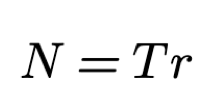
To achieve this, the following estimation is performed. We pick T = 8 hours of work because that is the standard length of a work day for a software developer.
To calculate the value of r we need to pick the symbol duration t.
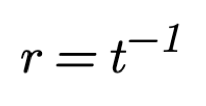
The value of the symbol duration time t is determined by two natural constraints:
- the maximum typing speed of human beings
- the capacity of the cognitive control of the human brain
Typing speed has been subject to considerable research. One of the metrics used for analyzing typing speed is inter-key interval (IKI), which is the difference in timestamps between two keypress events. We see that IKI is defined equal to the symbol duration time t. Hence we can use the research of IKI to find the symbol duration time t. It was found that the average IKI is 0.238s [26]. There are many factors that affect IKI [6]. It was also found that proficient typing is dependent on the ability to view characters in advance of the one currently being typed. The median IKI was 0.101s for typing with unlimited preview and for typing with 8 characters visible to the right of the to-be-typed character but was 0.446s with only 1 character visible prior to each keystroke [7]. Another well-documented finding is that familiar, meaningful material is typed faster than unfamiliar, nonsense material[8]. Another finding that may account for some of the IKI variability is what may be called the “word initiation effect”. If words are stored in memory as integral units, one may expect the latency of the first keystroke in the word to reflect the time required to retrieve the word from memory[55].
Cognitive control, also known as executive function, is a higher-level cognitive process that involves the ability to control and manage other cognitive processes that permit selection and prioritization of information processing in different cognitive domains to reach the capacity-limited conscious mind. Cognitive control coordinates thoughts and actions under uncertainty. It's like the "conductor" of the cognitive processes, orchestrating and managing how they work together. Information theory has been applied to cognitive control by studying the capacity of cognitive control in terms of the amount of information that can be processed or manipulated at any given time. Researchers found that the capacity of cognitive control is approximately 3 to 4 bits per second[32][33], That means cognitive control as a higher-level function has a remarkably low capacity.
Based on the above research we get:
- Maximum typing speed of human beings to be r=1/t=1/0,238=4.2 symbols per second
- Capacity of the cognitive control of the human brain to be approximately 3 to 4 bits per second. Since we assume one question equals one bit of information we get 3 to 4 questions per second.
- Asking questions is an effortful task and humans cannot type at the same time. If there was a symbol NOT typed then there was a question asked. That means the question rate equals the symbol rate, as explained here.
In order to get a round value of maximum symbol rate N of 100 000 symbols per 8 hours of work we pick symbol duration time t to be 0.288 seconds. That is a bit larger than what the IKI research found but makes sense when we think of 8 hours of typing. Having t of 0.288 seconds makes a symbol rate r of 3.47 symbols per second. That is between 3 and 4 and matches the capacity of the cognitive control of the human brain.
We define CPH as the maximum rate of characters that could be contributed per hour. Since r is 3.47 symbols per second we get CPH of 12 500 symbols per hour. We substitute T = h and r=CPH and the formula for N becomes:
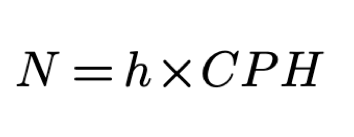
where h is the number of working hours in a day and CPH is the maximum number of characters that could be contributed per hour. We define h to be eight hours and get N to be 100 000 symbols per eight hours of work.
Total working time consist of four components:
- Time spent typing (coding)
- Time spent figuring out WHAT to develop
- Time spent figuring out HOW to code the WHAT
- Time doing something else (NW)
Let us assume an ideal system where the time spent doing something else TNW is zero. Using the new formula for N the formula for H becomes
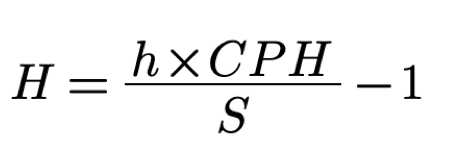
Note, that since N is calculated per hour so S also needs to be counted in an hour.
We see that the more symbols of source code contributed during a time interval the less missing information was there to be acquired. We want to compare the performance of different software development processes in terms of the efficiency of their knowledge discovery processes. Hence we rearrange the formula to emphasize that.
(8)
The right hand part is the KEDE we defined earlier. Thus, we define an instance of the metric KEDE - the general metric that we introduced earlier. This version of KEDE is for the case of knowledge workers that produce tangible outcome in the form of textual content:
(9)
KEDE from (9) contains only quantities we can measure in practice. KEDE also satisfies all properties we defined earlier. it has a maximum value of 1 and minimum value of 0; it equals 0 when H is infinite; it equals 1 when H is zero; it is anchored on a natural constraint—the maximum typing speed of a human being.
If we convert the KEDE formula into percentages then it becomes:
(10)
We can use KEDE to compare the knowledge discovery efficiency of software development organizations.
Testing Intelligence
Today all measure intelligence by the power of appropriate selection (of the right answers from the wrong). The tests thus use the same operation as is used in the theorem on requisite variety, and must therefore be subject to the same limitation. (D, of course, is here the set of possible questions, and R is the set of all possible answers). Thus what we understand as a man's “intelligence” is subject to the fundamental limitation: it cannot exceed his capacity as a transducer. (To be exact, “capacity” must here be defined on a per-second or a per-question basis, according to the type of test.)[3]
We can also use our model to the testing of human and AI intelligence. We infer this capacity from performance under variety — i.e., how many different problems a system or a person can solve correctly.
The dominant mathematical models for testing intelligence by the number of answered problems are benchmark datasets like MMLU, GSM8K, MATH, and FrontierMath. These models measure intelligence by the raw count or percentage of correctly solved problems, with more advanced benchmarks designed to minimize guessing and require deep reasoning.
From the knowledge-centric perspective:
- The disturbances are the questions
- The person gives responses
- The outcomes are
Several mathematical models and benchmark datasets are used to evaluate intelligence—especially artificial intelligence (AI)—by measuring the number and complexity of math problems answered correctly. These models serve as standardized tests for both AI and, by analogy, human intelligence[52].
Massive Multitask Language Understanding (MMLU):
- MMLU is a widely used benchmark that tests AI models on a broad range of subjects, including mathematics at various levels (high school, college, abstract algebra, formal logic).
- The test is typically formatted as multiple-choice questions, and performance is measured by the percentage of correct answers out of the total number of questions
- For example, advanced AI models have achieved up to 98% accuracy on math sections of MMLU, indicating high proficiency in standard math tasks but not necessarily deep reasoning
Grade School Math 8K (GSM8K)
- GSM8K is a dataset of 8,500 high-quality, grade school-level word problems designed to test logical reasoning and basic arithmetic skills.
- Evaluation is based on exact match accuracy: the number of problems answered exactly correctly divided by the total number attempted
- This benchmark is used to assess step-by-step reasoning and the ability to handle linguistic diversity in problem statements.
MATH (Mathematics Competitions Dataset)
- MATH consists of problems from high-level math competitions (e.g., AMC 10, AMC 12, AIME), focusing on advanced reasoning rather than rote computation.
- Performance is measured by the percentage of correct answers, with human experts (e.g., IMO medalists) providing a reference for top-level performance
- The dataset is challenging for both humans and AI, with LLMs typically scoring much lower than expert humans.
FrontierMath[53]
- FrontierMath is a new benchmark featuring hundreds of original, expert-level math problems spanning major branches of modern mathematics.
- Problems are designed to be "guessproof" and require genuine mathematical understanding, with automatic verification of answers
- The benchmark is used to assess how well AI models can understand and solve complex mathematical problems, similar to human performance.
In human intelligence testing, Psychometric models such as IQ tests or psychometric approaches also use the number of correctly answered problems as a key metric. These tests are standardized, and the raw score (number of correct answers) is often converted into a scaled score or percentile.
As an example we will use the Exact Match metric as the evaluation method[52]. Given that each question in our benchmark dataset has a single correct answer and the model produces a response per query, Exact Match ensures a rigorous evaluation by comparing the extracted answer to the ground truth.
Let represent the extracted answer from the model's outcome for the question, and let be the corresponding ground truth answer. The Exact Match accuracy is computed as:
where:
- is the total number of evaluated questions.
- is the indicator function, returning 1 if the extracted model response matches the ground truth after preprocessing, and 0 otherwise.
- is a function that standardizes formatting, trims spaces, and normalizes numerical values.
The knowledge discovery efficiency of an LLM can be calculated as:
Let's pick the case of the performance of GPT-4o on the MATH benchmark, which achieved a significantly lower accuracy of 64.88%, lagging behind its peer models[52]. Now, we can calculate the average knowledge discovered H(X|Y).
Basketball Game
We can also use this model to assess the performance of a basketball player.
- Timeframe is a basketball game.
- We observe N total shot attempts.
- S of them are successful (shot made).
-
We record a binary outcome sequence
-
The empirical success rate is:
Interpretation using Ashby's Law
The basketball shot is a regulation problem: the player must control their body and respond to the game environment to produce the desired outcome. The player is faced with a series of disturbances (D) in the form of different shots to make under different conditions. The player responds with a selection, drawn from their internal skills (regulatory variety R) in the form of different shooting techniques. Each shot is uncertain whether it will be successful. The outcome E is whether the shot is made (2) or missed (0).
Over N shots, the success rate
In basketball and intelligence testing, S/N happens to look like a success rate. That is only because every non-closure unit there is a failed attempt, a consequence of how units are defined in those cases, not a general identity.
In this case, θ becomes a practical proxy for how often the regulator (player) has sufficient internal variety to absorb the disturbance presented by the game. However, it is important to note that this is a simplified model and does not account for all the complexities of basketball performance. For example, the player may have different success rates depending on the type of shot, the position on the court, or the level of defense. These factors can all affect the player's ability to regulate their performance and should be considered when interpreting the results. Thus, as explained here θ is a useful heuristics for P(E=1), but the full picture includes the quality of mapping, not just quantity.
Applying the Model
NBA keeps track of field goal attempts and makes for each player. The most field goal attempts by a player in a single NBA game is 63, achieved by Wilt Chamberlain during his legendary 100-point game against the New York Knicks on March 2, 1962 We take this as the natural constraint so N=63. We can also take the number of successful shots S=36, which is the most field goals made in a single game by a player[13].
We can calculate the KEDE for this sequence of outcomes.
We can also calculate the knowledge discovered H(X|Y) in bits of information.
That means that the player needed to absorb 0.75 bits of information on average to make the shot.
We've turned a real-world sequence of basketball shots into a fine-grained, time-based measurement of a regulatory capacity — effectively measuring how much variety the player needed to absorb.
We can also use this model to assess the performance of a basketball team. In this case the success rate coincides with the field goal percentage (FG%) of the team which is the percentage proportion of made shots over total shots that a player or a team takes in games. There is a statistical distribution for NBA field goal percentage (FG%) [10]. Analysts and researchers often study the distribution of FG% across players or teams to understand scoring efficiency and trends[11]. The NBA record for the highest FG% in a single game by a team is 69.3%, set by the Los Angeles Clippers on March 13, 1998, when they made 61 of 88 shots[12].
For example, in the 2023-24 season, team FG% ranged from about 43.5% (lowest) to 50.6% (highest), with the league average typically falling in the mid-to-high 40% range[11]. if we take the average FG% of 45% , we can calculate the average knowledge discovered H(X|Y).
That means that a team needed to absorb 1.22 bits of information on average to make a shot.
Assembly Line
We can also use this model to assess the knowledge discovery efficiency of an assembly line.
The assembly line is a system that transforms raw materials into finished products. The assembly line has a set of disturbances (D) in the form of different raw materials, machines, and processes. The assembly line responds with a selection, drawn from its internal structure (R) in the form of different machines, processes, and workers.
From a knowledge-sentric perspective most of the knpwledge discovery happens in the design phase of the assembly line. This is the planning for design, fabrication and assembly. This activity has also been called design for manufacturing and assembly (DFM/A) or sometimes predictive engineering. It is essentially the selection of design features and options that promote cost-competitive manufacturing, assembly, and test practices[51]. Thus most of the disturbances D are already absorbed by the design of the assembly line. That means when the workers have most of the knowledge built into the assembly line and the operational procedures.
Assembly line efficiency (AE) is the ratio of the outcome to the maximum possible outcome, often expressed as a percentage.
The efficiency of the assembly line can be calculated as:
We can assume that an assembly line is designed to produce a certain number of successful products (S) with a maximum rate of N products per hour. So for example, a shoe manufacturer has an actual outcome of 100 shoes per day, and a maximum potential outcome of 120 shoes per day. Their production line efficiency would be 83%. Now, we can calculate the average knowledge discovered H(X|Y).
To optimize the AE, companies can apply DFA guidelines, such as minimizing the number and variety of parts, standardizing the fasteners and connectors, and simplifying the assembly sequence and orientation[51].
Interpreting the results involves a comprehensive analysis of the data to understand where and why inefficiencies occur. In general, the higher the AE, the better the design. On the other hand, AE close to 100% might indicate under-utilised capacity. It's essential to compare high efficiency with industry capacity standards to determine if an increase in production is feasible and beneficial.
If AE is consistently below industry benchmarks, this could highlight several potential issues:
- Machinery: It may indicate that machines are outdated, malfunctioning, or not suitable for the required tasks.
- Labour Skills: Low efficiency might be due to workforce training gaps.
- Process Design: Sometimes, the workflow or layout of the production line itself causes inefficiencies.
Appendix
Example: A Two-Dimensional Parabola
Consider the parabola as an example of the distinction between a variable, the set of its possible values, the set of realized values, and the graph of a mapping.
Let D be the disturbance variable, and let its set of possible values be
Let Z be the outcome variable, with possible outcome-values
and define the realized outcome map by
The parabola is then the graph
Thus:
- the x-axis contains disturbance-values
- the y-axis contains outcome-values
- the parabola itself is the graph of the map
Distinct disturbance-values may yield the same outcome-value:
The repetition belongs to the mapping, not to the set 𝒴. The set of possible outcome-values still contains the value 4 only once.
Where are and its acceptable subset η?
The essential-value space appears only once one specifies how outcomes are evaluated. There are two natural cases:
Case 1: The y-axis already represents the essential values
If the outcome-values themselves are the essential values, then
and the evaluation map is simply the identity:
In that case, E is represented directly by the y-axis and the acceptable subset is literally a subset of the y-axis. For example,
Geometrically, η is the allowed vertical segment on the y-axis.
Then the question of successful regulation becomes:
If then so success fails if , because outcomes larger than 4 occur. But if disturbances are restricted to then so success holds since .
Case 2: is an evaluative space distinct from the y-axis
If the y-axis shows fine-grained outcomes, while regulation cares only whether those outcomes are acceptable, then define
with evaluation map
Then the y-axis is still but E is now a coarser evaluative variable and the acceptable subset is
In this second case, E is not directly identical with the y-axis unless we add the extra evaluation layer. Rather, the y-axis is first mapped into an evaluative space by φ.
In one sentence, in the parabola example, the curve shows the mapping from disturbance-values to outcome-values; E appears only after we decide how those outcome-values are to be evaluated for survival or acceptability; and is the acceptable part of that evaluative space.
The Parabola as Possibility, and Realization as a Subset of Possibility
This full graph G the possible disturbance-outcome relation generated by the mapping.. Actuality appears only after a realized disturbance subset is specified.
Then the set of realized outcome-values is
and the realized part of the graph is
Thus, the x-axis contains possible disturbance-values, the y-axis contains possible outcome-values, the full parabola represents the possible disturbance–outcome relation, and only a subset of its points need be realized in fact.
For example, if the realized disturbances are
then the realized outcome-values are
not because these are all possible outcome-values, but because these are the values generated by the disturbances that actually occurred.
Example of a Human Knowledge Discovery Process with Goal-Model Revision
We now apply the same set-based structure to a simple human knowledge-discovery task: typing the word “Honorificabilitudinitatibus”.
The authoritative target word is:
It has 27 letters. Let be the set of target-word positions, and let be the set of possible typed symbols. Let denote the authoritative correct symbol at position in the target word.
Outcome-value space
The outcome-value space records what symbol was typed for what intended target position. Thus we define:
An outcome-value has the form:
where is the intended position in the target word, and is the typed symbol. For example, means that the symbol H was typed for position 1.
This is different from the closure-event index. The closure-event index records when the typing act occurred. The target-position index records which position the act attempted to satisfy. Therefore, in general.
Essential-variable space
In this example, both the outcome-value space and the essential-variable space are two-dimensional. The two dimensions are target-word position and symbol. Thus the outcome-value space has coordinates , and the essential-variable space uses the same two goal-relevant dimensions: which symbol occupies which target-word position for purposes of judging success.
There are two equivalent ways to read this example.
Reduced correspondence. In the reduced case, the concrete outcome-value is already the essential-variable value:
So, in the reduced case:
Bijective correspondence. In the bijective case, the outcome-value space and the essential-variable space are conceptually distinct, but every relevant outcome-value corresponds to exactly one essential-variable value, and every relevant essential-variable value corresponds to exactly one outcome-value.
For the bijective reading, the outcome-value space and essential-variable space are conceptually distinct but have the same two-dimensional coordinate structure:
where is the essential-variable coordinate for target position, and is the essential-variable coordinate for the symbol occupying that position. Thus an essential-variable value may be written as , where means: “the goal-relevant state in which symbol occupies target position .”
The outcome-to-essential-variable map is:
This map is bijective on the relevant modeled spaces. The concrete outcome and the essential-variable value are not the same object, but they carry the same distinctions for this regulatory model.
Authoritative acceptable essential-variable region
The authoritative acceptable essential-variable region is the set of goal-relevant states corresponding to the correct position-symbol pairs in the target word:
For example:
but:
The authoritative acceptable region does not change during the exercise. The target word remains the same. The Shakespeare text did not change. The required symbol at position did not change.
Authoritative acceptable outcome-set
The authoritative acceptable outcome-set is the pullback of the authoritative acceptable essential-variable region along :
In the bijective case, this gives:
In the reduced case, since , the same condition reduces to:
Thus the example can be read either way. In the reduced reading, outcome-values already are essential-variable values. In the bijective reading, outcome-values and essential-variable values are conceptually distinct but informationally equivalent under .
Believed acceptable outcome-set
The typist does not initially know the authoritative acceptable outcome-set perfectly. At time , the typist acts under a believed model of the acceptable essential-variable region:
This induces the typist's believed acceptable outcome-set:
In the reduced representation:
From the typist's subjective perspective, an incorrect symbol may initially appear to belong to the acceptable outcome-set. Later checking against the authoritative word reveals that it does not. This is not external goal revision, because and remain fixed. What changes is the typist's believed model: and therefore .
That is goal-model revision, not goal revision.
Closure events
Each typed symbol is a closure event:
where:
- is the closure-event index;
- is the current demand to type a symbol for an intended target position;
- is the selected keypress;
- is the resulting typed outcome-value.
The produced outcome-value is:
where is the intended target position and is the typed symbol.
For example:
					z₁ = (1, x)   provisionally accepted, later invalidated
					z₂ = (1, q)   provisionally accepted, later invalidated
					z₃ = (1, H)   survives authoritative checking
					z₄ = (2, o)   survives authoritative checking
					z₅ = (3, n)   survives authoritative checking
This preserves the distinction between event order and target position. Events 1, 2, and 3 are three different closure events, but all three attempt to satisfy position 1.
Operational trace
The following trace contains 37 typed closure events. The letters marked with 1 are the closure events that survive authoritative checking. The letters marked with 0 are provisional closure events that are later invalidated.
| Closure event | 1 | 2 | 3 | 4 | 5 | 6 | 7 | 8 | 9 | 10 | 11 | 12 | 13 | 14 | 15 | 16 | 17 | 18 | 19 | 20 | 21 | 22 | 23 | 24 | 25 | 26 | 27 | 28 | 29 | 30 | 31 | 32 | 33 | 34 | 35 | 36 | 37 |
|---|---|---|---|---|---|---|---|---|---|---|---|---|---|---|---|---|---|---|---|---|---|---|---|---|---|---|---|---|---|---|---|---|---|---|---|---|---|
| Target position pᵤ | 1 | 1 | 1 | 2 | 3 | 4 | 5 | 6 | 6 | 7 | 8 | 9 | 10 | 11 | 12 | 13 | 13 | 13 | 14 | 15 | 16 | 16 | 17 | 18 | 19 | 19 | 19 | 20 | 21 | 21 | 21 | 22 | 23 | 24 | 25 | 26 | 27 |
| Typed symbol aᵤ | x | q | H | o | n | o | r | e | i | f | i | c | a | b | i | o | r | l | i | t | m | u | d | i | p | v | n | i | y | k | t | a | t | i | b | u | s |
| Ledger status | 0 | 0 | 1 | 1 | 1 | 1 | 1 | 0 | 1 | 1 | 1 | 1 | 1 | 1 | 1 | 0 | 0 | 1 | 1 | 1 | 0 | 1 | 1 | 1 | 0 | 0 | 1 | 1 | 0 | 0 | 1 | 1 | 1 | 1 | 1 | 1 | 1 |
Reading only the surviving closure events, the events marked 1, gives the final accepted output:
Reading the events marked 0 gives the provisional closures that were later rejected:
Provisional closure history
Let the observation window be:
A closure is provisionally accepted when produced if its outcome-value belongs to the typist's believed acceptable outcome-set at that time:
The provisional closure history in the window is:
In this example, all 37 typed symbols were provisionally accepted when produced. Therefore:
Authoritative survival and model invalidation
A provisional closure survives if its produced outcome-value belongs to the authoritative acceptable outcome-set:
The net surviving closures are:
A provisional closure is invalidated by goal-model revision if it was accepted under the believed model when produced, but later judged outside the authoritative acceptable outcome-set:
The goal-model invalidation load is:
Therefore the ledger identity is:
Interpretation
In the reduced case, the typed outcome-value already is the essential-variable value. In the bijective case, the typed outcome-value is a concrete outcome description, and the essential-variable value is the corresponding goal-relevant description.
In this example, the 10 invalidated events are actual typed outputs. Each one was a provisional closure produced under the typist's then-current belief i.e. their model of the goal. Later, after checking the authoritative word in the script, the typist discovered that those provisional closures did not belong to the authoritative acceptable outcome-set.
| Quantity | Value | Meaning |
|---|---|---|
| 37 | All provisionally accepted typed closures. | |
| 27 | Typed closures that survived authoritative checking and form the final word. | |
| 10 | Typed closures invalidated after goal-model revision. |
In this example, the authoritative goal did not change. The word to be typed remained the same. What changed was the regulator's model of the goal. The process therefore involved goal-model revision, invalidation of provisional closures, and corrective replacement, not external goal revision.
Knowledge To Be Discovered perspective
In this example, the demand space is , rthe esponse space is , because the concrete response is the selected keypress or typed symbol . The closure outcome records that response together with the intended target position: . For knowledge accounting, we use the lifted response-equivalence space , where the response class is represented together with the target position, because the required response-class is not merely a symbol, but a symbol-for-a-position, because the closure records which symbol was typed for which intended position.
The task class is: type the correct symbol for a target-word position in “Honorificabilitudinitatibus.” Under that task class, every closure event in the trace is one episode of the same regulatory problem: given a target position p, determine and emit the authoritative symbol required at that position. Thus all closure events in the example are comparable under the same task class They share the same disturbance space , the same concrete response space , the same outcome space , and the same lifted target response-class space .
This example makes explicit why Knowledge To Be Discovered should be defined over the authoritative target response-class, not over the actual response-class emitted by the regulator. The typist produces actual closures, but those closures are not automatically the closures required by the authoritative goal.
For a closure event , the actual produced outcome-class is:
where is the intended target position and is the symbol actually typed.
But the authoritative target response-class for that same event is:
where is the authoritative symbol required at the intended target position.
Thus the central distinction is:
Knowledge To Be Discovered is the remaining uncertainty, given the typist's current information state, about the authoritative target response-class:
In the generic time-indexed notation used elsewhere, this is:
Here represents the disturbance, observation, or demand presented to the regulator at time . In this example, can be read as the current demand to type the symbol for target position . The typist's current knowledge, memory, belief, and goal-model state is represented separately by .
The subscript means that the entropy is evaluated relative to the regulator's current model. The conditioning variable specifies the disturbance or demand currently being faced. In this example, the demand may identify the target position, while the model determines how much uncertainty remains about the authoritative symbol required at that position.
In this example, if the typist is attempting to satisfy position 1, the authoritative target response-class is:
But the actual produced response-classes were:
							X₁ = (1, x)   actual closure, later invalidated
							X₂ = (1, q)   actual closure, later invalidated
							X₃ = (1, H)   actual closure, survives authoritative checking
Therefore:
This is why the strong alignment assumption:
does not hold during this knowledge-discovery process. The typist's actual closures are not yet reliably aligned with the authoritative target closures. Some actual closures are exploratory, mistaken, provisional, or based on an incorrect believed goal model.
Consequently, the entropy of the actual response-class:
does not necessarily measure Knowledge To Be Discovered. It measures residual variation in what the regulator actually does. That variation may come from several sources: randomness, indecision, exploration, implementation variation, motor error, or even consistently wrong behavior. From an outside black-box perspective, these sources are not directly separable merely by observing the emitted closures.
By contrast:
measures uncertainty about the target response-class that would satisfy the authoritative goal. That is the knowledge the regulator must acquire, infer, retrieve, or otherwise make available in order to close the demand correctly.
Why the ledger is evidence of discovery, not the entropy itself
The closure ledger:
is not itself an information-theoretic entropy identity. It is an operational accounting identity:
The 10 invalidated closures are not 10 bits of Knowledge To Be Discovered. They are observable consequences of acting before the relevant target knowledge was fully available. They show that the typist's believed model allowed closures that the authoritative goal later rejected.
Thus:
measures model-invalidation load, not Knowledge To Be Discovered directly. It is a trace left by knowledge discovery in the closure history. The entropy measure remains:
because the unresolved question is not merely “what will the typist type?” but “what response-class is required for authoritative success, given what the typist currently knows?”
Role of goal-model revision
The authoritative goal does not change in this example. The word remains:
Therefore and remain fixed. What changes is the typist's believed model:
This is why the process is goal-model revision, not external goal revision. The typist discovers that the believed acceptable outcome-set was too permissive. After checking, some provisional closures are removed from the believed acceptable region, and replacement closures are produced.
From the Knowledge To Be Discovered perspective, checking the authoritative word changes the information state:
and therefore can reduce:
When the typist finally knows that position 1 requires H, the uncertainty about the authoritative response-class for that position collapses:
At that point, no further knowledge must be discovered for that particular target-position closure. The remaining task is execution: producing the known required response.
Why this example supports the present definition
This example supports the definition:
because the discovered knowledge is knowledge about the target response-class required for successful regulation. The target is not whatever the regulator happens to emit. The target is the authoritative closure that would place the outcome inside the acceptable region.
The actual response-class can be wrong, exploratory, random, inconsistent, or provisionally accepted under a mistaken model. Therefore:
in the general case.
Only under the strong alignment assumption:
does the actual response-class entropy coincide with target response-class uncertainty:
This example is valuable precisely because it shows that the strong alignment assumption fails during knowledge discovery. The typist does not begin with perfect knowledge of the authoritative target closure. The typist emits closures, invalidates some of them, revises the believed goal model, and eventually aligns actual closures with authoritative target closures.
A Realized Knowledge Discovery Trace
This example shows how a concrete execution trace can be used to estimate the amount of knowledge discovered during a task. The purpose of the example is not to estimate the entropy of English, nor the entropy of a word. The purpose is to make visible the knowledge-discovery burden experienced during one realized execution of one task.
The Task
Consider the task of typing the word “Honorificabilitudinitatibus” on a keyboard. The word has 27 letters. The manual part of the task is to press the correct keys. The knowledge part of the task is to know which 27 letters must be typed, and in which order.
In this example, the typist does not remember the whole word at once. Sometimes the next required letter is already available from memory. At other times, the typist has to stop, think, or look up the word again. We record this process with a binary trace:
- 1 means the required next letter was already available for action.
- 0 means the typist was missing information and had to ask a question, think, or look up the word before continuing.
Thus, the ones are the surviving closures of the process — the letters that actually land — and the zeros are the missing-information intervals that separate them. This 0/1 string is the ground truth of what happened inside the process. A strict black-box observer does not see it: the zeros are not directly observable as such. We display the full trace here only to make the underlying process concrete. What the observer actually records is which letters landed and how much clock time the window afforded. The missing-information intervals are recovered afterward as a residual, not counted off the trace.
The Trace and What Is Actually Observed
The ground-truth trace — shown here for illustration, not as observer-side data — can be summarized as follows. The column records the missing-information intervals that in fact occurred in each subset; under the black-box regime these are inferred, not seen, and are listed here only so the arithmetic can be followed.
| Segment | Trace | Questions \(Q_i\) | Typed letters \(S_i\) | Missing information \(H_i = Q_i / S_i\) | Total intervals \(N_i = Q_i + S_i\) |
|---|---|---|---|---|---|
| Initial lookup and first remembered chunk | 00 11111 |
2 | 5 | 2/5 | 7 |
| Second remembered chunk | 0 1111111 |
1 | 7 | 1/7 | 8 |
| Third remembered chunk | 00 111 |
2 | 3 | 2/3 | 5 |
| Fourth remembered chunk | 0 111 |
1 | 3 | 1/3 | 4 |
| Fifth remembered chunk | 00 11 |
2 | 2 | 2/2 | 4 |
| Final remembered chunk | 00 1111117 |
2 | 7 | 2/7 | 9 |
| Total | Realized execution trace | \(\sum Q_i = 10\) | \(\sum S_i = 27\) | \(\sum N_i = 37\) |
Note: The observer's route to is the clock, not this sum. The observer sees 37 clock ticks, and the 27 letters that actually land. The 10 missing-information intervals are inferred as a residual, not directly observed.
Two quantities are available to a black-box observer of this window.
First, the surviving closures. Twenty-seven letters landed, so . This is read directly from the closure ledger.
Second, the window capacity. Under the declared convention, one closure-act-equivalent unit is the time to commit one letter, of normalized duration . The window's elapsed clock time affords 37 such units, so This count comes from the clock and the unit convention, not from any tally of missing-information intervals.
The residual is then inferred, not observed: The ten missing-information intervals are the closure-act capacity the window afforded but did not convert into surviving closures. They are recovered from and ; the observer never counts them directly.
Aggregating Missing Information Across Subsets
The trace can also be analyzed by decomposing the task into six subsets. Each subset has its own number of inferred, not counted questions , its own number of typed symbols , and therefore its own local missing-information value:
However, the total missing information for the whole task is not obtained by simply summing the six values, nor by taking their unweighted arithmetic average. The subsets have different sizes. A subset of seven typed symbols must contribute more to the aggregate value than a subset of two typed symbols.
Therefore, the aggregate missing information is computed as a weighted average, where each local value \(H_i\) is weighted by the proportion of symbols in that subset:
Here:
- is the number of subsets;
- is the number of typed symbols in subset ;
- is the number of questions in subset ;
- is the missing information in subset ;
- is the total number of intervals in subset ;
- is the total number of typed symbols.
Using the six subsets from the table:
So the aggregate missing information remains \(0.37\) missing-information units per typed symbol. The subset calculation gives the same result as the direct calculation, but it makes clear why the local \(H_i\) values must be weighted by subset size.
Subset missing-information values cannot be added directly. The correct aggregate is the symbol-weighted average: .
The Operational Estimator
The effective Knowledge To Be Discovered over this interval is:
Substituting the observed values gives:
So, in this realized execution, the typist needed approximately 0.37 inferred, not counted missing-information units per typed symbol.
Why This Corresponds to
The important point is that this calculation is based on the actual observed knowledge state of the typist during the task. We are not averaging over all possible memory states, all possible words, or all possible observations. We are looking at the realized case: this typist, this word, this sequence of remembered and forgotten chunks.
For that reason, the corresponding latent quantity is the realized row-level conditional uncertainty:
Here, is the required response-equivalence class for closure event , and is the actual knowledge state available at the start of that episode. The estimator uses the realized value , not the full distribution of possible values of .
By contrast, would be an ex-ante quantity. It would require a probability distribution over possible knowledge states before the realized state is known. That is not what the trace records. The trace records what actually happened.
Example: A Robot Discovering Its Next Move
Imagine a robot exploring the surface of a distant moon. At each step of its journey, the robot must select one of four possible moves:
- move up,
- move down,
- move left, or
- move right.
From a knowledge-centric perspective, the robot is discovering which move its goal calls for. The knowledge needed to select the move could, in principle, come from many places. It might come from the robot's sensors, from a map stored in its memory, from a rule learned during earlier exploration, or from a signal transmitted from Earth. The source is immaterial. The only quantity that matters is how much uncertainty must be eliminated before one move can be selected.
The robot discovers which move its goal calls for by following a protocol. The protocol proceeds through a sequence of stages. At each stage, the robot performs the same generic action unit. Executing that action unit exposes a realized signal , which in this case is in the form of a binary symbol. The realized symbol takes the value zero or one and constitutes the information-bearing signal at that stage. By processing those realized signals stage by stage, the robot progressively eliminates moves that are no longer compatible with the observed signal path.
The protocol does not directly hand the robot a completed instruction. Instead, it structures a process through which the robot discovers which move is required.
At episode , three objects must be kept distinct. The robot's knowledge state contains its stored law of action and its model of the terrain. The episode-start information is the response-relevant information actually available to the robot before the episode's internal staged discovery begins. The required response class is the move that must be identified for successful regulation.
These roles are different. The knowledge state determines the epistemic probability model by which the robot interprets what it observes. The episode-start variable is realized conditioning information supplied to that model. Thus is not absorbed into . A stored model tells the robot how to use episode-specific information; it is not the same thing as that information.
That distinction lets two robots receive the same but have different KTD because their 's interpret that evidence differently. Conversely, one robot with the same can encounter different 's in different episodes.
The Knowledge To Be Discovered at the start of the episode is therefore:
For one realized episode-start context , the corresponding uncertainty is .
For readability, when one episode is being analyzed we suppress the episode index and write , , and , while retaining when the epistemic model needs to be shown explicitly.
So the robot begins each episode with a definite amount of uncertainty about , and the practical question is this:
What is the most efficient possible protocol the robot can follow to discover its next move — that is, to determine which response is required using the fewest protocol stages on average?
The resulting robot example would then demonstrate the entire knowledge-discovery architecture in one line: followed by staged discovery through .
Action units and realized signals are two different things
The robot resolves the move by running a protocol : a sequence of action units .
An action unit is a discriminating operation. It specifies what the robot does to obtain the next piece of evidence. In this particular example, the action unit is simply:
Read the next binary symbol.
Executing that action unit exposes a realized signal , which in this case is in the form of a binary symbol, whose realized value is either zero or one. That realized signal updates the robot's epistemic state and may rule out some of the moves still compatible with what the robot knows.
The distinction to hold onto is that the action unit and its realized signal are not the same thing. The action unit is what the robot does; the realized signal is the evidence made available by performing that action.
There is another distinction that will matter later. A binary symbol is not, by definition, one bit of information. Zero and one are possible values of the signal. A bit, by contrast, is a unit used to measure information or uncertainty reduction. One protocol stage may expose one binary symbol without that stage necessarily contributing one full bit of expected information.
In this example, which action unit is performed next is fixed in advance by the protocol and the robot's knowledge state. That protocol structure, on its own, therefore tells nothing additional about the required move. The informational update is carried by the realized values of the signals.
That is why "receiving an instruction" and "discovering the next move" can be represented as the same process here. The uplink from Earth is simply one possible source of epistemic signals feeding the protocol. Whether a realized signal comes from Earth, from an onboard sensor, or from stored knowledge changes the source of the evidence, but not the staged account of discovery.
So discovering the move means running a procedure, allowing the realized signals to reduce the set of candidate moves, and stopping when the protocol reaches a terminal state in which the required response has been identified.
Fix a realized episode-start context . Under the robot's current knowledge state , the four moves are not equally likely to be the required one. The conditional distribution of the required response is:
Thus, given this episode-start context, half of the time the required move is up, one quarter of the time it is down, and the two remaining moves each occur one eighth of the time. For this first worked case, successive required moves are independent across episodes; the previous required move supplies no additional response-relevant information beyond the episode-start information already represented by .
Now imagine three engineers who each propose a discovery protocol — one straightforward, one clever, and one very theoretical.
Each protocol can be judged by two quantities that sound alike but mean different things. The first is how many protocol stages the robot runs before the required move is identified. This is a count of physical action units, measured in stages or binary symbols read. The second is how much response-relevant uncertainty remains after the episode-start information is already known. This is Knowledge To Be Discovered: , measured in bits.
These are not the same thing. One asks what the robot does; the other asks what it must still discover. The terrain and the episode-start information determine the conditional uncertainty. The protocol determines how many action units are expended to remove it.
The straightforward protocol
The first engineer suggests assigning a two-symbol binary code word to every possible move:
Under this protocol, each episode always contains exactly two stages.
At the first stage, the robot performs the action unit:
Read the next binary symbol.
The realized symbol is the information-bearing signal. Its value eliminates two of the four possible moves.
At the second stage, the robot performs one more action unit and reads one more binary symbol. The second realized signal eliminates all but one of the remaining candidates.
For example, suppose the robot reads:
followed by:
The realized binary signal discovery path is therefore:
According to the protocol, the unique move compatible with that path is left.
This approach is simple. The robot always reads two binary symbols, groups them into a two-symbol code word, and maps the resulting word to one move.
However, it ignores the fact that the four moves do not occur with equal probabilities. The move up occurs much more frequently than either left or right, yet all four moves are assigned discovery paths of exactly two stages.
A more efficient discovery protocol
The second engineer proposes a variable-length prefix protocol:
Under this protocol, the robot still performs the same basic action unit at every stage:
Read the next binary symbol.
The action unit specifies the discriminating operation. The realized value of the binary symbol is the epistemic signal that updates the robot's candidate set.
The protocol may terminate after one, two, or three stages, depending on the realized signal path.
Suppose the first observed signal is:
No other valid code word begins with zero. The robot can therefore conclude immediately that:
Its initial set of candidate moves,
has been reduced to:
The move has been discovered after one protocol stage.
Now suppose instead that:
The move is not yet known. Three candidates remain:
The protocol therefore continues. The robot performs another action unit:
Read the next binary symbol.
If the next realized signal is:
the observed prefix is:
Only down is compatible with that path, so the robot discovers:
If, however, the second signal is:
the observed prefix is:
Two possibilities remain:
The robot must therefore perform a third action unit and read one more binary symbol.
If:
the realized path is:
and the robot discovers left.
If:
the realized path is:
and the robot discovers right.
The protocol can therefore be represented as a staged candidate trace. For the realized signal path , the epistemic candidate trace is:
The action-unit sequence determines how the robot obtains the next piece of evidence. The realized signals determine which candidates survive. The mere act of reading another binary symbol does not reveal which move is correct. The information-bearing event is the realized value of that symbol.
In the notation of a staged knowledge-discovery process, the structure is:
Here:
- is the action unit "read the next binary symbol";
- is the realized signal, whose value is zero or one;
- is the set of response classes still possible before the signal is observed; and
- is the updated candidate set after the signal is observed.
The protocol structures the discovery episode. The realized signals carry the information.
Knowing when the move is discovered
Allowing different moves to require different numbers of protocol stages creates an immediate difficulty. How does the robot know when it has observed enough binary symbols to identify the move? How does it know where one discovery episode ends and the next begins? How does the robot know it is finished? It stops the instant the live candidate set of response classes becomes a singleton i.e. the instant the realized signals have fixed one required response class.
In the formal terms used above, the robot conditions on realized signals until the terminal Knowledge To Be Discovered reaches zero, which in this unique-target example occurs exactly when the terminal candidate-class set contains one element.
The constraint that makes this unambiguous is prefix-freeness: no completed discrimination path is the beginning of another completed path, or equivalently, no code word in a set is a prefix of any other code word.
Consider the four code words again:The answer lies in the structure of the code words. No code word is the prefix of another code word.
The one-symbol word identifies up, and no longer code word begins with zero. Once up is identified at the first stage, the robot does not continue executing action units for that episode.
The two-symbol word identifies down, and no longer code word begins with .
The prefixes and are not complete code words. They represent intermediate epistemic states in which more than one move remains possible.
The robot therefore follows a simple rule:
Continue reading binary symbols until the realized signal prefix matches a complete code word.
At that point, the required move has been uniquely identified and the episode closes.
Suppose the signal stream begins with:
The robot cannot yet commit to a move because down, left, and right all remain possible.
If the next binary symbol is zero, the prefix becomes:
Only down is compatible with that prefix, so the robot closes the episode and selects down. The next unread binary symbol begins a new discovery episode.
Suppose that symbol is zero. Because is already a complete code word, the robot immediately discovers up.
Now suppose the following binary signal path is:
After the first , three candidates remain. After the second , two candidates remain. After the final , only left remains. The move is discovered, and the episode closes.
A code with this property is called a prefix-free code, or more commonly a prefix code. The prefix-free condition is what makes the staged discovery path unambiguous.
If a fifth move were assigned the code word:
the protocol would fail. After observing:
the robot would not know whether it had completed the code word for down or had merely observed the first two binary symbols of the new code word .
The response class would appear to be fixed and unfixed at the same time. By preventing one code word from being the prefix of another, the protocol ensures that every terminal signal path corresponds to one unambiguous closure.
Reading binary symbols until a complete code word forms is therefore the coding-theoretic description of the same event that, in the staged knowledge-discovery formalism, is represented by conditioning until only one response class remains possible.
Those proportions — one half, one quarter, one eighth, and one eighth — exactly match the prior probabilities of the four moves. That alignment between probability mass and path length is the essential information-theoretic structure behind the efficiency of the protocol.
The average number of discovery stages
The operational cost of the protocol can now be calculated as the expected number of protocol stages required to discover a move. In this example, every stage consists of one action unit and exposes one realized signal in the form of a binary symbol.
Up requires one stage and occurs with probability one half. Down requires two stages and occurs with probability one quarter. Left and right each require three stages and each occurs with probability one eighth.
Let denote the number of protocol stages required to close an episode. Its expected value is:
Equivalently, because each stage reads exactly one binary symbol, the protocol consumes an average of binary symbols per discovered move.
This is more efficient than the fixed-length protocol, which always requires two stages and therefore always reads two binary symbols.
The variable-length protocol sometimes spends more than two stages. Discovering left or right requires three action units. But those moves occur infrequently. The additional operational cost of their longer paths is more than offset by the one-stage path assigned to up, the most probable move.
At this point we have measured the length of the protocol, not the amount of information discovered. The quantity is measured in protocol stages. Whether those stages correspond to the same numerical amount of information is a separate question.
Knowledge To Be Discovered along the protocol
Let denote the required move and let denote the response-relevant information already available when the episode begins. Before any internal discovery signal is observed, the robot's Knowledge To Be Discovered for this start context is:
For the conditional distribution used in this example:
The unit is bits, because this quantity measures residual epistemic uncertainty, not protocol length.
As the protocol runs, the information-bearing signals , , and so on are added to the conditioning information. After stages, the expected residual Knowledge To Be Discovered is:
Along one realized conditioning path , the corresponding posterior uncertainty is:
In this robot example the protocol terminates only when the required move has been uniquely identified. Therefore every completed realized path satisfies:
The realized signal path has therefore removed all of the Knowledge To Be Discovered that remained after the episode-start information was known. For the present start context, that amount is
We can now compare two quantities that must remain conceptually distinct:
while:
The first quantity measures how many physical action units the protocol expends. The second measures how much uncertainty still had to be removed after the robot's episode-start information was already available. They collapse to the same numerical value here only because this conditional distribution is dyadic and the binary protocol is probability-matched to it.
The protocol as a binary discovery tree
The prefix code can be represented as a binary tree. Each internal node represents an epistemic state in which several moves remain possible. Each action unit instructs the robot to read another binary symbol.
Each outgoing branch represents one possible realized signal:
or:
Each leaf represents a terminal response class. The tree begins with all four candidate moves.
The first binary distinction separates up from all other moves:
The next distinction separates down from left and right:
The final distinction separates left from right:
The tree is therefore not merely a visual representation of an encoding. It is a staged knowledge-discovery protocol.
The robot begins at the root with unresolved Knowledge To Be Discovered. Each executed action unit exposes another binary signal. Each realized signal moves the robot along one branch of the tree and updates the posterior distribution over possible moves. The episode terminates when the path reaches a leaf and only one required response class remains possible.
Why this protocol is perfectly matched to the distribution
This is the tightness case of Lemma 1′ with and zero coding gap.
The probability of each move is related directly to the length of its discovery path.
For up:
For down:
For left and right:
Thus, for every move ,
where is the number of protocol stages, equivalently the number of binary symbols in the code word, required to discover move .
Equivalently:
A highly probable move receives a short discovery path. A less probable move receives a longer path. This is not an arbitrary design choice. It is the central information-theoretic principle behind efficient coding. The protocol assigns shorter code words to less surprising outcomes and longer code words to more surprising outcomes.
One binary stage is not necessarily one bit of information
This is Proposition 0: the bound is on the expected information of a stage, and the realized amount on a given branch may be more or less than one bit.
It is important not to infer from the binary nature of the protocol that every executed stage must contribute one bit of information.
At stage , the robot executes one action unit and observes one binary signal . The expected epistemic contribution of that stage is:
which is measured in bits.
For a general binary discrimination, that quantity may be strictly less than one bit. If, for example, the two possible realized signals at some stage occur with probabilities and , then one binary symbol is still observed, but the uncertainty of that binary outcome is only:
So an action unit, a realized binary symbol, and a bit of information are three distinct concepts.
The present protocol is special because every internal node that the robot can reach divides the remaining probability mass exactly in half.
At the beginning of an episode, the first signal is zero precisely when the required move is up. Since:
the first realized signal is zero with probability one half and one with probability one half.
Conditional on the first signal being one, the remaining candidates are down, left, and right. Within that remaining probability mass, down accounts for exactly one half:
Therefore, conditional on reaching the second stage, its next realized binary signal is again zero or one with equal probability.
Conditional on the first two signals being , the remaining candidates are left and right, and they are equally probable. The third signal is therefore once again zero or one with equal probability.
Thus, at every stage actually reached by the protocol, the next binary discrimination evenly divides the remaining probability mass. Conditional on reaching stage , the realized binary signal has entropy:
Because the signal at each reached stage is also exactly the discrimination needed to determine which branch contains , each executed stage contributes one bit of expected information about the required move.
This is why the numerical alignment found above is exact:
and:
On average, the protocol therefore expends one action unit for each bit of Knowledge To Be Discovered that it removes. But this statement is a consequence of the even-split structure of this particular protocol. It is not a general identity between action units and bits of information.
From Discovery Efficiency to Knowledge Discovery Rate
So far, nothing in the robot example has depended on time. We have counted how many protocol stages are required to discover a move and how much uncertainty those stages remove, but we have not asked how quickly either happens. Time enters through the unit convention of the execution channel (see the unit-convention layer), and the robot is the place to make that convention concrete.
The unit convention for the robot
Under the time-normalized convention, the unit length is the duration of one commitment act, , and non-closure action units inherit the same length. We take the robot's elementary action unit, read the next binary symbol, to last one as well.
Closure rate
Here is the rate at which moves are committed. For the robot every committed move survives and stages are counted directly, so , , and over a long window . The robot then commits moves per unit time.
Two discovery rates
The article defines the effective load rate as
The quantity the robot example is really about is the latent discovery rate:
In the expectation reading, where the window is long enough for the path fluctuation and boundary terms of Theorem 2 to vanish, and the latent rate is bits per unit time.
The two rates differ by exactly the number of bits each counted discrimination unit delivers. Define the effective discovery information per discrimination stage:
where is the total gap of Theorem 2(i). Then:
The units make the factorization explicit:
The quantities that enter are conceptually separate:
- : counted units per unit time, how fast the channel runs. It is fixed by the unit convention.
- : the fraction of counted capacity spent on discrimination rather than commitment, the article's . It is a fraction, not an entropy rate.
- : bits actually removed per discrimination (discovery) stage, the conversion rate from load to knowledge. It is a property of the pairing of a protocol with a knowledge state, not of the binary stream alone.
- : moves discovered and committed per unit time.
- : Knowledge To Be Discovered per move, the uncertainty left after the episode-start information is known. It coincides with the marginal entropy when is uninformative under , and with the entropy rate for the calibrated first-order Markov terrain below.
- : discrimination stages per move, a count, not bits.
- : bit-equivalents of discrimination load per unit time, and
- : bits of Knowledge To Be Discovered actually removed per unit time.
The ceiling on
The robot's stage alphabet is binary, so Corollary 0′ applies with for each realized start context:
Averaging over gives . The bound runs through the conditional entropy, not the marginal entropy : the robot has to discover only what its episode-start information has not already settled. In the robot example the gap reduces to the search excess , so in the expectation reading:
with equality exactly in the even-split regime of Lemma 1′(iv): dyadic posteriors, probability-matched trees, and no null stages.
Grain dependence
, , and all depend on what the unit convention counts as one action unit. and do not: re-segmenting the same physical episode into finer or coarser units changes neither the elapsed time per committed move nor the uncertainty removed. The latent rate is therefore invariant under a change of grain, and it is the quantity to compare across protocols and across regulators. The comparison is meaningful only inside one declared comparable task class (same , same , same response-equivalence map, same resolution), and only once Knowledge To Be Discovered has been evaluated against a common reference law, because KTD is relative to a knowledge state. The Markov terrain below shows why that last qualification matters.
Knowledge discovery rate for the straightforward protocol
The first engineer's protocol always reads two symbols, so and each move consumes three counted units: two reads and one commitment.
Each move removes 1.75 bits, so:
The gap is . In the notation of Lemma 1′(ii) all of it is tree redundancy: the posterior is dyadic, so the coding gap is zero, while the fixed-length tree is not optimal for it, so . The latent efficiency exceeds the operational by exactly the amount Corollary 3(ii) requires:
Knowledge discovery rate for the probability-matched protocol
The second engineer's protocol needs reads per move, so each move consumes 2.75 counted units on average:
Here : stages are counted directly, nothing is invalidated, and every reached split is even. This is the ideal regime of Corollary 4(iii), in which operational and latent efficiency coincide and the operational rate is the latent rate.
The two rates rank the protocols in opposite orders
| Straightforward | Probability-matched | |
|---|---|---|
| (reads per move) | 2 | 1.75 |
| Counted units per move | 3 | 2.75 |
| 0.333 | 0.364 | |
| 0.364 | 0.364 | |
| (bits per read) | 0.875 | 1 |
| (operational) | 0.667 | 0.636 |
| (latent) | 0.583 | 0.636 |
The operational rate is higher for the worse protocol. Its extra read is real channel load, and counts it as discrimination load, but it removes no Knowledge To Be Discovered. The latent rate and the closure rate rank the protocols correctly: at the same , the matched robot commits times as many moves per unit time and discovers knowledge 1.091 times as fast. measures how fast discrimination capacity is consumed; measures how fast knowledge is discovered. They coincide exactly when , which is the rate form of .
For a fixed channel rate, is the fraction of the one-bit-per-discrimination-stage ceiling that a protocol converts into actual uncertainty reduction, and is the knowledge it discovers per unit time.
The instantaneous-commitment limit
If the commitment act is treated as taking no time, a read rate gives , and the latent rates become and . That is the limit . It is not free under the convention : a read lasting many occupies several -intervals and enters the ledger through the unit-inference term (condition still holds, since no interval contains two stages). The ranking by is the same under either convention. In the limit, equals for both protocols and cannot rank them at all.
Breaking the coincidence: a distribution that is not dyadic
The numerical agreement found above — stages and bits — is easy to misread as an identity. It is not. It is a coincidence manufactured by two conditions that happened to hold together: the conditional distribution over required moves was dyadic, and the protocol was probability-matched to it. Remove either condition and the two quantities come apart.
To see this, suppose the robot has descended into a shallow crater. For the episode-start context , the robot's current model assigns:
The required knowledge
The Knowledge To Be Discovered at the start of this episode is:
A probability-matched protocol would ideally assign a required move a discovery path of length:
A protocol cannot execute action units. The robot reads a whole binary symbol or it does not read one at all. The ideal path length is not an integer, so no binary protocol can be probability-matched to this distribution.
The distribution is not dyadic: its probabilities are not powers of one half. The matching that made the previous protocol exact is therefore unavailable in principle, not merely undiscovered.
The best protocol available
The second engineer returns and constructs the shortest possible prefix protocol for the new distribution. This time the answer is a fixed-length one:
Every episode closes after exactly two stages, so:
This is a genuinely uncomfortable result for the first engineer's rehabilitation and the second engineer's pride at once. The variable-length protocol that served the earlier distribution so well now buys nothing. One can verify that every alternative prefix assignment including the variable-length assignment with path lengths also yields an expected stage count of at least two. The ordered assignment with lengths does average two reads, as does the fixed-length code. But other assignments average more. Assigning lengths to , for example, gives: The straightforward protocol is optimal here, and it is still not efficient.
The two quantities separate
We may now place the two readings side by side:
while:
The numbers no longer agree, and the inequality runs in the direction the general bound requires:
The gap is the redundancy of the protocol:
This represents the unused information capacity. Its first stage is informative, not null.
Roughly eight hundredths of an action unit per episode is expended without removing any Knowledge To Be Discovered. The robot pays it because binary protocols are quantised and this distribution is not.
Where exactly the waste sits
The deficit is not distributed evenly across the protocol, but concentrated entirely in the first stage. The gap between expected stages and entropy is , i.e. one row's contribution to
At the first stage, the realized signal separates from . Those two branches do not carry equal probability mass:
One whole binary symbol is read, but the uncertainty of that symbol is only:
The second stage, by contrast, is perfectly balanced. Conditional on , up and down remain and are equally probable; conditional on , left and right remain and are equally probable. Hence:
The two stages together deliver:
which is exactly the required knowledge, as it must be: the protocol does close the episode with certainty. But it takes two action units to deliver bits, because the first action unit is an unbalanced discrimination and an unbalanced discrimination cannot carry a full bit.
This is the earlier warning made concrete. An action unit, a realized binary symbol, and a bit of information are three distinct things. In the dyadic example they were numerically interchangeable. Here the first stage exposes one binary symbol and contributes bits, and the ledger no longer balances stage by stage.
The efficiency of the protocol
For the dyadic distribution and its matched protocol, i.e. one bit removed per action unit spent, which is why the two numbers collapsed into one. For the crater distribution:
The ratio is bounded above by one and attains one only under the two conditions stated at the outset. It is a property of the pairing of a protocol with a distribution, not of either alone.
Can the gap be closed?
It can be narrowed, though never eliminated for this distribution. Suppose the robot defers commitment and discovers consecutive required moves in a single extended episode, assigning code words to whole blocks of moves rather than to individual ones. Because the moves are drawn independently, the block has entropy , and the optimal block protocol satisfies:
The quantisation penalty is incurred once per block rather than once per move, so it is diluted as . The average stage count per discovered move can therefore be driven as close to as desired, and as close to one as desired, but the robot must wait longer before it learns any move at all. Efficiency is bought with latency.
No protocol, of any block length or any cleverness, brings the expected number of action units per discovered move below . That is what makes entropy the right measure of the knowledge the situation demands rather than merely a description of one protocol's behaviour.
Is a still more efficient protocol possible?
Could some more sophisticated protocol process long sequences of moves together and reduce the average number of binary symbols required per discovered move even further?
This leads to the third engineer.
The third engineer does not begin by proposing another concrete code. Instead, they ask what properties a perfectly efficient binary discovery protocol must have.
Their key intuition is that a perfectly compressed binary signal stream should contain no exploitable predictability. If predictable structure remained in the stream, then redundancy would remain as well, and a better coding scheme could exploit that structure to reduce the average description length.
The correct lower bound for a protocol that is allowed to use the robot's episode-start information is therefore:
For the stationary first-order Markov terrain used here, and under the assumption that the robot's model matches the source transition law, this is the same numerical floor as the source entropy rate:
The earlier reading was a special case in which the available episode-start information supplied no additional knowledge about the required move. Then:
By contrast, a protocol that deliberately ignores and uses one fixed codebook is restricted by the marginal distribution and therefore cannot exploit the approximately bits of response-relevant information already available at episode start. The distinction is therefore not that the knowledge state suddenly contains the previous move. The model is in ; the realized side information is ; and Knowledge To Be Discovered is what remains after conditioning on it.
Both quantities are properties of the source i.e. the terrain. What distinguishes them is whether the dependence between successive responses is taken into account. The protocol determines only which of the two floors is reachable. Structure in the environment is, from the robot's perspective, discoverable knowledge it does not have to pay for twice.
The reason the inequality holds is just that conditioning reduces entropy. The difference between and isn't distribution vs protocol. It's marginal vs joint: one asks how uncertain a move is considered in isolation, the other how uncertain it is given everything that came before. The terrain generates the moves; the protocol only discovers them. Nothing the engineers do changes either or .
Where the protocol enters is one level down, in the bound . The protocol determines ; the source determines the floor. No protocol design can lower a floor — is the protocol's, is the terrain's.
is the floor for protocols that do not exploit : protocols whose knowledge state lacks the transition law, such as Robot A's, and protocols whose knowledge state has it but which still run one fixed codebook. Neither can get below 1.75 stages per move, however cleverly its code is designed, because neither turns the predecessor into conditioning information. Only a protocol run under a knowledge state that contains the transition law, and that selects its codebook by the realized , can approach 1.347. The previous move itself is never inside the knowledge state: it arrives in each episode, and the knowledge state supplies the law that reads it. Both numbers are lower bounds; they bound different protocol classes. It is the marginal entropy that acquires the protocol-relative reading, not the entropy rate.
Every quantity so far has been a per-move figure, and every one of them has been attainable, at least in principle, by a robot that closes one episode, acts, and walks on. There is one more benchmark available, and it is the first that the robot cannot reach while remaining a robot. It answers a question we have not yet been able to ask:
Had we been allowed to encode the entire -move trajectory jointly, how short could its description have been?
Blocking as commitment, blocking as description
The earlier appeals to block coding carried a cost we noted only in passing. If the robot defers commitment until moves have been resolved together, it does not learn the first move until the last one has been drawn. Pushed to its limit — the whole traverse as one block — the robot would discover its entire route only after the route was over. That is a perfectly good compression scheme and a useless protocol for an agent that has to walk.
But two different things travel under the name block, and only one of them costs latency. A block may be the unit of commitment, meaning the robot resolves nothing until the block closes; or it may be the unit of description, meaning that we, afterwards, treat the sequence as one draw from the source. The robot may encode each required move separately, closing an episode and acting at every step, and the second reading still applies in full. The asymptotic equipartition property is a theorem about the source, not about the protocol. It does not care whether anything was deferred.
What changes is the scale at which we describe what happened. After the robot has completed episodes, the observer may regard the realized sequence
as one completed trajectory. The episode remains the unit of commitment: the robot must determine and execute one move at a time. The completed trajectory may nevertheless be used as a unit of description: once moves have occurred, we can ask how much information is required to distinguish that realized path from the other paths that could have occurred.
Retrospective blocking gives the accounting of a block code at no latency cost. It does not give the compression. That asymmetry is the whole of what follows.
The traverse as a record
Because the code is prefix-free, the concatenation of the code words is itself a block code for the -block — a particular one, and generally not a good one. The traverse leaves behind a single binary record of random length
By the law of large numbers , so the record is close to symbols long, with fluctuation of order . The trajectory it identifies, meanwhile, lives in a typical set of about members, out of conceivable ones. Correlated terrain is a smaller world of possible journeys than its move frequencies alone would suggest.
Shannon-McMillan-Breiman: what one long realized path tells us
The definition above is an ensemble statement: it is written in terms of the entropy of distributions over possible trajectories. For the robot example we want something stronger. We observe one path actually traversed by the robot. Can the information density of that realized path itself be connected to the entropy rate?
For a finite-valued stationary ergodic source, the Shannon-McMillan-Breiman theorem (also known as the Asymptotic Equipartition Property), gives exactly that connection:
Here a.s. means almost surely. With probability one under the source law, the average information content of a sufficiently long realized trajectory converges to the entropy rate. This means the asymptotic information density (or negative log-likelihood per symbol) of an almost-surely realized sample path converges to the statistical entropy rate of the underlying stochastic process.
Using the chain-rule decomposition above, the same result may be read as
This is the important bridge between the episode and the trajectory. Each move is still committed locally. Its informational contribution depends on the path that preceded it. Yet when those contributions are averaged along almost any sufficiently long path generated by a stationary ergodic terrain, they settle on a single source-level quantity: .
The source-coding interpretation
Shannon's source-coding result now gives the operational meaning of that limit. A long stationary ergodic trajectory has a typical set containing, asymptotically, approximately
relevant trajectories, each carrying probability of approximately
Thus a lossless description of long trajectories can asymptotically approach bits, or bits per move.
This does not require the robot to postpone its moves until an -move block has been collected. The source-coding theorem supplies an asymptotic descriptive benchmark. The robot's commitment process and the observer's descriptive scale are different things.
If the robot continues to use a fixed code matched only to the marginal probabilities, it may expend more action units than the correlated source actually requires. A correlation-aware protocol can instead exploit the conditional law at each episode. Ideally, the informational burden associated with the realized move is then
and over a long stationary ergodic path the average of those burdens converges to .
What the block means in this example
We can therefore state the distinction precisely:
- Episode as unit of commitment. The robot discovers and executes before proceeding to the next episode.
- History as informational context. The uncertainty associated with the next commitment is determined by , not merely by the marginal probability of that move.
- Trajectory as unit of description. After episodes have closed, the observer may treat as one stochastic object whose information content is .
The Shannon-McMillan-Breiman theorem then connects the local and global views:
The robot commits locally, but the path is informative globally. The entropy rate is the asymptotic amount of new response-relevant uncertainty per commitment once the predictive structure of the terrain has been taken into account. It is therefore not merely an ensemble average. Under stationarity and ergodicity, it is also the information density approached by almost every sufficiently long trajectory the robot actually traverses.
The benchmark
According to the Shannon Source Coding Theorem, for a stationary ergodic source, the absolute minimum expected description length in binary digits (bits) required to code or describe a sequence of length from a stationary ergodic source approaches the source entropy rate times the length of the sequence:
This figure is achievable to within an additive constant, and unachievable below it. Both halves of that claim are worth spelling out, because the constant is where the last of the quantisation penalty hides.
The typical set contains at most
trajectories. Order them however we like — lexicographically, say — and the description of a typical trajectory is simply its position in that ordering. Naming one item out of requires binary symbols, so the index occupies
The is nothing but the rounding up. The quantity is in general not a whole number, and the robot cannot read a fractional symbol. It is the same quantisation penalty that cost the crater protocol stages on every single move — except that here it is paid once for the entire traverse rather than once per move, which is precisely the dilution promised earlier.
That +1 covers indexing within the typical set. A complete scheme also has to say which set the trajectory fell in, since atypical trajectories still occur with small probability and must remain decodable. The standard construction prefixes a flag bit: 0 followed by the typical-set index, or 1 followed by a plain description otherwise.
Writing a trajectory out in full costs two symbols per move, since there are four moves and
So, one symbol more is still needed. The length of the typical branch is:
with the second symbol of being the flag.
The length of the atypical branch is:
Since the atypical branch is taken with probability at most , which can be made as small as we please by taking large enough, the expected description length is
and dividing through by gives the per-move cost
Every term after the first can be driven to zero: by choice, and by taking a longer traverse. The two rounding symbols are therefore an overhead against a description of some symbols, and they do not disturb the benchmark.
The other half is what makes a benchmark rather than merely a construction. Suppose some scheme allots fewer than
Whatever trajectories it can name, their total probability tends to zero as , because typical trajectories each carry probability close to and there are too few names to go round. It becomes virtually certain that the traverse that actually occurred has no description — which, for the robot, means an episode closing on the wrong response class. No code with fewer than words has error probability bounded away from one. So is not the best description anyone has yet managed to find. It is a wall.
For a thousand-step traverse of the correlated terrain, the three quantities can be read side by side:
| Quantity | Thousand-step traverse | What it measures |
|---|---|---|
| 1750 bits | uncertainty if each move is judged in isolation | |
| 1347 bits | the trajectory's actual information content | |
| 1469 binary reads | what the conditional protocol actually spent |
The first two are properties of the terrain, differing only in whether the dependence between successive moves is counted. The third belongs to the protocol. The memoryless protocol of the second engineer would have spent 1750 binary reads on the same traverse, and a naive two-reads-per-move protocol 2000 binary reads. The trajectory itself required 1347 bits.
Why the benchmark is out of reach
is the cost of describing a trajectory that is already known in full. Whoever computes it sees through simultaneously. The robot never does: at the moment it must resolve , the later moves have not been drawn. The comparison is therefore between an agent operating under causality and an archivist operating without it, and the gap
is what the robot pays for acting in time, counted in protocol symbols in excess of the bits the trajectory contains. For the memoryless Robot A the same excess is about 403 symbols, and the difference between the two figures is worth stating plainly, because the two resources are not paid for in the same currency:
- stages per move are recovered by learning and conditioning. Once the knowledge state contains the transition law, conditioning on the realized predecessor in costs no latency. The learning is a one-time L2 update to the stored law of action; after it, the robot still closes one episode per move and acts immediately.
- About stages per move remain, and are recoverable only by blocking, that is, only by deferring commitment.
Conditioning on the past is free once the law that reads it has been learned; deferral about the future is not. A robot that must keep walking can have all of the first and none of the second. The residual is the price of its being an agent rather than an observer.
Where the residual sits
The remaining waste is not spread evenly across the four code books. Comparing the stages each spends against the bits each is required to deliver:
| Predecessor | Waste | |||
|---|---|---|---|---|
| up | 1/2 | 1.375 | 1.186 | 0.189 |
| down | 1/4 | 1.5 | 1.424 | 0.076 |
| left | 1/8 | 1.625 | 1.592 | 0.033 |
| right | 1/8 | 1.625 | 1.592 | 0.033 |
Weighting by returns approximately the above, but note the concentration: of that total, — over three quarters — is the first read of the after-up book alone. That read asks whether the terrain is still doing what it was already doing, when the answer is three-quarters likely to be yes, and so delivers bits for one whole action unit. It is also the read the robot performs most often, since up is the most common predecessor.
Convicting the record
The third engineer's criterion was that a perfectly efficient signal stream should contain no exploitable predictability. That criterion can only be tested retrospectively: a single episode is far too short to show structure. Hand the completed record to an outside observer who has never seen the terrain, and ask them to compress it.
Under the memoryless protocol they succeed easily. Under the conditional protocol the fingerprint is fainter, and it degrades in stages. Every code book emits exactly zeros per move against symbols, so the record has
An observer exploiting nothing but that bias — understanding neither the protocol nor the terrain — would recode the record from down to about stages per move. Real compression, and proof of real waste. But the floor is , and the last stretch is invisible to any such analysis: the protocol's effective yield
sits below the stream's own marginal entropy of , and the difference is precisely the structure an order-zero observer cannot see. To find it one must parse the record into episodes, track which code book was in force at each position, and only then notice that certain positions in certain books divide the remaining probability mass unevenly. The redundancy has become conditional on parse state. The better the protocol, the more of the protocol one must already understand in order to prove it imperfect.
Two caveats, and the point
The benchmark is asymptotic and the traverse is finite: , with a correction of order for a Markov source, plus a one-time constant to name , since the conditional code books are state-dependent. At these are small but not zero, so about 1347 bits is the right register. And the record's length is itself random, concentrating on rather than equalling it.
The compressibility of the transcript is the proof of the robot's overspending, and it is only ever available after the fact. Which is the situation the robot is permanently in. It can be shown to have been inefficient; it could not, from inside any single episode, have known. Perfect efficiency is a property visible only from the end of the journey, and the robot is never there until the journey is over.
What if changes?
The above definitions assume that the essential-variable space and the outcome-to-essential-variable map are held fixed. Under that assumption, addition, deletion, and substitution are changes in acceptability-status caused by a change in the acceptable region .
if changes, then the logic changes conceptually. This is not merely a different acceptable region. It is a different evaluative model: different dimensions of what counts as goal-relevant.
That matters because Ashby treats the system as a set of variables selected for analysis; changing the selected variables changes the modeled system/criterion, not just the acceptable subset. Ashby's framework is explicitly functional and behavior-oriented rather than material-object-oriented, so the selected variables are part of the formal description[1]. Umpleby also emphasizes that, for Ashby, the “system” is a set of variables selected by an observer[57].
If the essential-variable space itself changes, then the change is no longer merely a revision of the acceptable region. It is a change in the evaluative model. In that more general case, one would write and . The acceptable outcome-set would still be comparable across time if the outcome-space remains fixed:
In that case, deletion, addition, and substitution can still be defined as set differences inside , but their interpretation changes: they may result from a changed acceptable region, a changed essential-variable space, a changed mapping from outcomes to essential variables, or some combination of these.
If the outcome-space remains fixed, then we can still define:
Now both acceptable outcome-sets are again subsets of the same , so our deletion/addition/substitution logic still works.
But the interpretation is different.
The change may now be caused by:
- a changed acceptable region
- a changed essential-variable space
- a changed outcome-to-essential-variable map
- or some combination of the above.
So we can still say: outcome-value z lost acceptability, but we should not say: z lost acceptability only because the goal region changed.
It may have lost acceptability because the system is now being evaluated through different essential variables.
Example
At , suppose success is evaluated only by temperature:
At , success is evaluated by temperature and blood sugar:
An outcome z that was acceptable at may become unacceptable at , not because the acceptable temperature range changed, but because blood sugar is now included as a goal-relevant dimension.
So the outcome has been “deleted” from the acceptable outcome-set, but this deletion comes from a change in evaluation space, not merely a narrower acceptable region.
In summary, changing does not destroy the deletion/addition/substitution logic if we compare pulled-back acceptable outcome-sets inside the same fixed . But it changes the meaning of those changes. They are no longer purely goal-region revisions; they may be changes in the evaluative model itself.
What learning could also do (but we are explicitly excluding)
Not every form of learning improves regulation H(E|Y) in Ashby's sense. Other possibilities include:
-
Expanding action variety without selectivity
Learning might increase (more possible actions, tools, behaviors) without reducing .
- The system becomes more capable in principle
- But still does not know which action to take
- Regulation does not improve
This violates Ashby's requirement that variety must be constrained, not merely expanded.
-
Improving buffering instead of knowledge
Learning might increase buffering capacity (delay, slack, tolerance), so disturbances are absorbed without better action selection.
- Outcomes may improve
- But does not increase
- Regulation improves without learning the mapping
This is explicitly separated from knowledge in Ashby's extended formulation.
-
Changing goals or success criteria
Learning could redefine what counts as success .
- Apparent performance improves
- But the structural coupling (mapping) is unchanged
- Information-theoretically, nothing about need change
This is semantic drift, not cybernetic learning.
-
One-off adaptation without structural retention
The system may succeed through exploration without storing the result.
- Regulation succeeds this time
- Next encounter repeats the same uncertainty
- No accumulation of
This is regulation, not learning.
Cumulative Knowledge To Be Discovered
Using
Cumulative w.r.t. S
Choose a baseline > 0.
Define:
Key properties:
- → is concave in .
Domain: ∈ (0, N]. Since > 0 for , increases with (for ) and is finite as long as .
Useful normalizations:
Dimensionless form with :
Total cumulative up to completion S = N:
This can be thought of as the total knowledge-effort curve or “cumulative residual variety as a function of performance level” i.e. how much “knowledge work” has been consumed to reach performance level S.
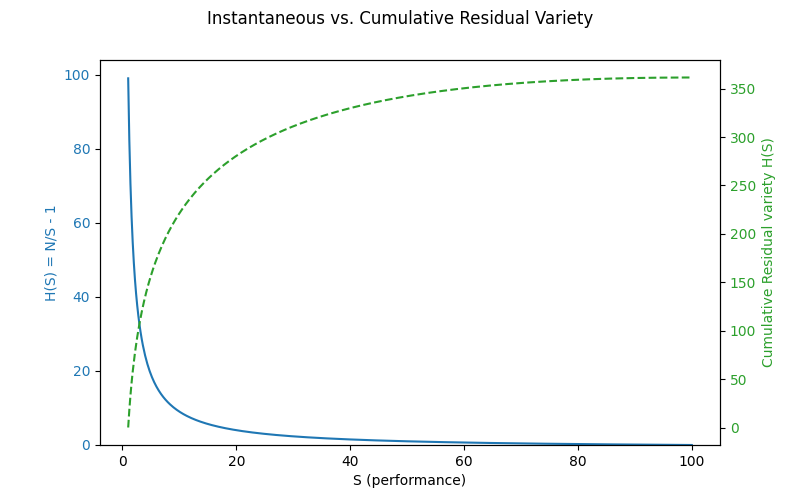
Fig.2 Total Knowledge-Effort Curve Here we see the cumulative residual variety as a function of performance level.
- Blue curve: instantaneous 𝐻(𝑆)=𝑁/𝑆−1H(S)=N/S−1 (residual variety ratio).
- Green dashed curve: cumulative residual variety C(S) as we accumulate uncertainty over growing performance level S.
Defining the unit length
In the current measurement construction, the fixed time window is doing real constitutive work. The operational bridge is explicitly: $$ I=(t_a,t_b],\qquad \Delta=\text{duration of one closure-act-equivalent unit}, $$ Δ is a calibration constant, not a random variable. The unit-length procedure takes an observed in a particular domain distribution p(δ_cl) of closure acts, and collapses it to a single number by average. Once declared, Δ converts elapsed time into counted capacity: $$ N(I)=\frac{|I|}{\Delta}. $$ The time-normalized convention tiles the window into intervals of length \(\Delta\), with \(\Delta\) held constant across all closures in the window.
Note that only $$ \Delta = E[\delta_{\rm cl}] $$ makes N(I) equal, in expectation, to the number of closure-acts' worth of time the window contains, which is what licenses reading $$ N - S_{\rm gross} $$ as selection time measured in closure-equivalents. A median-based Δ gives a robust but biased capacity, and that bias passes multiplicatively into $$ \widehat K + 1 = \frac{N}{S_{\rm net}}. $$
So the elapsed size of \(I\), together with the unit calibration \(\Delta\), determines the channel capacity. N(I) represents the maximum number of closure-act-equivalent opportunities available in that elapsed interval. The time-normalized convention tiles the window into intervals of length \(\Delta\), with \(\Delta\) held constant across all closures in the window.
Why the fixed-time window belongs in the operational layer The causal order in your current construction is really: $$ \boxed{\text{fix/calibrate }\Delta} \longrightarrow \boxed{\text{choose }I} \longrightarrow \boxed{N(I)=|I|/\Delta} \longrightarrow \boxed{\text{observe closures}} $$ and then $$ S_{\rm gross}(I),\quad W(I),\quad S_{\rm net}(I) $$ are outputs observed inside that fixed capacity.
That separation is valuable because \(N(I)\) is the exposure/capacity side and \(S_{\rm net}(I)\) is the realized-output side. Your text explicitly says that these two sides are separated: capacity is fixed by the window convention and closure-act unit, while closures are observed in the window. In particular, $$ \widehat K(I) = \frac{N(I)}{S_{\rm net}(I)}-1 $$ has the interpretation “closure-equivalent capacity consumed per surviving closure, minus the closure itself.”
Δ makes the fixed time interval even more important There are actually two slightly different roles here. First, \(\Delta\) determines the granularity of the channel: $$ N(I)=|I|/\Delta. $$ Second, once the window is tiled at that granularity, it determines the inferred per-closure interval counts \(n_u\). Those are then compared with the latent conditioning-stage counts \(k_u\): $$ \varepsilon_\Delta(I) = \frac1{S_{\rm net}} \sum_u(n_u-k_u). $$ Condition \(C_\Delta\) says that a \(\Delta\)-interval must not conceal two or more conditioning stages; that is what gives $$ n_u\ge k_u $$ and hence $$ \varepsilon_\Delta(I)\ge0. $$ So \(\Delta\) is not just a harmless normalization applied at the end. It determines both the denominator of physical capacity and the resolution at which latent stages can be inferred.
Let \(\mathcal G_I\) contain, at minimum, the fixed window \(I\), calibrated \(\Delta\), realized closure population, disturbance values \(y_u\), and whatever observed invalidation/attribution information is being held fixed, but but not the within-episode paths: population labels, \(\{y_u\}\), \(\{M_u\}\), \(S_{\rm gross}\), \(S_{\rm net}\), \(W_{\rm obs}\). Then \(K^* = (1/S)\sum H(p_{0,u})\) is \(\mathcal G_I\)-measurable, as it must be for the bound to say anything. For a fixed-time window: $$ |I| \text{ fixed},\qquad \Delta \text{ fixed}, $$ therefore $$ N(I)\text{ fixed}. $$ After the window has been observed, \(S_{\rm net}(I)\) is also observed. The randomness sits in \(S_{\rm net}\): how many episodes finished inside the window. Consequently, $$ \widehat K(I) = \frac{N(I)}{S_{\rm net}(I)}-1 $$ is simply an observed window statistic and has a random denominator. The remaining randomness in the theoretical comparison can live in the latent path variables, such as $$ K_u,\qquad k_u,\qquad H(p_{K_u}), $$ under \(M_u\), conditional on the observed disturbance/population information. So if \(\mathcal G_I\) contains the observed ledger skeleton of the realized window, then $$ \widehat K(I) $$ can actually be \(\mathcal G_I\)-measurable, Then $$ N(I),\quad S_{\rm net}(I),\quad \widehat K(I) $$ are \(\mathcal G_I\)-measurable. In which case $$ \mathbb E[\widehat K(I)\mid\mathcal G_I] = \widehat K(I). $$ That simply means the expectation is over the unobserved epistemic paths, not over repeated random realizations of the externally observed estimator.
Notes:
- The episode in progress at t_b contributes Δ-intervals to N but its closure to no S_gross, so Prop. 1' is not exhaustive and an extra Q_open term is needed.
- Long episodes are likelier to straddle t_b and be excluded, so completed episodes are biased short and (1/S)Σk_u underestimates E_u[K_u]. That gives ζ a negative conditional mean from sampling alone. It is O(1/S_net) for well-behaved path lengths and can be folded into the declared margin, but it should be named.
- \(\widehat K = \frac{N}{S_{\rm net}} - 1 \) is convex in \(S_{\rm net}\), so by Jensen \(\mathbb E[\widehat K] \ge \frac{N}{\mathbb E[S_{\rm net}]} - 1\): KTD is biased upward. But KEDE = S_{\rm net}/N is linear, hence unbiased.
Keep the fixed elapsed-time window. Do not make the operational estimator closure-indexed. The problem in Theorem 2 should instead be solved by specifying the conditioning sigma-algebra correctly and distinguishing observed-window quantities from latent path randomness.
How to cite:
Bakardzhiev D.V. (2025) Knowledge Discovery Efficiency (KEDE) and Ashby's Law https://docs.kedehub.io/knowledge-centric-research/kede-ashbys-law.html
Works Cited
1. Shannon, C. E. (1948). A Mathematical Theory of Communication. Bell System Technical Journal. 1948;27(3):379-423. doi:10.1002/j.1538-7305.1948.tb01338.x
2. Ashby, W.R. (1956). An Introduction to Cybernetics; Chapman & Hall,
3. Ashby, W. R. (2011). Variety, Constraint, And The Law Of Requisite Variety. 13, 18.
4. MacKay, D. M. (1950). Quanta! aspects of scientific information. Philosophical Magazine; 41, 289-311;
5. Cover, T. M. & Thomas, J. A. (2006). Elements of Information Theory, 2nd ed., Wiley. §5.2-5.5 (Kraft, entropy bound, source coding bracket), §5.7 (Huffman codes and twenty questions), §2.8 (data-processing inequality).
6. Wheeler, J. A. (1990). Information, physics, quantum: The search for links. In W. H. Zurek (Ed.), Complexity, entropy, and the physics of information (Vol. 8, pp. 3'-28). Taylor & Francis.
7. Yaneer Bar-Yam.(2004) Multiscale variety in complex systems. Complexity, 9(4):37{45,
8. Ashby, W.R. (1991). Requisite Variety and Its Implications for the Control of Complex Systems. In: Facets of Systems Science. International Federation for Systems Research International Series on Systems Science and Engineering, vol 7. Springer, Boston, MA. https://doi.org/10.1007/978-1-4899-0718-9_28
9. Shannon, C. E. Communication theory of secrecy systems. Bell System technical Journal, 28, 656-715, 1949
10. Kubatko J, Oliver D, Pelton K, et al. A starting point for analyzing basketball statistics. J Quant Anal Sports 2007; 3: 1'-22.
11. Sports Reference LLC. "NBA League Averages." Basketball-Reference.com - Basketball Statistics and History. https://www.basketball-reference.com/leagues/NBA_stats_totals.html.
12. Bucks post highest single-game field-goal percentage by any team in 21st century https://sports.yahoo.com/article/bucks-post-highest-single-game-040313061.html
13. https://www.statmuse.com/nba/ask/most-field-goals-made-record-in-a-game-nba-player
14. Lewis, G. J., & Stewart, N. (2003). The measurement of environmental performance: an application of Ashby's law. Systems Research and Behavioral Science, 20(1), 31'-52. https://doi.org/10.1002/sres.524
15. Norman, J., & Bar-Yam, Y. (2018). Special Operations Forces: A Global Immune System? In Springer Unifying Themes in Complex Systems IX (pp. 486'-498). Springer International Publishing. https://doi.org/10.1007/978-3-319-96661-8_50
16. Norman, J., & Bar-Yam, Y. (2019). Special Operations Forces as a Global Immune System. In Springer Evolution, Development and Complexity (pp. 367'-379). Springer International Publishing. https://doi.org/10.1007/978-3-030-00075-2_16
17. O'Grady, W., Morlidge, S., & Rouse, P. (2014). Management Control Systems: A Variety Engineering Perspective. SSRN Electronic Journal. https://doi.org/10.2139/ssrn.2351099
18. Love, T., & Cooper, T. (2007). Digital Eco-systems Pre-Design: Variety Analyses, System Viability and Tacit System Control Mechanisms. 2007 Inaugural IEEE-IES Digital EcoSystems and Technologies Conference, 452'-457. https://doi.org/10.1109/dest.2007.372013
19. Love, T., & Cooper, T. (2007). Complex built‐environment design: four extensions to Ashby. Kybernetes, 36(9/10), 1422'-1435. https://doi.org/10.1108/03684920710827391
20. Bushey, D. B., & Nissen, M. E. (1999). A Systematic Approach to Prioritizing Weapon System Requirements and Military Operations Through Requisite Variety. Defense Technical Information Center. https://doi.org/10.21236/ada371943
21. Jones, H. P. (2018). Evolutionary stakeholder discovery: requisite system sampling for co-creation.
22. Grimm, D. A. P., Gorman, J. C., Robinson, E., & Winner, J. (2022). Measuring Adaptive Team Coordination in an Enroute Care Training Scenario. Proceedings of the Human Factors and Ergonomics Society Annual Meeting, 66(1), 50'-54. https://doi.org/10.1177/1071181322661074
23. Becker Bertoni, V., Abreu Saurin, T., & Sanson Fogliatto, F. (2022). Law of requisite variety in practice: Assessing the match between risk and actors' contribution to resilient performance. Safety Science, 155, 105895. https://doi.org/10.1016/j.ssci.2022.105895
24. Tworek, K., Walecka-Jankowska, K., & Zgrzywa-Ziemak, A. (2019). Towards organisational simplexity — a simple structure in a complex environment. Engineering Management in Production and Services, 11(4), 43'-53. https://doi.org/10.2478/emj-2019-0032
25. Chester, M. V., & Allenby, B. (2022). Infrastructure autopoiesis: requisite variety to engage complexity. Environmental Research: Infrastructure and Sustainability, 2(1), 012001. https://doi.org/10.1088/2634-4505/ac4b48
26. van der Hoek, M., Beerkens, M., & Groeneveld, S. (2021). Matching leadership to circumstances? A vignette study of leadership behavior adaptation in an ambiguous context. International Public Management Journal, 24(3), 394'-417. https://doi.org/10.1080/10967494.2021.1887017
27. Ulrik, S., & Isabella, A. (2023). Variety versus speed: how variety in competence within teams may affect performance in a dynamic decision-making task.
28. Bakardzhiev, D., Vitanov, N.K. (2025). KEDE (KnowledgE Discovery Efficiency): A Measure for Quantification of the Productivity of Knowledge Workers. In: Georgiev, I., Kostadinov, H., Lilkova, E. (eds) Advanced Computing in Industrial Mathematics. BGSIAM 2022. Studies in Computational Intelligence, vol 641. Springer, Cham. https://doi.org/10.1007/978-3-031-76786-9_3
29. Heylighen, F., & Joslyn, C. (2001). Cybernetics and Second Order Cybernetics. In R. A. Meyers (Ed.), Encyclopedia of Physical Science and Technology, Eighteen-Volume Set, Third Edition (pp. 155-170). Academia Press. http://pespmc1.vub.ac.be/Papers/Cybernetics-EPST.pdf
30. Schwaninger, M., & Ott, S. (2024). What is variety engineering and why do we need it? Systems Research and Behavioral Science, 41(2), 235'-246. https://doi.org/10.1002/sres.2964
31. AULIN‐AHMAVAARA, A.Y. (1979), "THE LAW OF REQUISITE HIERARCHY", Kybernetes, Vol. 8 No. 4, pp. 259-266. https://doi.org/10.1108/eb005528
32. Wu, T., Dufford, A. J., Mackie, M. A., Egan, L. J., & Fan, J. (2016). The Capacity of Cognitive Control Estimated from a Perceptual Decision Making Task. Scientific Reports, 6, 34025.
33. Abuhamdeh S (2020) Investigating the “Flow” Experience: Key Conceptual and OperationalIssues. Front. Psychol. 11:158.doi: 10.3389/fpsyg.2020.00158
34. Automatic Screw Tightening Machine and Its Hidden Features
35. Keating, C. B., Katina, P. F., Jaradat, R., Bradley, J. M., & Hodge, R. (2019). Framework for improving complex system performance. INCOSE International Symposium, 29(1), 1218-1232. https://doi.org/10.1002/j.2334-5837.2019.00664.x
36. S. Engell (1985). An information-theoretical approach to regulation.
37. K. Kijima, Y. Takahara, B. Nakano (1986). ALGEBRAIC FORMULATION OF RELATIONSHIP BETWEEN A GOAL SEEKING SYSTEM AND ITS ENVIRONMENT.
38. W. Kickert, J. Bertrand, J. Praagman (1978). Some Comments on Cybernetics and Control. IEEE Transactions on Systems, Man and Cybernetics.
39. S. Engell (1985). Information-theoretical bounds for regulation accuracy. IEEE Conference on Decision and Control.
40. Hui Zhang, Youxian Sun (2003). Bode integrals and laws of variety in linear control systems. Proceedings of the 2003 American Control Conference, 2003.
41. R. Conant (1969). The Information Transfer Required in Regulatory Processes. IEEE Transactions on Systems Science and Cybernetics.
42. S. Engell (1987). Analysis of Regulation Problems based on Real-Time Rate-Distortion Theory. American Control Conference.
43. Hui Zhang, Youxian Sun (2003). Information theoretic limit and bound of disturbance rejection in LTI systems: Shannon entropy and H/sub /spl infin// entropy. SMC'03 Conference Proceedings. 2003 IEEE International Conference on Systems, Man and Cybernetics. Conference Theme - System Security and Assurance (Cat. No.03CH37483).
44. N. C. Martins, M. Dahleh (2008). Feedback Control in the Presence of Noisy Channels: “Bode-Like” Fundamental Limitations of Performance. IEEE Transactions on Automatic Control.
45. Hui Zhang, Youxian Sun (2003). H/sub /spl infin// entropy and the law of requisite variety. 42nd IEEE International Conference on Decision and Control (IEEE Cat. No.03CH37475).
46. Tsuji, M., Crookshank, M., Olsen, M., Schemitsch, E. H., & Zdero, R. (2013). The biomechanical effect of artificial and human bone density on stopping and stripping torque during screw insertion. Journal of the mechanical behavior of biomedical materials, 22, 146'-156. https://doi.org/10.1016/j.jmbbm.2013.03.006
47. Akizuki, K., & Ohashi, Y. (2015). Measurement of functional task difficulty during motor learning: What level of difficulty corresponds to the optimal challenge point?. Human movement science, 43, 107'-117. https://doi.org/10.1016/j.humov.2015.07.007
48. Bootsma, J. M., Hortobágyi, T., Rothwell, J. C., & Caljouw, S. R. (2018). The Role of Task Difficulty in Learning a Visuomotor Skill. Medicine and science in sports and exercise, 50(9), 1842'-1849. https://doi.org/10.1249/MSS.0000000000001635
49. Akizuki, K., & Ohashi, Y. (2013). Changes in practice schedule and functional task difficulty: a study using the probe reaction time technique. Journal of physical therapy science, 25(7), 827'-831. https://doi.org/10.1589/jpts.25.827
50. Goldhammer, F.; Naumann, J.; Stelter, A.; Tóth, K.; Rölke, H.; Klieme, E.: The time on task effect in reading and problem solving is moderated by task difficulty and skill. Insights from a computer-based large-scale assessment - In: The Journal of educational psychology 106 (2014) 3, S. 608-626 - URN: urn:nbn:de:0111-pedocs-179679 - DOI: 10.25656/01:17967; 10.1037/a0034716
51. Boothroyd, G., and P. Dewhurst, "DESIGN FOR ASSEMBLY", Dept. of Mechanical Engineering, University of Massachusetts, Amherst, Massachusetts, 1983.
52. Jahin, A., Zidan, A. H., Bao, Y., Liang, S., Liu, T., & Zhang, W. (2025). Unveiling the mathematical reasoning in deepseek models: A comparative study of large language models. arXiv preprint arXiv:2503.10573.
53. FrontierMath: A Benchmark for Evaluating Advanced Mathematical Reasoning in AI
54. Francis Heylighen, Cybernetic Principles of Aging and Rejuvenation: The Buffering- Challenging Strategy for Life Extension, Current Aging Science; Volume 7, Issue 1, Year 2014, . DOI: 10.2174/1874609807666140521095925
55. Ostry, D. J. (1980). Execution-time movement control. In G. E. Stelmach & J. Requin (Eds.), Tutorials in motor behavior (pp. 457-468). Amsterdam: North-Holland.
56. Siegenfeld, A. F., & Bar-Yam, Y. (2025). A Formal Definition of Scale-Dependent Complexity and the Multi-Scale Law of Requisite Variety. Entropy, 27(8), 835. https://doi.org/10.3390/e27080835
57. Umpleby, S. A. (2009). Ross Ashby's general theory of adaptive systems. International Journal of General Systems, 38(2), 231-238. https://doi.org/10.1080/03081070802601509
58. Zheng, J., & Meister, M. (2024). The unbearable slowness of being: Why do we live at 10 bits/s?. Neuron.
59. Ohlsson, S. (1992). The Learning Curve for Writing Books: Evidence from Professor Asimov. Psychological Science, 3(6), 380-382.
60. L. B.S. Raccoon. 1996. A learning curve primer for software engineers. SIGSOFT Softw. Eng. Notes 21, 1 (Jan 1 1996), 77-86. https://doi.org/10.1145/381790.381805
61. Deweese, M. R., & Meister, M. (1999). How to measure the information gained from one symbol. Network: Computation in Neural Systems, 10(4), 325-340. https://doi.org/10.1088/0954-898X_10_4_303
62. Gallager, R. G. (1978). Variations on a theme by Huffman. IEEE Trans. Inform. Theory 24(6), 668-674. (Redundancy bound p_{\max} + 0.086.)
63. MacKay, D. J. C. (2003). Information Theory, Inference, and Learning Algorithms, CUP, ch. 5 (Ex. 5.24, 5.28).
64. McMillan, B. (1956). Two inequalities implied by unique decipherability. IRE Trans. Inform. Theory 2(4), 115-116. (Optional; Cover & Thomas suffices.)
65. Azuma, K. (1967). Weighted sums of certain dependent random variables. Tôhoku Math. J. 19, 357-367; Hoeffding, W. (1963). Probability inequalities for sums of bounded random variables. JASA 58, 13-30. (For Theorem 2(iv).)
66. Metzler, R., Bar-Yam, Y., & Kardar, M. (2004). Information flow through a chaotic channel: prediction and postdiction at finite resolution. Physical review. E, Statistical, nonlinear, and soft matter physics, 70(2 Pt 2), 026205. https://doi.org/10.1103/PhysRevE.70.026205
Getting started